DeepSeek V4 Flash Vision Exp for Marketers: 5 Vision Jobs That Just Got Cheap Enough to Run Daily (and 3 to Keep on Opus 4.x)
Contents
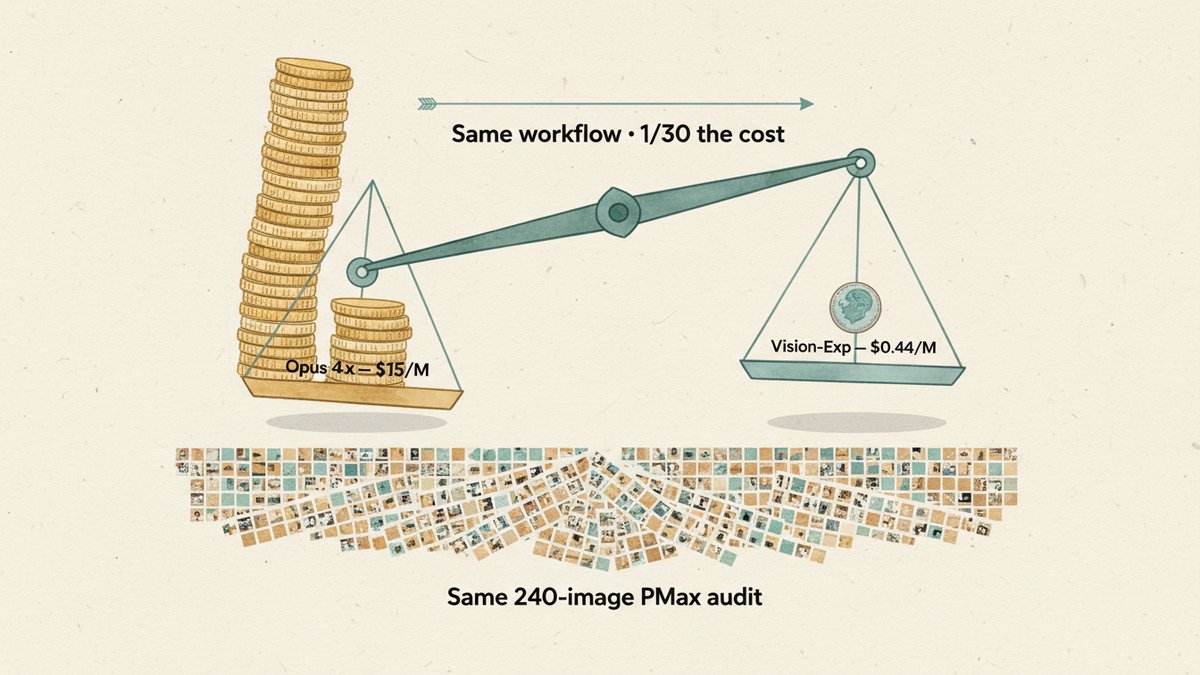
At 2pm yesterday I was running a PMax creative audit for a client with 240 image assets. I needed each ad summarized: what product it shows, what copy overlay sits on top, what call-to-action, and whether it duplicates any other asset in the library. That has been a 40-minute Opus 4.x job all year. Yesterday, with the new DeepSeek V4-Flash-Vision-Exp, it finished in 22 minutes, cost me about a dime, and the output was usable. Same caveats. Roughly 1/30th the price.
Two days ago — August 21, 2026 — DeepSeek pushed V4-Flash-Vision-Exp to their API (model=deepseek-v4-flash-vision-exp). It's labeled "experimental," it's the V4 family's first native vision endpoint, and DeepSeek's own changelog says its multimodal-Agent benchmarks sit close to Opus 4.8. The pricing is identical to text-only V4-Flash. For the first time, vision is a Flash-tier cost, not an Opus-tier cost.
This is what I'd actually hand it in a marketing workflow, what I'd keep on Opus 4.x, and the one caveat that matters while it's still experimental.
What got released
Three API surfaces, all available on day one:
- Chat Completions (OpenAI-compatible)
- Messages (Anthropic-compatible)
- Responses
Three ways to send images: base64 inline, public URL, or a new free Files API where you upload once and reuse via file_id. Supported formats: JPEG, PNG, GIF, WebP. Each image is tokenized at a maximum of 384 tokens, so a single screenshot doesn't blow up your context budget. Context window is 1M tokens, max output 384K. Tool calling, JSON mode, and structured responses are all wired up.
The text-only numbers match V4-Flash exactly — same agent performance, same reasoning, same world knowledge. Where DeepSeek claims the leap is on vision-required Agent benchmarks. From the official changelog:
- Terminal Bench 2.1: 83.9
- Chartography: 64.3
- DeepSWE: 59.3
- DSBench-Hard: 63.6
- ZeroBench (Pass@5): 35.0
The fine print: as of my research window, none of these are listed on Artificial Analysis or LMArena. Treat them as lab-claimed for now. Once independent evals run the same images, we'll know whether 64.3 Chartography actually holds. Same day as the model, DeepSeek Harness pushed v0.1.1-rc.1 with native multimodal support — my earlier note on Harness covers what that framework is and isn't.
The cost story
Same price as V4-Flash. That's the punchline. If you're already routing V4-Flash off-peak (per my note on the V4 pricing reset), vision costs you nothing extra — one image at max 384 tokens adds a fraction of a yuan to your bill.
The international SKU on OpenRouter is $0.44/M input, $1.32/M output (see the OpenRouter rotation workflow). Compare that to Opus 4.x class at $15/$75 per million, and the gap is real. For the 240-image PMax audit I opened with, the run cost me under $0.10 — the same job on Opus would have been 25-30x more.
5 marketing jobs I'd hand it today
These are the workflows where vision capability plus Flash pricing earns a daily slot.
1. PMax creative audit at scale. The job I opened with. Feed DeepSeek a folder of 200-500 ad images, ask for product type, copy overlay, CTA, and a near-duplicate flag. Each image becomes ~384 tokens; off-peak, the whole audit is a few yuan. Opus was overkill for this anyway.
2. Competitor landing-page screenshots to spec. Drop a competitor's pricing page screenshot into Files API, ask for the section structure, hero copy, social proof patterns, and CTA hierarchy. Use the output to brief your own designer. This is the same audit pattern I used with Computer Use — see the Screaming Frog + Claude crawl analysis for a related crawl-side workflow.
3. Slack screenshot triage. Teammates paste dashboards, error messages, weird UI states into your Slack all day. Hook Files API to a Slack monitor (swap the source channel in the Reddit monitoring agent pattern) and have the model classify: bug report / data anomaly / ad creative question / ignore. Cheap enough to run five times daily without a budget conversation.
4. Chart-to-table extraction. Pull a number off a client's Looker screenshot or a Tableau dashboard without API access. Useful for the "they sent me a PNG instead of a CSV" problem.
5. Visual brand audit. Upload your last 20 Instagram posts, ask for color palette drift, typography consistency, and logo treatment variance. The output is a one-page audit that used to cost a brand strategist an afternoon.
3 jobs to keep on Opus 4.x
Vision at Flash pricing has tradeoffs. These are the jobs where I'd still pay Opus-class rates.
1. Multi-image comparison at scale. "Compare these 12 competitor landing pages and tell me the pattern." Opus-class models still hold visual + textual context across many images more reliably. DeepSeek handles one or two well; push it past a handful and answers get brittle.
2. Refusal-sensitive image analysis. Regulated industries — pharma claims, financial disclaimers, child-directed content. Opus-class models have tighter refusal controls. Vision-Exp is experimental; treat its outputs as draft material, not ship-ready.
3. Ad creative where the visual IS the brand. When the work depends on subtle aesthetic judgment — "does this hero image carry the same emotional weight as the reference mood board" — Opus still wins. DeepSeek describes; Opus feels.
Where it sits in the rotation
For international readers, OpenRouter is the cleanest entry point — same API key you already use, model ID deepseek/deepseek-v4-flash-vision-exp. For mainland China and peak-hour routing, use the DeepSeek direct API with off-peak scheduling. The model is also wired into the just-updated DeepSeek Harness 0.1.1-rc.1 — if you already run a Harness agent stack, you get multimodal without changing anything.
My routing table, today, looks like this:
- Screenshot audits at scale → Vision-Exp off-peak
- Vision-required Agent benchmarks (where I need consistency) → Opus 4.x class
- Pure text → V4-Flash off-peak
- Vision R&D and mood-board judgment → Opus 4.x class or Sonnet 4.6
The caveat that matters
"Experimental" is the word DeepSeek uses. The model dropped on August 21, 2026. The benchmarks are lab-claimed. Files API just launched. The pricing reset (peak/off-peak) is only a week old. Three of those four moving parts will stabilize in the next 30 days; pricing is the one I'd watch most.
If you're going to route any marketing production traffic at it, do this: run a 100-image audit on Vision-Exp, compare the output to the same audit on Opus 4.x, and decide whether the gap is worth 30x the cost. For most of what I do, it's not. For brand-judgment work, it is.
Vision at Flash pricing is the unlock. Before V4-Flash-Vision-Exp, every screenshot in your agent stack either cost Opus money or got skipped. Now it costs a dime. That's not a "revolutionary AI" story — it's a unit-economics story. The marketing jobs that weren't worth automating because the cost-per-screenshot made them uneconomic are now automatable. That's the part worth paying attention to.