Turn One Pillar Idea Into a 30-Day Content Calendar with Claude
Contents
The reason most content calendars fall apart by week three has nothing to do with discipline. It's that they're stitched together one piece at a time — a Monday post, a Wednesday newsletter, each topic decided the day before it ships. By the time you've published 20 disconnected things, your own audience isn't sure what your channel is actually about.
Working from a single pillar idea fixes this. A pillar isn't a topic — it's a thesis broad enough to feed a month of related angles, narrow enough to keep them coherent. Last fall I built a 30-day calendar in roughly two hours of Claude work for a fintech client who'd been struggling to ship more than two posts a week. They published 24 of the 30 (the other six got pushed to month two) and their LinkedIn impressions tripled by the end of the month. The speed wasn't the point. The point was that every piece was an angle on the same underlying argument, so each one made the others stronger.
Here's the exact workflow I now use whenever a new client asks me to "get content production going."
Step 1: Pick a pillar that survives 30 days
A good pillar is a position, not a category. Bad pillar: "AI in marketing." Good pillar: "Marketers should treat LLMs like junior analysts, not interns."
The test: can you defend, qualify, illustrate, attack, or extend this thesis 30 different ways without repeating yourself? If not, broaden or sharpen until you can.
I spend about 15 minutes here with Claude as a sparring partner:
I'm planning a month of content for [audience]. I want a pillar thesis that's specific enough to be distinctive but broad enough for 30 angles. Here are three rough directions I'm considering: [A], [B], [C]. For each one, give me: the underlying claim made sharper, two ways it could fall apart over 30 posts, and the kind of reader it would attract. Then tell me which one you'd pick and why.
You're not asking Claude to choose for you. You're using it to pressure-test your instinct before you commit 30 days to it.
Step 2: Decompose the pillar into 30 atomic angles
Once the pillar is locked, the next prompt does the heavy lifting:
Pillar thesis: [your one-sentence thesis]. Audience: [who, what they care about, what they Google]. Generate 30 distinct content angles that each defend, complicate, illustrate, or apply the pillar. Each angle should be one specific argument or example — not a topic area. Group them in 5 buckets: foundational claims, counterarguments and rebuttals, case studies and examples, how-to applications, and contrarian or "spicy" takes. For each angle, write a one-line working headline.
Two things make this prompt earn its keep.
The 5-bucket constraint forces variety. Without it Claude defaults to "10 ways to do X, 10 mistakes to avoid, 10 tools to try" — which is fine and also why every marketer's content looks identical.
The "angle, not topic area" instruction stops you from ending up with a calendar of 30 thinly different things that all read the same.
Expect to throw out 8–12 of the 30. Replace them yourself or run a follow-up asking for "10 more angles in the buckets that came back weakest."
Step 3: Assign format, search intent, and platform
This is the step almost nobody does explicitly. Every piece of content has three dimensions that decide whether anyone will read it:
- Format — long blog, short blog, X/Twitter thread, LinkedIn post, short video, carousel, newsletter, podcast clip, deep technical doc
- Search intent — informational, commercial investigation, transactional, navigational, or "social / no search intent" (entertainment, opinion, community)
- Platform — where the piece lives natively; whether it gets cross-posted later
Run this prompt over the 30 angles:
Here are the 30 angles. For each one, recommend:
- Primary format (pick one from: [your list])
- Search intent (informational, commercial investigation, transactional, or social/none)
- Primary platform (pick one), plus any obvious cross-post platforms
Return a markdown table with columns: Day, Angle, Format, Intent, Platform, Cross-post.
The output you get back is roughly 70% right. Resist editing it before you've read all 30 rows — the patterns in Claude's choices will tell you whether your pillar is well-suited to a particular platform mix, or whether you've accidentally written 30 LinkedIn-shaped angles.
Step 4: Sequence the 30 angles into weeks with a rhythm
A calendar isn't a list — it's a sequence. Two rules I've learned the expensive way:
Front-load the strongest 5 angles. First impressions on social compound. If your sharpest piece is on day 22, the audience that would have shared it has already tuned out.
Cluster by intent, not by topic. Three "how-to applications" in a row train the algorithm and the reader. Bouncing between a hot take, a tutorial, and a case study every day feels diverse to you and incoherent to your audience.
Final prompt:
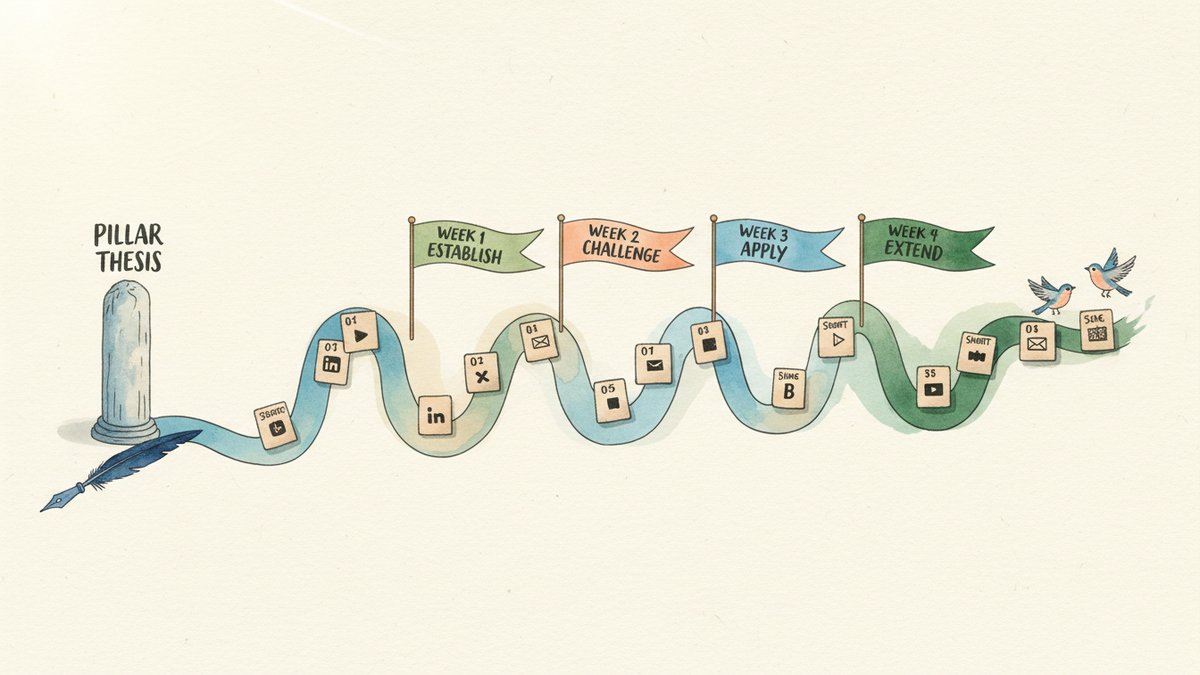
Re-sequence the 30-row table by week so each week has a coherent arc — week 1 establishes the pillar, week 2 challenges it, week 3 applies it, week 4 extends it. Within each week, mix formats so no two consecutive days use the same format. Add a "Week" column.
What the output actually looks like
A trimmed sample of days 1–7 from that fintech project (pillar: "B2B fintech buyers don't want shorter sales cycles — they want safer ones"):
| Day | Angle | Format | Intent | Platform |
|---|---|---|---|---|
| 1 | Why "shorten the sales cycle" is the wrong CRO metric for B2B fintech | LinkedIn post | Social | |
| 2 | The 4 risk signals procurement actually looks for | Blog (1,500w) | Informational | Blog → LinkedIn |
| 3 | Tear-down: what Brex's pricing page tells buyers about risk | X thread | Social | X |
| 4 | Anatomy of a "safe enough" demo deck (template) | Newsletter | Informational | |
| 5 | One client's 90-day procurement audit, day by day | Long blog (2,400w) | Informational | Blog |
| 6 | When a faster cycle is a bad sign | LinkedIn carousel | Social | |
| 7 | 7 sentences to add to your demo script this week | Short post | Informational | Blog → LinkedIn |
A few things to notice. Day 1 is a sharp claim, not a tutorial — it earns the rest of the month a reason to exist. Days 2 and 5 are the only big-lift pieces; the rest can ship in under an hour. And every row, even the spicy LinkedIn carousel on day 6, is pulling on the same thread.
Where this breaks
A few honest failure modes I've hit:
Claude will pad to hit 30 if your pillar is too thin. The fix isn't a better prompt; it's a better pillar.
Calendars that look great on paper still need a brand-voice editor pass, especially for X and LinkedIn copy. I keep a Claude Project with my voice doc pinned so the second pass takes 5 minutes instead of 30.
Don't generate 30 finished pieces from this calendar. Generate the calendar, then draft one week at a time. Reader signal after week 1 should reshape weeks 2–4 — and almost always will, if you're paying attention.
The point of this workflow isn't to automate content. It's to make sure that 30 days from now, somebody scrolling your feed can tell, without thinking about it, what you actually believe.