DeepSeek V4 for Marketers: What the Peak/Off-Peak Pricing Reset Actually Means for Your AI Bill
Contents
When DeepSeek's V4 cache-hit input jumped from 0.025 yuan to 0.30 yuan per million tokens at peak hour — a 12x increase — every long-context daily-digest pipeline I'd quietly routed onto DeepSeek's cheap tier became a third-tier routing decision instead of a default.
The cache-hit line is the one that bankrolled most of our high-volume background jobs. That's the number to look at first.
What changed, in plain numbers
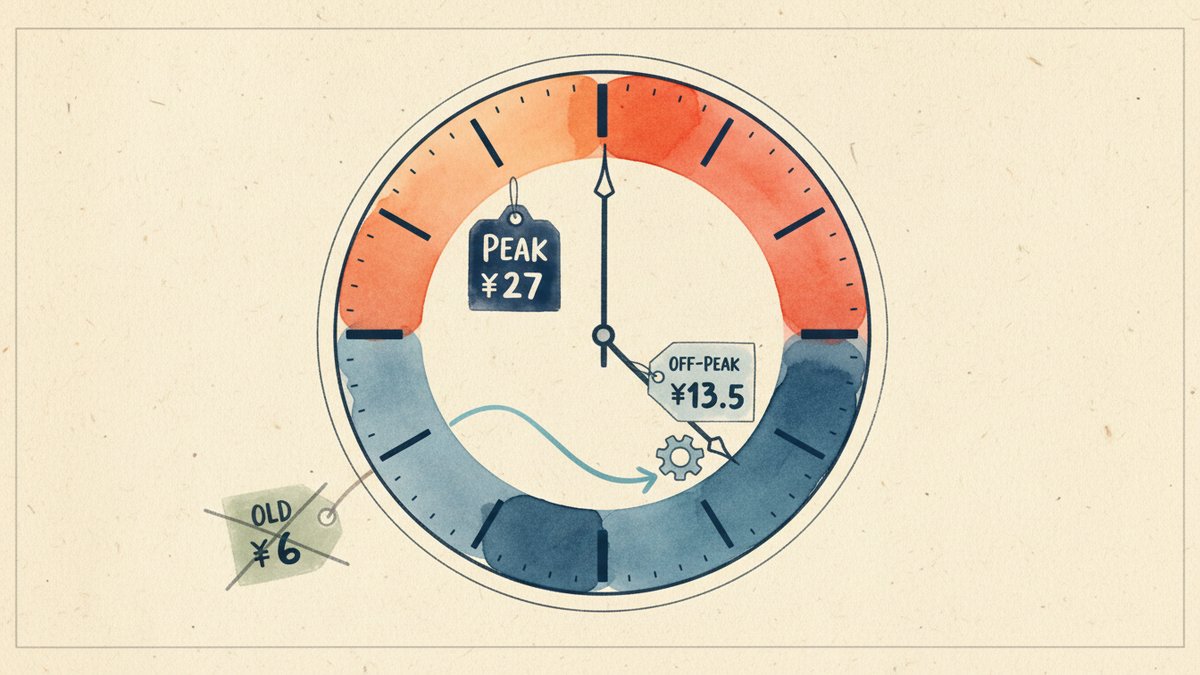
DeepSeek's V4 family (Pro and Flash) moved to a peak/off-peak pricing model effective August 17, 2026, 00:00 Beijing time:
- Peak hours: 9:00–12:00 and 14:00–18:00 Beijing time, weekdays.
- Off-peak hours: everything else (overnight, weekends, holidays).
- Off-peak price = half of peak price.
Here are the three numbers that actually matter for marketing pipelines (per million tokens, ¥):
V4 Pro
| Item | Before | Off-peak | Peak |
|---|---|---|---|
| Input (cache hit) | 0.025 | 0.15 | 0.30 (+1100%) |
| Input (cache miss) | 3 | 4.5 | 9 (+200%) |
| Output | 6 | 13.5 | 27 (+350%) |
V4 Flash
| Item | Before | Off-peak | Peak |
|---|---|---|---|
| Input (cache hit) | 0.02 | 0.05 | 0.10 (+400%) |
| Input (cache miss) | 1 | 1.5 | 3 (+200%) |
| Output | 2 | 4.5 | 9 (+350%) |
Two things to notice. First, the headline number everyone quotes — "27 yuan per million tokens at peak for Pro output" — is real, but it's still well below what US frontier models charge. DeepSeek didn't suddenly become expensive; it stopped being cheap enough to be a no-think default.
Second, the off-peak column is what most coverage misses. Off-peak Pro output is 13.5 yuan — only a 125% increase from the old price. That's still cheaper than what most marketers were paying on Claude Sonnet a year ago. The new model punishes peak-hour bulk use; it leaves the rest alone.
Where the cost actually breaks
I ran three of my standard pipelines through the new math to see what stings and what doesn't.
Daily SEO brief generator. Long context (around 200K tokens), about 30K input + 3K output, runs once at 8 AM Beijing time to feed my morning Slack. Old cost: roughly ¥0.20/day. New peak cost (since 8 AM doesn't quite hit peak but is close): around ¥0.35/day. New off-peak cost (if I push it to 6 AM): about ¥0.18/day. The peak shift costs me an extra ¥4–5/month. Survivable.
Reddit monitoring agent running at 7:30 AM on a DeepSeek Flash backend. The daily 100K-token input is mostly cache hits (system prompts + subreddit context). Old cost: roughly ¥0.10/day. New peak cost (cache-hit input jumped 400%): around ¥0.50/day. New off-peak: about ¥0.25/day. This one hurts a little — a 5x daily increase on a job that runs every morning.
Weekly competitor ad library scrape. Runs Sunday at 2 AM Beijing time — pure off-peak. Cost change is the off-peak column only: 13.5/M output instead of 6. About ¥1/month more. Negligible.
The pattern is clear: anything running during 9–12 or 14–18 Beijing time, on cache-heavy workloads, on Flash — that's where the new math stings. Everything outside those windows is a shrug.
5 jobs to keep on DeepSeek (off-peak), 3 to re-route
This isn't an "abandon DeepSeek" take. The new off-peak pricing is still genuinely competitive for a large class of marketing workloads. Here's how I'd split it:
Keep on DeepSeek V4 Pro/Flash, but push to off-peak:
- Overnight competitor monitoring
- Weekly content refresh batches (Sunday 2 AM)
- Quarterly content audits (10K-URL crawl + Claude analysis — perfect off-peak workload)
- Reddit + forum digest (shift from 7:30 AM to 6 AM — nobody notices)
- Backlink reclamation sweeps (background jobs, no time pressure)
Move to OpenRouter or another vendor at peak:
- Interactive client-facing tools (chat widgets, on-demand summarization) — these hit peak
- Daily morning briefs that need to be in the Slack by 9 AM sharp
- Real-time content QA on live ad copy
The OpenRouter rotation setup I documented handles exactly this — a daily Slack /research workflow that auto-falls back from DeepSeek to Qwen 3 Max to Claude Sonnet when DeepSeek's peak-hour prices or latency make it the wrong choice. Most marketers running a single-vendor stack right now don't have that escape hatch. Build one this week.
The bigger shift under this news
DeepSeek's hike isn't an isolated event. Throughout 2026, Chinese model vendors have been quietly stepping back from the "cheapest possible" race. Zhipu, Moonshot, and the cloud vendors have all nudged prices up. Meanwhile, on the other side of the Pacific, GPT-5.6 Luna dropped 80% in Q2. The two curves crossed sometime in the last six months.
What that means for marketers is the rotation logic I'd been running on intuition now becomes a hard requirement: stop treating DeepSeek as the always-default low-cost vendor. Treat it as one slot in a four-or-five-vendor rotation. Use it for off-peak bulk. Use Qwen 3 Max or Claude Sonnet for interactive work. Use local models (Llama 3.3, Qwen 2.5 14B) for low-stakes privacy-sensitive work. The vendor lineup I laid out in the Grok 4.5 first-week take and the xAI Grok vs the rest comparison slot into this same picture.
What to do before August 17
Three concrete moves, in order of effort:
- Audit your DeepSeek calls by hour. If you have the OpenAI-style usage logs in your backend, plot them. Anything in the 9–12 or 14–18 Beijing window is about to get more expensive; anything outside it isn't.
- Shift non-time-sensitive jobs to off-peak. Most "daily digest at 8 AM" pipelines can become "daily digest at 6 AM" without anyone noticing. A 1-hour shift is often the difference between a 4.5x cost and a 1.25x cost.
- Wire up a fallback path. Even a single OpenRouter key with a fallback model configured is the difference between "DeepSeek hiked prices and now we're over budget" and "DeepSeek hiked prices and we routed around it."
The marketers who built entire pipelines around DeepSeek's pre-August pricing are going to feel this one. The marketers who already had OpenRouter or Qwen 3 as a fallback won't. That's the entire lesson.