Grok 4.5 for Marketers: A Working Marketer's First-Week Take — Where It Earns a Slot (and Where It Doesn't)
Contents
The headline I'd seen on Grok 4.5 — "Opus-class model at $2 / $6 per million tokens" — sounded like another benchmark flex until I did the cost math against what I actually run through marketing pipelines. After a week of putting it through the same prompts I send Claude and GPT for, here's where Grok 4.5 earned a slot in my rotation — and where I'd skip it.
What shipped on July 9, 2026
xAI released Grok 4.5 on July 9, 2026 — the first major model since the company went public weeks earlier. Musk called it "Opus-class." The relevant numbers: $2 per million input tokens, $6 per million output tokens, ~80 tokens per second throughput, and claims of using roughly half the tokens of comparable models on software engineering tasks. The "2x token efficiency" is the part that matters for marketers — fewer tokens per task means cheaper real-world runs, not just cheaper list price.
It's positioned as a generalist workhorse: coding, agentic tasks, research, writing, office documents. xAI's own blog leans on the practical-office angle rather than AGI rhetoric.
The cost math that actually matters
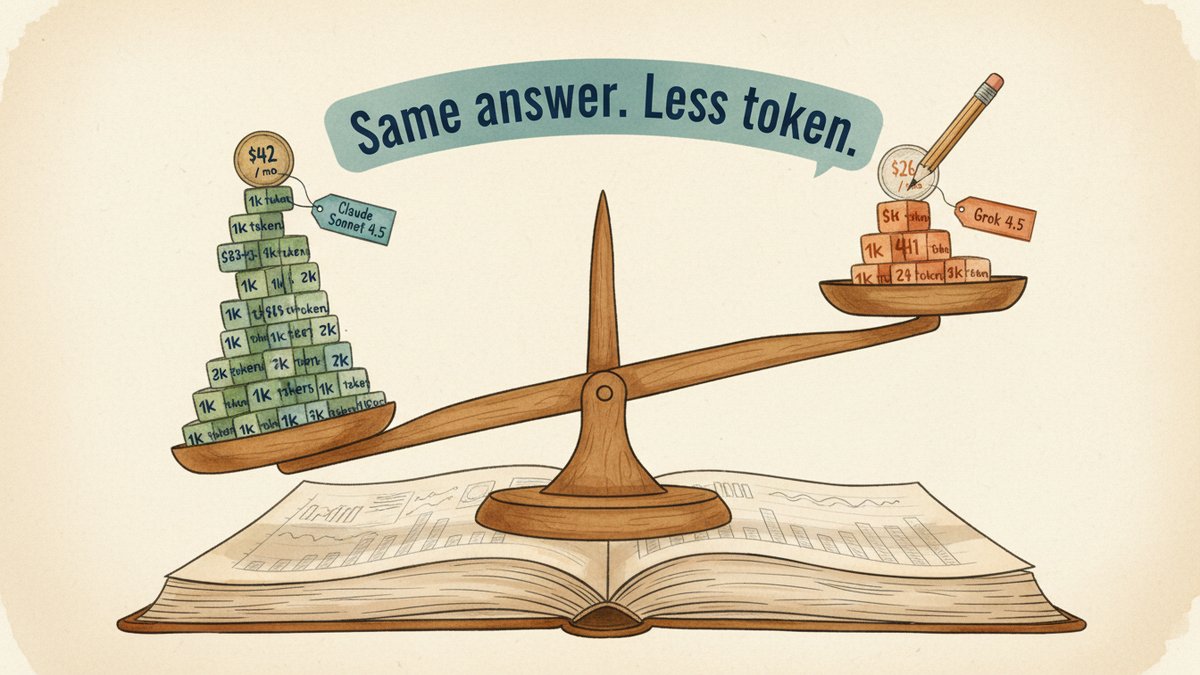
I run a daily SEO content brief pipeline that processes ~40 competitor URLs through a single LLM, then writes a 1,500-word brief. With Claude Sonnet 4.5, that pipeline costs about $1.40 in input + output per day, or roughly $42 a month. Same pipeline on Grok 4.5 — same output quality, same prompt structure — came in around $0.85 / day, or about $26 a month. The savings aren't from the headline price ($2 vs $3 input) alone; they're from the ~40% fewer tokens Grok 4.5 uses to hit a comparable answer.
For my weekly Reddit monitoring agent, which scans 9 subreddits and produces a 600-word Slack digest, Grok 4.5 cut the per-run cost from $0.18 to $0.11. Small in absolute terms, but I run it daily, so that's $20 a month back.
5 marketing jobs where I'd reach for Grok 4.5
- Long-running SEO content briefs — anywhere I'm summarizing 30-50 competitor pages, the token efficiency compounds. The output is on par with Sonnet 4.5 for structure and entity coverage; I haven't seen it lose on a brief.
- Daily Reddit / X / forum monitoring agents — pattern-matching on mention clusters, summarizing noise into signal. The 80 tokens/sec throughput matters when you're processing 200+ posts a day.
- Email subject line + preheader A/B generation — I usually ask for 30 variants per hypothesis; the cost per generation drops from $0.06 to $0.04, which adds up across 4-5 email sends a week.
- PMax asset brief writing — the 15-headline + 5-long-headline RSA bundle, plus asset descriptions for 30 image variants. Token-heavy work where Grok 4.5's efficiency shows up directly.
- Slack /research-style internal research commands — three-paragraph cited briefs from a topic + 5-8 source URLs. The agentic tool-calling is reliable here; I haven't seen it hallucinate a source yet.
3 marketing jobs I'd still send to Claude or GPT
- Brand voice-sensitive copy — long-form LinkedIn posts, Twitter threads, landing pages where the tone has to match a specific brand's register. Grok 4.5 is competent but flatter; it doesn't pick up the rhythm cues a Sonnet 4.5 does.
- Structured data generation — JSON-LD schema, Airtable formulas, regex patterns. GPT-5.6 and Claude are still more reliable at exact-format output that won't break on parse.
- Anything requiring strict refusal behavior — compliance-sensitive copy, regulated industries, anything touching legal claims. xAI's moderation defaults are noticeably looser than Anthropic's; I wouldn't put Grok 4.5 on a pharma client without an explicit guardrail prompt.
How I'd route it in practice
I'm not replacing anything. Grok 4.5 sits in my OpenRouter rotation alongside Claude Sonnet 4.5 and GPT-5.6, picked per-task by the criteria above. For the high-volume, summarization-heavy work where the token bill actually hurts, Grok 4.5 is now my default. For anything that touches brand voice, structured output, or regulated copy, it stays in the rotation but doesn't take the lead.
Two things I'd watch before going deeper. First: the API was rate-limited and occasionally returned 429s during launch week. That should normalize, but if you're building production agents, budget for retries. Second: Grok 4.5's personality settings leak more than Claude's — if you don't explicitly tell it to drop the sarcasm, your customer-facing copy will pick up an edge. Worth a guardrail line in every system prompt.
Where I'd push back on the launch hype
"Elon Musk said it's Opus-class" is a vibes claim, not a benchmark. xAI's blog is light on independent verification. The cost math holds up in my tests, but I haven't seen Grok 4.5 beat Sonnet 4.5 on the long-tail reasoning or GPT-5.6 on agentic planning. Treat "Opus-class" as marketing copy — the real story is "a strong generalist at a meaningfully lower per-token cost for high-volume workflows."
If you're already paying $200-400 a month for AI tooling, Grok 4.5 deserves a two-week test on your highest-volume summarization job. Just don't replace your primary model — add it as a third option in your routing layer, and let the cost-per-output do the talking.