OpenRouter for Marketers: One API Key, 300+ Models, and the Workflow That Cut My AI Bill in Half
Contents
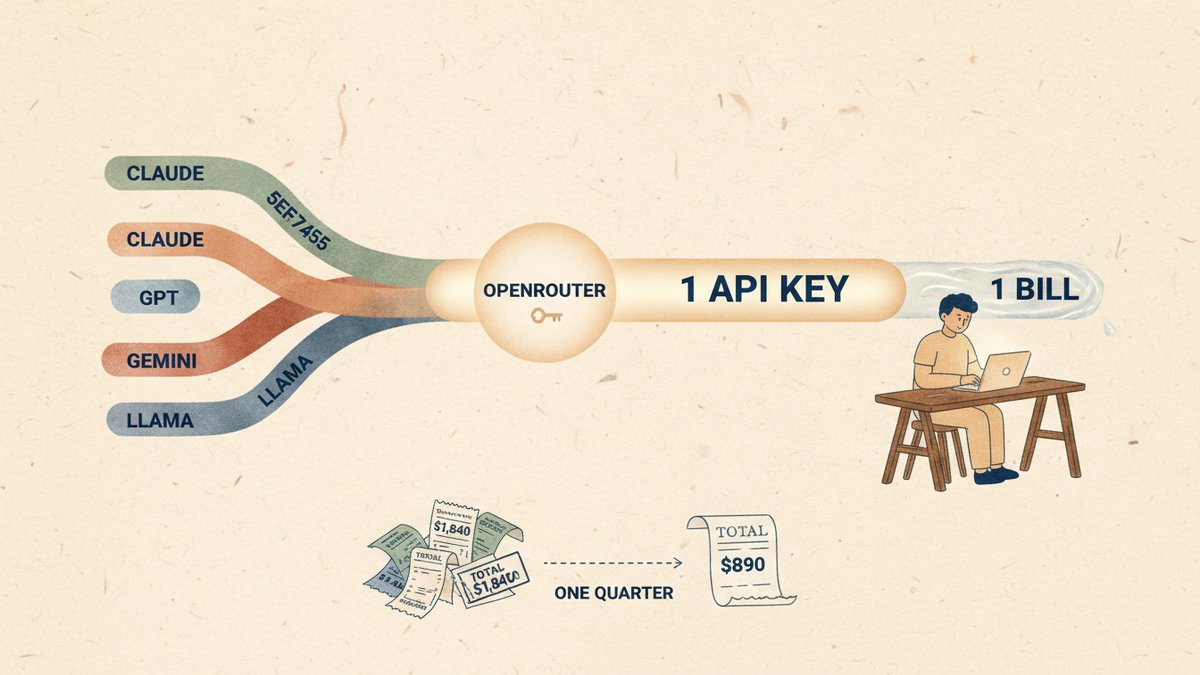
I used to keep four browser tabs open to use AI: ChatGPT for one task, Claude for another, Gemini for a third, and a self-hosted Llama for the boring rewrites. Each one had its own login, its own billing page, its own API key sitting in a .env file I was afraid to commit. Last quarter the bill across all four services hit $1,840. This quarter it hit $890 — and the output got better, not worse. The change was a single piece of plumbing called OpenRouter.
I didn't switch models. I switched how I called them.
What OpenRouter actually is
OpenRouter is one API endpoint that talks to 300+ models from Anthropic, OpenAI, Google, DeepSeek, Meta, Mistral, xAI, and a long tail of smaller providers. You sign up, drop $20 into credits, get one API key, and change a model name in your code. The format is OpenAI-compatible, so if you've ever used openai.ChatCompletion.create(...) you can swap the base URL and keep going.
That's the whole product description. It's not a model, it's not a chat app, it's not a wrapper that re-sells GPT-4 with a markup. It's a router. And for marketers running more than one AI workflow, that router is the missing piece you've been too busy to notice.
Why the bill dropped by more than half
The savings didn't come from picking one cheap model and using it for everything. They came from picking the right model for each task and routing the request there. Most of my work is some mix of these:
- Rewriting 50 stale product pages → a fast, cheap model does this fine. DeepSeek, Llama 3.3 70B, or the Haiku class are all over-qualified.
- Writing 10 LinkedIn thought-leadership posts → Sonnet-class quality, no debate. This is the work that pays the bills, so I don't pinch pennies here.
- Translating an EN pillar into 6 languages → different model is better at different language pairs. Rather than test in 6 directions, I just let OpenRouter route by language strength.
- Classifying 4,000 Reddit comments by intent → a small, fast model with structured output. Costs almost nothing.
- Drafting a 2,000-word pillar post → Sonnet or Opus. Time matters here; quality matters more.
When I used direct APIs, I'd run everything through whatever I'd last set up — usually Sonnet, because it was open in my terminal. That meant I was paying Sonnet prices to rewrite product pages that a $0.10/M-token model would handle just as well. When I routed by task, the cost structure looked like a real budget instead of a single line item.
The other half of the savings was operational. One bill, one dashboard, one usage log. Before, reconciling "which AI tool ate how much of client X's budget" required opening four portals and exporting four CSVs. Now it's one export.
A real workflow, not a feature list
Here's what an actual production day looks like for me. I'm building a 30-day content calendar for a B2B SaaS client. Three streams of work happen in parallel:
Stream 1 — Bulk ideation. I need 200 blog post angles. I use the cheapest viable model. The prompt is short, the output is short, the quality bar is "non-cringe." I send the request to deepseek/deepseek-chat and let it rip. This used to be a Sonnet job; the difference in quality was not worth 30x the cost.
Stream 2 — The pillar draft. I write a 2,000-word pillar on the strongest angle. This goes to Claude Sonnet. I'm not optimizing for cost here, I'm optimizing for "would I publish this under my byline." Sonnet is my default for high-stakes writing, same as the orchestrating-three-tools post I wrote earlier — the difference is now the call comes through OpenRouter, so it shows up on the same bill as the bulk ideation.
Stream 3 — Repurposing. Once the pillar is done, I send the same source text to three different models in parallel: one for LinkedIn carousel copy, one for a Twitter thread, one for an email newsletter. Each model has a different style strength. The output of all three is better than any single one would have produced, and I get to compare them side-by-side in the same conversation view. This is the manual version of what OpenRouter now offers as a one-click feature called Fusion — multi-model synthesis, where the system fans your prompt out to several models, scores the outputs, and returns a fused best-of response. I tried it on a quarterly research brief last month and the result was noticeably better than the single-model version I'd been producing.
The point isn't "Fusion is magic." The point is that all three streams run through the same key, the same dashboard, the same cost-tracking row. That's the workflow.
The three catches I actually hit
It isn't perfect, and I want to be specific about where it bit me.
1. Free models are free for a reason. OpenRouter exposes a long list of "free" models with no rate limit listed. The catch: the rate limits are aggressive, especially during US business hours, and you'll get 429s in the middle of a batch job. For one-off tests, fine. For a 4,000-row CSV run, you'll want to either pay for a stable provider or build a retry layer. I learned this the hard way when a brand-mention scan failed at row 2,847 and I had to restart it.
2. Latency is the worst model's latency, not the average. When you call a single model, you wait for one response. When you fan out to four models, you wait for the slowest. The Fusion feature inherits this — for any latency-sensitive flow (live chatbot, real-time scoring), stay on a single model. For batch work where 20 extra seconds doesn't matter, it's a free quality boost.
3. Vendor lock-in goes sideways. Using OpenRouter means your prompts, your prompt library, your temperature defaults — they all live in OpenRouter's request format. If you ever want to move off it, you have a migration to do. It's not as bad as moving off, say, a HubSpot workflow, but it's not zero. The trade-off is worth it for me because the productivity gain outweighs the switching cost, but I'd be lying if I said there was no lock-in.
What I'd try first if I were starting today
If you haven't touched OpenRouter yet, do this: pick the one workflow that already costs you the most on a direct API, and route it through OpenRouter for a week. For most marketers, that's the rewriting/refreshing work — content refresh, ad copy variants, FAQ generation, translation. Drop in the OpenAI base URL, swap the API key, change model="gpt-4o" to model="anthropic/claude-3.5-sonnet" (or whatever), and watch the bill at the end of the week.
The boring infrastructure move is the one that compounds. You stop thinking about which tool is open in which tab, and start thinking about which model fits which task. That reframe alone is worth the $20 in starter credits.