GPT-5.6 for Marketers: A Working Marketer's Pre-Release Field Notes (Sol, Terra, Luna — and What Each One Is Actually For)
Contents
OpenAI shipped GPT-5.6 on June 26 — but only to a small list of "trusted partners," pending a US government national-security review that pushed the broad release out by two weeks. As of this Thursday (today), it's finally opening up to everyone. Three models at once. Three price points. Three very different jobs.
Most of the launch coverage is comparing benchmark charts: Sol beating Claude Mythos 5 by three points on Terminal-Bench 2.1, hitting 91.9% in Ultra mode. That's the headline. It's also the least interesting part for anyone running real marketing work.
Here's what a 15-year marketer actually cares about after reading every page of OpenAI's announcement and the postmortems that followed.
What OpenAI actually shipped — three models, not one
GPT-5.6 is a family, not a single API call. If you've been treating "GPT-5.6" as one thing, you've already misread the launch.
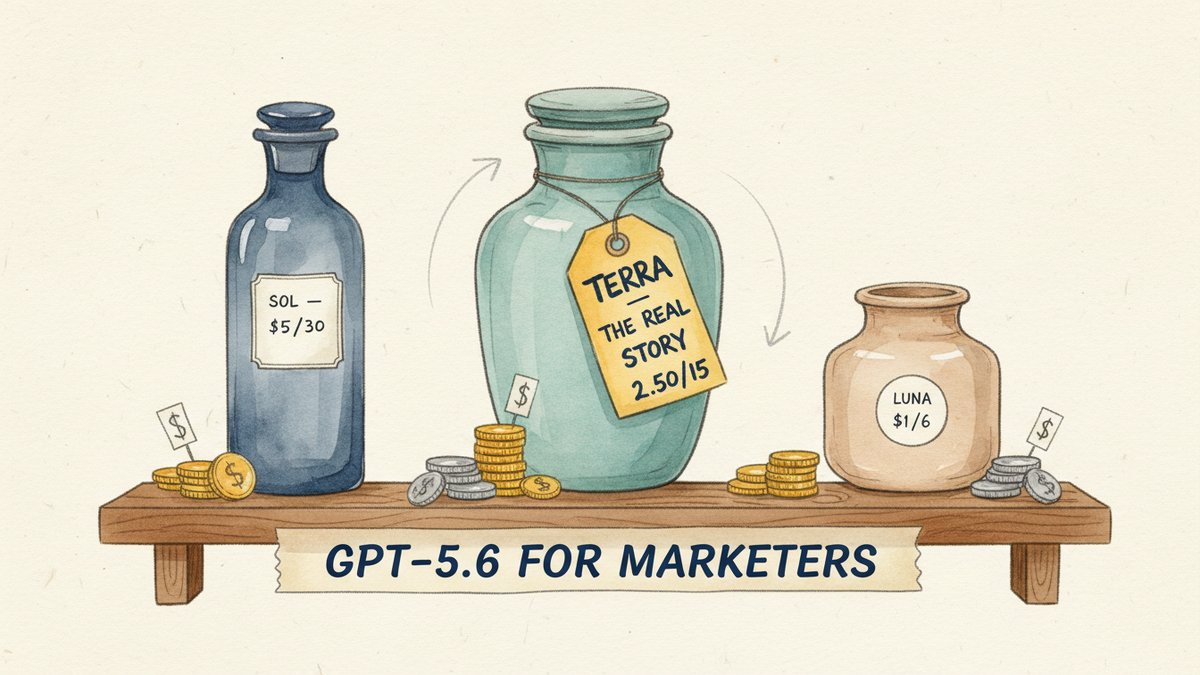
| Model | Role | Input $/M | Output $/M | What it replaces |
|---|---|---|---|---|
| Sol | Flagship — coding, agents, deep reasoning | $5 | $30 | GPT-5.5 at the same price |
| Terra | Balanced — daily production work | $2.50 | $15 | GPT-5.5 perf at half the cost |
| Luna | Fast & cheap — high-volume batch tasks | $1 | $6 | GPT-5.4 mini / nano |
The pricing tells you everything about OpenAI's actual play. Sol isn't priced to displace Claude Fable 5 or Mythos 5 — it's priced to match GPT-5.5 while being a clear upgrade. Terra is the move: same performance as GPT-5.5 for half the per-token cost. That's the one that should change your monthly AI bill.
Luna at $1/$6 isn't a marketing-tier headline, but for the marketers running serious volume — UGC moderation, keyword clustering at scale, A/B variant generation in the thousands — it's the first time an OpenAI flagship family has a model cheap enough to throw at bulk work without flinching.
The four things that actually change for marketers
Most frontier-model launches hide the marketing-relevant changes behind benchmark tables. GPT-5.6's announcement is no different, but here are the four shifts worth tracking.
1. 1.5M-token context window — not a bigger document, a different job.
The previous 1M-token ceiling (GPT-5.5, Claude Opus 4.8, Sonnet 5) already let you fit a long brief, a content audit, or a full SERP. 1.5M opens up a different category: the whole thing. Not "the whole long brief" but the whole client — twelve months of customer interviews, every product page, the competitor set, the brand-voice corpus, all in one window.
The first thing I'll test the day it opens: dropping a 12-month transcript archive plus the current product catalog plus a year of GA4-exported landing-page data into a single Sol call, and asking it to find the three content gaps the agency has been missing. That's a job that previously needed RAG (Retrieval-Augmented Generation, retrieval增强生成) hacks, a vector DB (向量数据库), and a chunking script. With 1.5M tokens it's one prompt.
The honest caveat from the developer-side coverage: long-context models still degrade in the middle of the window — "lost in the middle" is real. The 1.5M number is the ceiling, not a guarantee that retrieval quality holds at token 800,000. Treat it as a generous working memory, not infinite RAM.
2. UltraFast mode — sub-200ms responses.
OpenAI's developer post cites UltraFast bringing latency under 200ms, 2–5× faster than GPT-5.5's Fast tier. For most marketing tasks this is irrelevant — you don't care if your 50-ad-variant generation takes 8 seconds or 40. But for anything user-facing (on-site chat, dynamic personalization, real-time ad copy selection in a programmatic creative pipeline), sub-200ms is the threshold where the experience stops feeling AI-mediated.
The actual use case I'd build: an on-page variant selector that rewrites a hero headline based on the visitor's UTM source, served before the page paints the LCP (Largest Contentful Paint, 最大内容绘制时间 — 衡量首屏速度的指标). Today's stack needs a precomputed variant table; with UltraFast, the variant is generated per-session. Don't deploy it on Tuesday; prototype it in July.
3. Ultra mode — sub-agents running in parallel.
Sol's Ultra mode runs sub-agents concurrently on decomposed parts of a complex task. The vendor-reported number is 42% latency reduction on multi-step jobs versus running them serially. The actual shift isn't the speed — it's that you can now hand a model a marketing job that's too big for one prompt context.
Concretely: a 30-day omnichannel content calendar with 7 channels, 3 audience tiers, and conflict detection against the paid-media schedule. Today, that's an n8n + Claude pipeline with manual chunking. With Ultra mode, it's one prompt and a 90-second wait. The benchmark number on Terminal-Bench 2.1 (91.9% Ultra vs 88.8% Standard) suggests it doesn't just parallelize — it plans better. Caveat: vendor-reported, and the early-access partners testing it have been tight-lipped about real-world win rates.
4. The pricing on Terra is the only one that matters for most teams.
Sol at $5/$30 is exactly GPT-5.5's price. If you're already on GPT-5.5, switching to Sol is a free perf upgrade. If you're on GPT-5.4, it's a 100% price hike for marginal gains.
Terra at $2.50/$15 changes the math for the work most marketers actually do — long-form content drafts, persona synthesis from interview transcripts, content brief generation, SEO rewrites at scale. My rough estimate: switching my daily production jobs from GPT-5.5 to Terra cuts the monthly API bill in half for the same quality. That's the line item finance will ask about.
The honest part: vendor benchmarks, not field data
Three things the announcement does not include:
- Independent benchmark runs. Every chart in OpenAI's launch post is internal. The Terminal-Bench 2.1 numbers are reproducible but vendor-staged.
- Real-world marketing test data. The "trusted partners" running GPT-5.6 since June 26 are mostly enterprise and government. Public marketing-workload benchmarks haven't surfaced yet.
- A clear commitment on data retention. OpenAI's API defaults are 30-day retention for abuse monitoring, with zero-retention available for some tiers. Agencies running client work should confirm before routing sensitive copy through Sol.
The most useful signal right now: the pricing. OpenAI has a strong incentive to overstate benchmarks and an equally strong incentive to keep Terra cheap, because that's how they reclaim Anthropic's enterprise ground. The benchmark gap to Mythos 5 may close. The price gap is structural.
What I'm routing to GPT-5.6 the day it opens
Order of operations, based on which upgrade pays back fastest:
- Terra for daily content and SEO rewrites. Same quality I had on GPT-5.5, half the cost. No new workflow to build. Pure margin.
- Sol for the monthly whole-corpus analysis job. Drop the full transcript + product + GA4 stack into 1.5M context. This is a new job I couldn't run before, not an upgrade to an existing one.
- Luna for UGC moderation and bulk keyword clustering. Anything I previously routed to GPT-5.4 nano because the cost mattered, Luna does the same job cheaper. Mostly a swap.
- Ultra mode for the async content calendar pipeline. The multi-agent parallel execution is genuinely new. Worth a careful A/B against my current n8n + Claude chain before committing.
Two things I am not doing on day one: paying Sol's premium for short prompts where GPT-5.4 nano works fine, and trusting the 91.9% Terminal-Bench number as a marketing-workload proxy. Marketing is not software engineering. The benchmark that matters is the one your last campaign actually shipped against.
The takeaway
GPT-5.6 is three models priced to win three different jobs. The launch coverage spent two weeks comparing Sol to Claude Mythos 5 on coding benchmarks. The actual play for marketing teams is Terra — and the second-order story is that 1.5M context plus Ultra mode opens up whole-corpus analysis jobs that didn't fit in any model six months ago.
Skip the model-war coverage. Read the pricing table. Route your daily production through Terra on day one. Save Sol for the jobs you couldn't run before.