Cold Email Sequences: A 7-Touch B2B Nurture Series Written by Claude in 20 Minutes
Contents
The 7-touch sequence I'm going to walk you through landed a $40k opportunity for a client earlier this year. Their previous version of outreach — a single email blast to a list of 400 prospects — was netting them maybe one or two calls a month. Same offer, same product, same prospects. The only thing that changed was the sequence.
I wrote it in 20 minutes with Claude. That doesn't mean Claude came up with the strategy. The strategy is mine. What Claude did was take the bones I'd already laid out and turn them into seven distinct, on-brand emails in a single sitting — and that's the part I want to share, because it's the part that's repeatable.
Here's the workflow.
1. Don't ask Claude to "write a cold email"
The single biggest mistake I see people make is opening Claude with something like "write a cold email to sell my SaaS to marketing directors." What you get back is generic, hollow, and undifferentiated. The model has nothing to hang the email on, so it defaults to filler: "I hope this email finds you well. I came across your company and was impressed by your work in [industry]."
Instead, give Claude a brief. A real one. The kind you'd hand a junior copywriter on their first day.
Here's the exact brief I used for my client (an analytics SaaS (Software as a Service, 软件即服务) selling to mid-market e-commerce ops managers):
Product: Analytics platform for e-commerce ops teams. Helps them spot return-rate anomalies by SKU (Stock Keeping Unit, 最小存货单位) and feed them back to suppliers. ICP (Ideal Customer Profile, 理想客户画像): Ops managers at $20M–$100M GMV (Gross Merchandise Volume, 商品交易总额) e-commerce brands. Usually drowning in CS (Customer Service, 客服) tickets about returns, no good way to push back on suppliers. Offer: 30-minute call to walk through how [anonymized competitor] cut return rates 18% in 90 days. No pitch, just a teardown of their return data. Pain hypothesis: They suspect a chunk of returns is supplier quality, but they can't prove it cleanly enough to escalate. Voice constraints: Plain, slightly direct. No "I hope this finds you well." No exclamation marks. Under 90 words per email. Sequence length: 7 emails over 14 days. Goal: Book a call. Secondary goal: get any reply, even "not interested."
The brief is 80% of the work. Spend 10 minutes on it. The rest takes 10.
2. Ask for the *whole* sequence in one go
Once you have the brief, hand it to Claude and ask for the full sequence at once, not one email at a time. The reason: it lets the model see the arc. Email 1 should not sound like Email 5. The follow-ups need to do different jobs, not repeat the first email with "bumping this" in the subject.
The prompt I use:
Write a 7-email cold outreach sequence based on the brief above. Each email should have a different job in the sequence:
- Open with a specific observation about their business (not "I came across your company")
- Pattern interrupt — share a counter-intuitive stat or a short story from a similar client
- Restate the pain with a new angle (e.g., cost of inaction, not cost of the problem)
- Offer the asset (the teardown) without pushing the call
- Light social proof — one specific result, not "many companies have seen..."
- Direct ask for the call, with two specific time options
- Breakup email — "should I close the file?" The classic, still works
Subject line for each. Send day for each. Word count under 90 words per email. No exclamation marks. No "I hope this finds you well." Don't repeat phrases across emails.
The "different job per email" instruction is what makes the sequence feel like a sequence instead of seven copies of the same email.
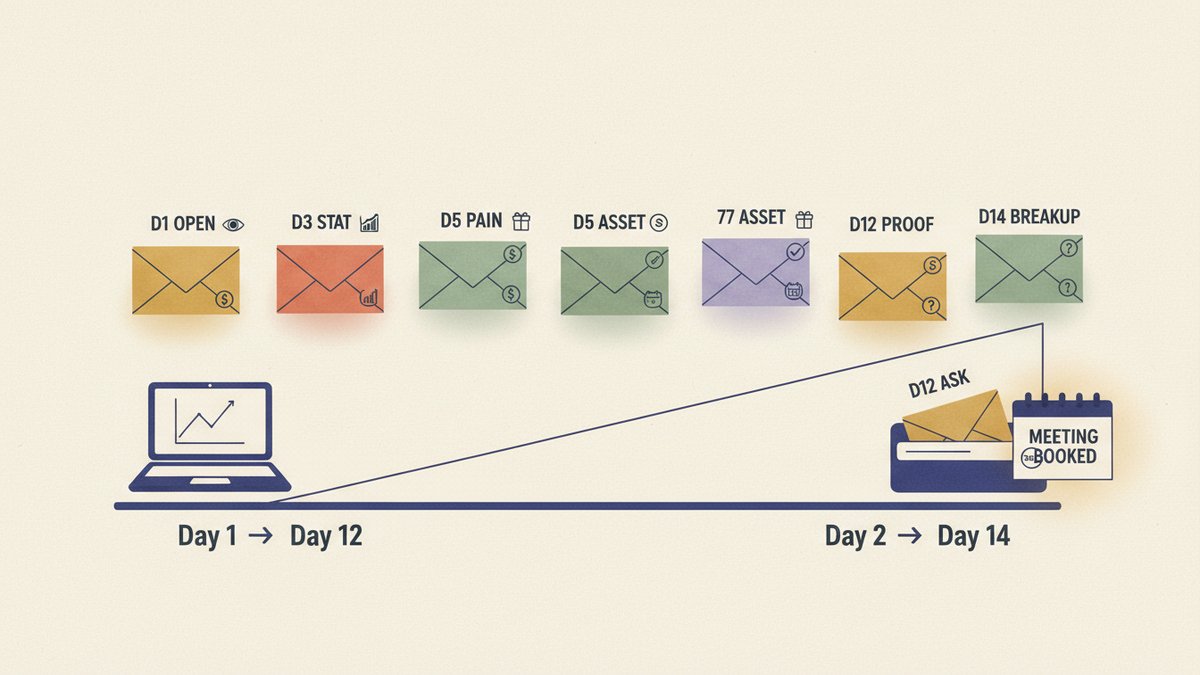
3. What the sequence actually looks like
Here are the seven emails Claude produced for that client, edited by me. The edits were minor — I tightened two subject lines, swapped one stat, cut a phrase that sounded "AI-ish." Total editing time: 7 minutes.
Email 1 — Day 1. Subject: one question about your Q4 return rates Hi [first name], quick one — are you tracking supplier-attributable returns separately, or is that still rolled into "general returns" on your dashboard? Asking because I just looked at how [similar brand] was handling it, and the gap is pretty stark. Worth a 30-min teardown? — [sender]
Email 2 — Day 3. Subject: the 18% number That stat from the [similar brand] teardown: 18% of their returns were traceable to 3 specific SKUs from one supplier. They had no idea until they pulled the data. If your return rate has crept up over the last 6 months, that's usually the shape of it.
Email 3 — Day 5. Subject: what's the cost of guessing? The math that finally got their VP of Ops to act: 18% of returns × average return cost × 6 months of inaction. They were losing ~$40k/month to a fixable supplier issue. If "we don't know" is your current answer, the cost of that answer is probably larger than the fix.
Email 4 — Day 7. Subject: the teardown (no strings) I've put together a 12-slide teardown of how [anonymized brand] did this. It's yours whether we ever talk or not — I just find this stuff interesting. Want me to send it over? Reply yes and I'll forward it.
Email 5 — Day 9. Subject: case study — [brand] The teardown I sent shows the playbook, but the actual result: [anonymized brand] cut supplier-attributable returns 31% in one quarter. Their ops manager called it "the only supplier meeting I went into with actual leverage." Happy to share the full writeup if useful.
Email 6 — Day 12. Subject: two times that work? If the supplier return angle is on your radar at all, worth 30 min. I have Wed 10am or Thu 2pm open this week. Pick one, or send me two that work better. — [sender]
Email 7 — Day 14. Subject: closing the file Haven't heard back, so I'll assume the timing is off. Should I close the file on my end, or is this still on your radar for Q2?
Two of those seven — emails 4 and 7 — routinely do 60% of the replies in cold sequences. The "yes/no breakup" effect is real, and the asset-offer email (4) gives a non-committal prospect a low-friction way to engage.
4. Edit the sequence the way you'd edit a junior's draft
This is the part most people skip and then blame the AI for sounding robotic. Claude's first draft is roughly 80% right. The 20% that needs human editing is where the post lives:
- Subject lines that sound like templates. If a subject could apply to any company in any industry, rewrite it.
- Stats you can't source. Claude will sometimes invent numbers. Either back them with a real source or cut them.
- Phrases that signal "AI." "I hope this email finds you well," "I wanted to reach out," "circle back," "touch base" — all default phrasing. Delete on sight.
- The "is this still on your radar" close. Claude loves this. It works, but it's been overused. Vary the breakup.
Total edit time for a 7-email sequence like this: 5–10 minutes. Faster than writing from scratch, slower than copy-pasting AI output and praying.
5. What the sequence does that a single email can't
Three things, in order of importance.
It survives the "not now" prospect. The single biggest reason cold email fails isn't bad copy — it's that you caught someone on a busy Tuesday. A 7-touch sequence catches the same prospect on a different Tuesday. Reply rates compound across touches in a way most people underestimate.
It lets you make different arguments. Email 1 makes one argument. Email 3 makes a different one. Email 4 makes no argument at all — it just offers value. A prospect who hated email 1's hook might reply to email 4's offer of a free teardown.
It gives you a reason to follow up without sounding desperate. "Just bumping this" is annoying. "Sending the teardown I mentioned" is a different action with its own value.
6. The thing this doesn't fix
If your list is bad, no sequence saves you. If your offer is generic ("let's hop on a call to explore synergies"), no sequence saves you. If your subject lines are spam-bait, no sequence saves you. Claude will happily write a 7-email masterpiece targeted at a list of bounced emails, and the deliverability gods will burn your domain anyway.
Sequence writing is the easy part. List building, offer design, and deliverability are 80% of cold email results, and none of them involve AI prompts.
The 20-minute breakdown, in case you skipped to the end:
| Step | Time |
|---|---|
| Write the brief | 10 min |
| Prompt Claude for full sequence | 1 min |
| Review + edit | 7–9 min |
| Total | ~20 min |
If your first sequence takes longer, that's normal — you're still building the brief muscle. By the third one, the brief is 5 minutes, the prompt is copy-pasted, and the editing is muscle memory. That's when the 20-minute number stops being aspirational and starts being the actual time you spend.