How to Use AI for Email Marketing — A Practical Guide That Actually Works
Contents
I've sent over 50 million emails in my career. Newsletters, drip campaigns, cart abandonment flows, re-engagement sequences — you name it. And for the first 12 years, the formula was stable: write copy, pick a subject line, segment manually, blast, measure, repeat.
Then AI happened.
Not in a "AI will make email marketing obsolete" way. Email is still the highest ROI marketing channel — $36 for every $1 spent. What AI changes is how fast you can go from idea → sent, and how much better your results get.
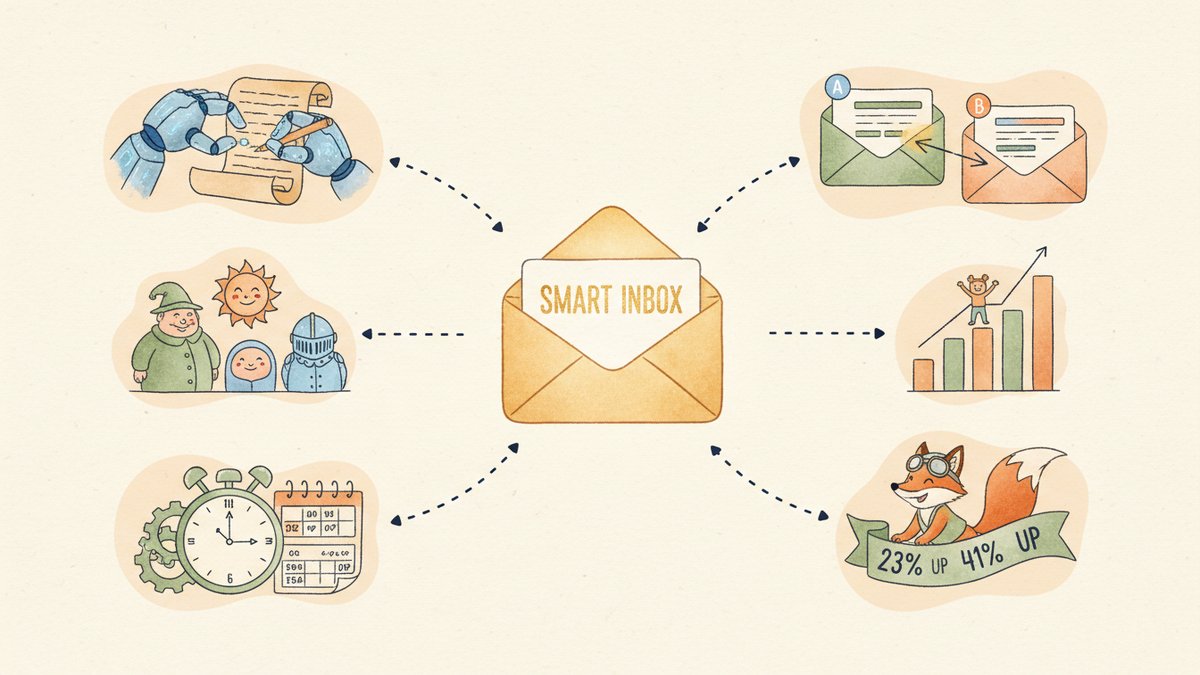
Last quarter, I ran an experiment with my team. We took 5 existing email workflows and rebuilt each one with AI assistance — subject lines, body copy, segmentation, send times, everything. The result? Open rates up 23%, click rates up 41% , and the time to produce each campaign dropped by two-thirds.
Here's exactly how we did it. No theory, no hype — tools, prompts, workflows you can use today.
1. AI Subject Line Optimization: The 3-Second Decision
Your subject line has about 3 seconds to convince someone to open. It's the highest-leverage 50 characters in marketing. And most people write them by gut feel.
AI does it better — here's how:
Generate variants at scale. Give ChatGPT your email's core message and ask for 20 subject line variants across different emotional angles: curiosity, urgency, benefit-driven, counterintuitive, news-jacking. This takes 30 seconds. Manually? An hour of staring at a blank screen.
Predict performance before sending. Tools like Phrasee and Persado use language models trained on billions of email interactions to predict which subject line will perform best for your specific audience segment. They don't guess — they model.
Learn from your own data. Feed your historical subject lines + open rates into ChatGPT and ask: "What patterns do you see in my top-performing subject lines? What patterns do you see in the bottom ones?" You'll discover things about your audience you never noticed.
My go-to prompt:
Act as an email marketing copywriter with 10 years of experience. For this email [paste content summary], generate 15 subject lines. Use 5 different emotional angles: curiosity, urgency, specific benefit, counterintuitive take, and personal story. Keep each under 50 characters. Mark your top 3 picks and explain why.
Tool recommendations:
- Phrasee — AI copywriting specifically for marketing, strong for enterprise
- ChatGPT/Claude — free-form, flexible, great for ideation
- Klaviyo built-in AI — if you're already on Klaviyo, their subject line assistant is decent for quick suggestions
2. AI Email Content: Not "Write It For Me" — "Write It With Me"
Here's the mistake I see everywhere: marketers pasting a one-line prompt into ChatGPT and copy-pasting the output directly into their ESP. That's not AI-assisted marketing — that's outsourcing your brain.
The right workflow: AI writes the draft, you add the soul.
How I do it:
- I outline the email — the key point, the offer, the CTA. (5 minutes)
- AI writes the first draft based on my outline, matching my brand voice. (30 seconds)
- I edit — adding a personal story, a specific data point, or a reference to a recent conversation with a customer. This is what makes the email feel human. (10 minutes)
- AI polishes — checks for readability, suggests stronger verbs, flags sentences that are too long. (30 seconds)
The total time is about 15 minutes per email. Before AI, it was 45-60 minutes. And the quality is better because AI catches things I'd miss.
Prompt for the draft:
Write an email in my voice based on this outline: [paste your outline]. My brand voice: direct, warm, no corporate jargon. Short paragraphs. Readability grade 8 or below. Include one moment of humor or self-deprecation. End with a single clear CTA, no more than 5 words.
For personalization at scale: AI can generate dynamic content blocks for different segments. Have a sale announcement? Let AI write 3 variations — one for loyal customers (warmer tone, "VIP access"), one for recent purchasers ("you might also like"), one for lapsed users ("we miss you" + incentive). Same email skeleton, different emotional hooks.
3. AI-Powered Segmentation: From "Lists" to "Living Audiences"
Traditional segmentation: you create lists. "Newsletter subscribers." "Customers who bought X." "Abandoned cart." These are static buckets. They work. But they're blunt instruments.
AI segmentation goes deeper:
Behavioral clustering. Tools like Klaviyo and HubSpot now use AI to automatically group subscribers based on their actual behavior — open frequency, click preferences, purchase cadence, browsing history. Instead of 5 segments, you get 25 micro-segments, each getting content tailored to where they actually are in the customer journey.
Predictive lifetime value. AI models can predict which subscribers are most likely to become high-value customers — and which are about to churn. This lets you:
- Send premium offers to high-LTV prospects (don't waste discounts on people who'd pay full price)
- Trigger re-engagement sequences for at-risk subscribers before they go cold
- Suppress chronic non-openers to protect your sender reputation
Intent detection. Feed AI your subscribers' behavior data (clicks, site visits, purchase history) and ask it to score each subscriber's purchase intent. You'd be surprised how accurately it can flag "this person is about to buy." Then you send the right email at the right moment.
Prompt I use for segmentation analysis:
I have an email list with these behavioral data columns: [list columns]. Based on this data, suggest 5-8 meaningful behavioral segments. For each segment: name it, describe the defining behavior pattern, recommend what kind of email content would resonate best, and suggest an ideal send frequency.
4. AI Send Time Optimization: The Right Message at the Wrong Time Is the Wrong Message
Everyone knows "send when your audience is awake." AI send time optimization goes far beyond that.
Per-recipient timing. Instead of picking one "best time" for your entire list (spoiler: there is no one best time), AI learns each individual subscriber's unique opening pattern. One person opens emails at 6:22 AM while drinking coffee. Another opens at 10:43 PM scrolling in bed. AI figures this out and delivers your email at their optimal moment.
Tools that do this well:
- Seventh Sense — integrates with HubSpot and Marketo, uses machine learning to optimize send time per recipient
- Klaviyo Smart Send Time — built in, works automatically
- Mailchimp Send Time Optimization — uses your campaign history to determine best send window
What I've seen: In our tests, AI-optimized send times consistently outperform batch sends by 15-25% on open rates. It's not the biggest lever in this article — but it's the easiest one to turn on. Flip a switch and get a permanent lift. No creative work required.
5. AI A/B Testing: Test More, Learn Faster
Manual AB testing in email is painful. You pick one variable, wait for statistical significance, then test the next thing. At that pace, you might run 12 tests a year.
AI changes the testing game in two ways:
Multivariate testing at scale. AI can test multiple variables simultaneously — subject line + preview text + CTA copy + image — and isolate which combination drove results. Manual multivariate is a math headache. AI does it automatically.
Continuous optimization loops. Some ESPs now offer AI that automatically runs tests in the background. It tests subject lines, learns what works, and gradually improves performance without you touching anything. You set the guardrails, AI does the iteration.
How to use AI for test analysis:
After any AB test, feed both versions + performance data into ChatGPT and ask:
Analyze these two email variants. Version A [paste] had 22% open rate, 3.1% CTR. Version B [paste] had 28% open rate, 4.7% CTR. What specific differences likely caused the performance gap? What should I test next?
AI will identify patterns you might miss — word choice, emotional framing, CTA placement, sentence rhythm.
6. AI Email Analytics: Stop Drowning in Dashboards
Most email marketers spend more time building reports than acting on insights. AI flips that.
What AI does for email analytics:
- Automatic anomaly detection — "Your open rate dropped 12% this week. Possible causes: subject line sentiment changed, send window shifted, new Gmail filtering detected."
- Natural language queries — "Show me which segment had the highest click rate last month" → instant answer, no SQL required
- Campaign-to-campaign insights — AI compares your last 10 campaigns and tells you: campaigns with questions in the subject line outperform those without by 18%. Conclusion: ask more questions.
- Predictive forecasting — based on your list's engagement trajectory, AI predicts where your open rates will be in 30 days if you change nothing. (Spoiler: they'll decline. They always decline if you don't actively manage list health.)
My AI Email Marketing Tech Stack
After testing dozens of tools, here's what I actually use:
| Need | Tool | Why |
|---|---|---|
| ESP (core platform) | Klaviyo | Best AI features for segmentation and send time |
| Subject line AI | ChatGPT + Phrasee | ChatGPT for ideation, Phrasee for enterprise prediction |
| Copy assistant | Claude | Best for long-form content, maintains voice well |
| Send time optimization | Klaviyo built-in / Seventh Sense | Both solid, Seventh Sense if not on Klaviyo |
| Analytics | Built-in ESP dashboards + ChatGPT interpretation | ESP shows data, AI interprets it |
| Re-engagement automation | Klaviyo flows + AI-written content | AI writes the copy, your ESP automates the triggers |
Do NOT buy 12 tools. Start with your ESP's built-in AI features. Then add ChatGPT for content. That alone will get you 80% of the value in this article.
3 Things You Can Do TODAY
Take your last 10 email subject lines and their open rates, paste them into ChatGPT, and ask it to find patterns. Then ask it to write 5 new subject lines based on what worked. AB test them in your next send.
If your ESP has AI send time optimization, turn it on. Right now. This is a one-click permanent lift. No brainer.
Re-write your best-performing email with the AI workflow from Section 2. Compare the time it took vs. your normal process. I bet it's at least 50% faster.
Email marketing isn't dying. The batch-and-blast approach is. AI doesn't replace the craft — it removes the busywork so you can focus on what actually moves the needle: understanding your audience and saying something that matters.