AI Agents for Freelancers: Your Unfair Advantage in Digital and Affiliate Marketing
Contents
Tuesday morning, 8:00 AM. A freelance affiliate marketer sits down at their laptop.
By 8:05, an AI agent has already scanned their email for partner program updates, flagged two commission rate changes, drafted reply templates, and pulled yesterday's click-through data into a spreadsheet. While they make coffee, another agent is generating five variations of a product comparison table for a new campaign, complete with pros, cons, and pricing pulled live from three merchant APIs.
By 9:30, they've done what used to take two days.
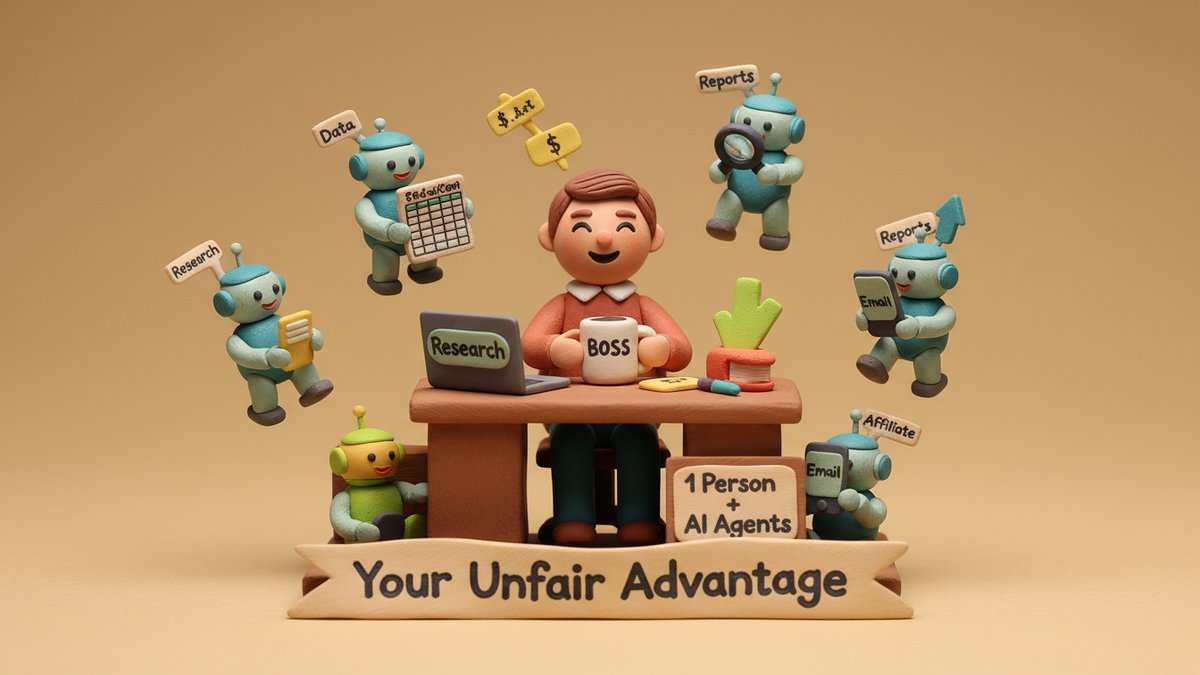
This isn't a futuristic fantasy. It's what AI agents can do right now — and freelancers are uniquely positioned to benefit. More than agencies. More than in-house teams. Because when you're a one-person operation, an AI agent isn't a nice-to-have. It's a force multiplier that closes the gap between you and a 10-person team.
First, What Is an AI Agent (Actually)?
The term "AI agent" is already getting muddy. Let's clear it up.
A chatbot answers questions. You ask, it responds. One turn at a time. ChatGPT in its basic mode, Claude, Gemini — these are chatbots.
An AI agent does things. You give it a goal, and it plans steps, uses tools, makes decisions, and executes — across multiple turns, without you steering every move. It might browse the web, fill out forms, run code, send emails, pull data from APIs, write to spreadsheets, then report back with results.
The key difference: agency. A chatbot needs you to drive. An agent drives itself toward a goal you set.
Think of it like this:
| Chatbot | AI Agent | |
|---|---|---|
| Interaction | One question, one answer | One goal, many actions |
| Tools | None (text only) | Browser, code, APIs, files |
| Decision-making | None | Plans, adjusts, retries |
| Duration | Seconds | Minutes to hours |
| Example | "Write me a product review" | "Research the top 5 standing desks, compare prices across 3 retailers, create a comparison table, draft a review, and email me when done" |
Right now, the most accessible AI agents for freelancers are: ChatGPT Operator (browser-based task execution), Claude with tool use (code + file operations), Manus (autonomous multi-step research), and Make/Zapier AI agents (workflow automation with LLM decision nodes).
Why Freelancers Benefit More Than Anyone
Here's something counterintuitive: AI agents help freelancers MORE than they help agencies.
An agency with 50 people already has specialization. One person does keyword research, another writes content, another runs ads, another handles client communication. AI agents improve each function incrementally — maybe 20-30% efficiency gains per person.
A freelancer does ALL of those things alone. When you add an AI agent that can handle research while you write, monitor campaign performance while you sleep, and draft client reports while you pitch new business — you're not getting 20%. You're getting 5X, 10X, because you're filling functions that were previously just... empty.
The freelancer's bottleneck has always been time. There's only one of you. AI agents don't give you 26 hours in a day — they give you parallel execution. While you do the high-value creative work, agents handle the five other things that would've sat in your to-do list until Thursday.
Six AI Agent Workflows for Affiliate & Digital Marketing
Here are the workflows I've tested or seen working reliably. Each one replaces hours of manual work with minutes of oversight.
1. Automated Product Research & Comparison
The manual way: Browse Amazon, read specs, check prices on 3-4 retailer sites, copy-paste into a spreadsheet, manually format comparison tables.
With an AI agent: Give it a product category and criteria. It browses retailer sites, extracts specs and prices, cross-references reviews, and builds a formatted comparison table with affiliate links.
Real prompt example (ChatGPT Operator or Manus):
"Research the top 5 ergonomic office chairs under $500. For each chair: get the current price on Amazon and at least one other retailer, extract key specs (weight capacity, material, warranty), summarize 3-5 verified-purchase reviews, note any red flags. Output as a comparison table with my Amazon affiliate links. Flag which chair offers the best value."
What used to take an afternoon now takes 15 minutes of agent time plus 10 minutes of your review.
2. Content Production Pipeline
The manual way: Write the article, find images, format for each platform, schedule posts, create social snippets.
With an AI agent chain: One agent researches and drafts the main review article. A second agent extracts key points into social media posts (Twitter thread, LinkedIn carousel script, Instagram caption). A third agent formats everything for scheduling. You review at two checkpoints.
This is the difference between publishing once a week and publishing three times a week — which, in affiliate marketing, directly correlates with revenue.
3. Commission Monitoring & Opportunity Alerts
Affiliate programs change commission rates constantly. A program that paid 10% last month might pay 4% today, and you won't notice until your monthly check is lighter.
Agent workflow: An agent checks your affiliate dashboard daily (or scrapes program pages), compares current rates against a baseline, and emails you when something changes. It can also surface new high-commission products in your niche.
This is a perfect use case for a scheduled agent — set it, forget it, only hear from it when something needs attention.
4. Competitor Content Gap Analysis
The manual way: Open Ahrefs or SEMrush, export competitor keywords, cross-reference against your content, manually identify gaps, prioritize.
With an AI agent: The agent pulls competitor content lists, compares them to your published URLs, identifies topics they cover that you don't, and ranks them by estimated traffic potential. Output: a prioritized content calendar.
This isn't speculative — it's exactly what content strategists charge $2,000+ per month to do, automated down to a weekly 15-minute review.
5. Client Outreach & Proposal Drafting
For freelancers doing client work: an agent can research a prospect's website, analyze their current marketing gaps, and draft a personalized proposal with specific recommendations — all before you've even had the first call.
Feed it a prospect's URL and a brief about your services. It returns:
- Their current traffic estimate and visible marketing channels
- 3 specific gaps or opportunities it found
- A draft proposal email referencing those gaps
- A suggested service package with pricing rationale
You still close the deal. The agent just gets you to the table with a tailored pitch instead of a template.
6. Performance Reporting & Client Dashboards
This one saves freelancers the most time per week. Instead of logging into 5 platforms, exporting CSVs, and building reports manually: an agent pulls data from Google Search Console, affiliate dashboards, email platforms, and social analytics, then compiles everything into a formatted report.
For agencies, this is a junior analyst's job. For freelancers, it was their Sunday afternoon. Now it's an agent's job.
Tools to Start With (No-Code, Freelancer-Friendly)
You don't need to code. Here's what's accessible right now:
| Tool | Best for | Cost |
|---|---|---|
| ChatGPT Operator | Browser-based research, form-filling, data extraction | ChatGPT Pro ($200/mo) |
| Claude + Tool Use | Code execution, file processing, data analysis | API usage (~$0.015-0.075/task) |
| Manus | Autonomous multi-step research & report generation | ~$39/mo (varies) |
| Make.com + AI modules | Scheduled workflow automation with LLM decision nodes | Free tier available, $9+/mo |
| Zapier Central | Multi-step automation with AI-powered branching | $30+/mo |
| n8n (self-hosted) | Open-source workflow automation, full control | Free (self-hosted) |
Start with ChatGPT Operator if you're already paying for ChatGPT Pro — it's the lowest-friction entry point. Run one task, watch how it browses and executes, then decide what to automate next.
What AI Agents Won't Do (Yet)
Let me be direct about the limits, because the hype is loud and the reality is messier.
Agents still make wrong turns. An agent researching products might pull outdated prices, miss a crucial spec, or misinterpret a review. You must review its output — think of it as a very fast junior assistant, not an autonomous expert.
Authentication walls are real. Many affiliate dashboards and analytics platforms require login. ChatGPT Operator can log in with your permission, but some sites block automated access. Workflow agents (Make, Zapier) connect via APIs, which is more reliable.
Creative judgment still needs you. An agent can draft a product review, but it can't tell whether the tone matches your audience's expectations or whether the angle is genuinely interesting. That editorial layer is your value — don't outsource it.
Costs add up if you're not selective. Running agents on API credits means each task costs money. A complex research task might run $0.50-2.00 in API fees. Worth it for high-value work, wasteful for trivial tasks. Be deliberate about what you automate.
Where to Start Tomorrow
Pick ONE workflow. Not all six. The freelancers who get the most out of AI agents are the ones who automate one thing deeply before moving to the next.
My recommendation: start with product research automation. It's high-friction (every affiliate marketer hates it), high-reward (better comparisons = more conversions), and easy to verify (you can spot-check prices against Amazon in 30 seconds).
Run it once manually so you know what good output looks like. Then hand the same task to an agent. Compare. Tweak the prompt. Run it again. Within three iterations, you'll have a prompt template that produces reliable results — and a workflow that saves you 4-6 hours per campaign.
That's one afternoon of setup for a permanent time dividend. The math on that is hard to argue with.