Create an AI Style Guide and Lock In Your Brand Voice
Contents
A prospect DM'd me last month. "I gave ChatGPT our brand guidelines and asked it to write a launch email. The result was technically correct and completely soulless. How do I make it sound like us?"
She'd done what 90% of marketers do: pasted a PDF brand book into the prompt, hit enter, and expected magic. It doesn't work. Traditional brand books are written for humans, full of adjectives like "authentic" and "approachable" that mean nothing to a language model.
What you need is something different — an AI style guide. It's a short, structured document (usually 2-4 pages) that tells the model exactly how to write in your voice: not vague values, but concrete voice dimensions, do/don't examples, and a vocabulary list. Once you build one, every piece of AI-generated content comes out sounding recognizably yours.
I've built these for a fintech, a D2C skincare brand, and a B2B SaaS — and used my own to write this article. Here's the exact template.
Why Traditional Brand Books Don't Work with AI
The core problem is that LLMs (Large Language Models, 大语言模型) process instructions differently than humans. A human reads "we are warm and approachable" and infers tone from context, examples, and shared cultural knowledge. A model just sees two abstract adjectives. It has no idea what you mean by "warm" — your warm might be Patagonia's earthy minimalism, or it might be Wendy's snarky Twitter voice.
Three specific failure modes I see constantly:
1. The "average" trap. When you give a model no voice constraints, it produces the statistically average version of the genre. B2B blog post? It will sound like every other B2B blog post. Email subject line? It will write the same five templates everyone uses. Average is invisible.
2. Hallucinated confidence. Generic prompts also produce generic-sounding confident claims ("Our product is the leading solution for…"). The model has no calibration for how bold your brand is — are you a Patagonia-style industry critic, or a Stripe-style quiet professional?
3. Inconsistency across tools. ChatGPT, Claude, and Gemini each have their own default voice. Without an explicit style guide loaded into all of them, switching tools means switching voices — your "voice" becomes a moving target.
A proper AI style guide fixes all three. It's not a replacement for your human brand book — it's the operational layer that turns values into enforceable rules the model can follow.
The 5-Part AI Style Guide Template
Here's the structure. It fits on a single page when formatted tightly, which is exactly the point — if it's longer than 4 pages, no one will load it into their tools.
Part 1: Voice Dimensions (Pick 3-4)
Voice dimensions are paired adjectives on a spectrum. They force specificity in a way a single word never can. Here are the 5 dimensions I use most often:
- Formal ↔ Casual — "we publish research papers" vs. "we're chatting over coffee"
- Serious ↔ Playful — Stripe vs. Duolingo
- Reserved ↔ Bold — Bloomberg vs. Oatly
- Technical ↔ Plain Language — AWS docs vs. Apple product copy
- Detached ↔ Personal — The Economist vs. a Substack writer
Pick the 3-4 that matter most for your brand, mark where you land on the spectrum (e.g., "75% casual, 25% formal — we use contractions, but never slang"), and write 1-2 sentences explaining why in terms a junior copywriter would understand.
Real example from a client: "We're 60% playful, 40% serious. We'll joke around, but we never make fun of the reader's problem. The joke is always at our own expense, not the customer's."
Part 2: Do / Don't Examples (5 Pairs Minimum)
This is the most important section. Models learn tone from examples better than from any adjective. For each pair, the contrast must be obvious — same content, different voice.
Do: "Our Q3 numbers came in soft. Here's what we're doing about it." Don't: "We are pleased to announce that despite challenging macroeconomic conditions, our Q3 performance has demonstrated remarkable resilience."
Do: "Quick question: when was the last time you actually finished your CRM migration? Yeah, us too." Don't: "Many organizations struggle with the complexities of customer data unification."
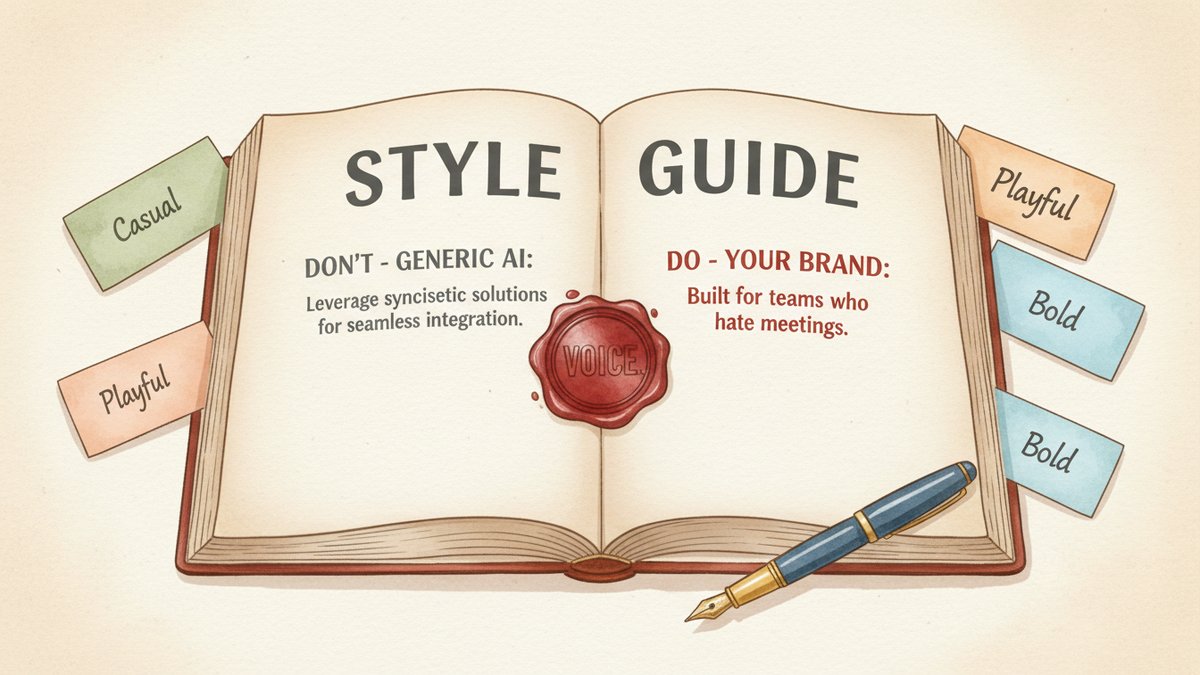
Do: "Built for teams who hate meetings. Use the time you save to do literally anything else." Don't: "An innovative productivity solution for the modern enterprise."
Five pairs is the floor. Ten is better. Cover your top content types: blog intros, product descriptions, social posts, support replies, sales emails. If your writers can recognize the "don't" as a typical AI output, you've got the right contrast.
Part 3: Vocabulary Rules
Three sub-lists:
Words we use. A short list of branded terms, product names, and signature phrases. "We say 'unifying your stack,' never 'integrating your tools.'" "We say 'founders,' never 'customers' or 'users.'" For a D2C brand, this might be the specific sensory words ("crisp," "melt-in," "clean finish") that show up across every product page.
Words we avoid. Industry jargon you actively reject. For a B2B brand targeting SMBs (small and medium businesses, 中小企业): "synergy," "leverage," "best-in-class," "robust," "seamless." For a premium brand: "cheap," "deal," "discount" — anything that signals low-trust positioning.
Phrases to translate. The legacy copy your legal team wrote 5 years ago that everyone is tired of. "Leverage synergistic solutions" → "make your tools work together." This is where most brand books fail — they keep the old phrases in the official doc but everyone knows no one actually says them. The AI style guide codifies the real translation.
Part 4: Audience Persona (Compressed)
Don't paste in your full 30-page persona document. Models can't reason across 30 pages of demographic data. A compressed 4-bullet version works better:
- Who they are: Marketing managers at 50-500 person companies, 5-15 years experience, drowning in tools
- What they fear: Wasting budget on channels that don't move the needle; looking dumb in front of the CMO
- What they secretly want: Permission to ignore the latest "shiny object" and just do their job
- What we should never do: Talk down to them, imply they're behind the times, use consultant-speak
This is enough for the model to calibrate its tone. Save the full persona doc for human writers.
Part 5: Custom Instructions / System Prompt Block
The last part is the operational version — the exact text you'd paste into ChatGPT's "Custom Instructions" field, Claude's "Project Instructions," or a custom GPT (ChatGPT's feature for building a specialized assistant trained on your own data and instructions) / Gemini Gems (Gemini's equivalent — a saved, personalized AI assistant) system prompt. It pulls parts 1-4 into a single block of plain text the model reads on every conversation.
A simplified version for a hypothetical fintech client might look like:
You are writing for [Brand], a consumer fintech targeting millennials who are skeptical of traditional finance advice. Our voice is 70% casual, 30% formal. We use contractions. We are playful but never at the reader's expense. We avoid the words "leverage," "robust," "seamless," and any phrase that sounds like a bank wrote it. We speak like a smart friend who happens to know a lot about money — never a financial advisor, never a parent. Before you finish any response, check: would a smart 28-year-old share this in a group chat? If no, rewrite.
That last sentence — "would a smart 28-year-old share this in a group chat" — is the kind of self-check the model can actually run. Vague goals like "be authentic" can't be checked; concrete questions can.
How to Extract Your Voice From Existing Content
The hardest part isn't writing the guide. It's figuring out what your voice actually is — especially if you don't have a documented style guide yet. Here's the process I use:
Step 1: Gather 10-20 pieces of content you're proud of. Blog posts, emails, sales decks, support tickets, social posts — anything where the writing felt like "us." The more variety the better.
Step 2: Run a voice audit with the model. Paste 3-5 examples into ChatGPT or Claude and ask:
Analyze the writing style of these samples. Identify: (1) the 3-5 most consistent voice patterns, (2) recurring sentence structures, (3) signature word choices, (4) what the writing is not doing. Output as a structured list.
You'll get a draft voice profile in 30 seconds. It won't be perfect, but it's a starting point.
Step 3: Compare AI default output to your voice. Ask the model to write a piece in your genre (say, a product launch email) without your style guide. Then write the same piece with the guide. The contrast reveals what's missing from the guide.
Step 4: Identify the gaps. Usually the gaps are in: humor (the model can't replicate your specific brand of humor unless you show it), specific vocabulary, and structural patterns (your intros always start with a question, your CTAs (calls to action, 行动召唤) always use second person).
Step 5: Iterate. Treat the style guide as a living document. Every time the model produces something that doesn't sound right, add the fix to the guide. Every time you manually rewrite an AI draft, save the rewrite and ask: "What would have prevented this rewrite?" The answer goes into the next version of the guide.
Operationalizing: Where to Load the Guide
A style guide that lives in a Google Doc is a style guide that gets used twice. Wire it into the tools your team actually uses:
- ChatGPT — Custom Instructions (Settings → Personalization) for personal use, or Custom GPTs for shared team use
- Claude — Project Instructions for shared contexts, with reference docs uploaded
- Gemini — Gems for persistent personalized assistants
- Notion AI / Coda / ClickUp — Most AI workspace tools now have a "voice" or "instructions" field. Set it once.
- Your CMS (Content Management System) — If you use Jasper, Copy.ai, or Writer.com, load the guide as the global brand voice. Every piece of AI copy in the system inherits it.
For a content team of 5+ people, build the guide as a shared Custom GPT or Project. Everyone's prompts pull from the same voice source, so a blog post by Alice and a sales email by Bob sound like they came from the same brand.
The One Mistake That Breaks Everything
The fastest way to wreck an AI style guide: no negative examples.
If you only show the model "good" examples, it averages them. The result drifts toward the generic mean — which is exactly what you're trying to avoid. The "don't" examples are the constraint that keeps the voice sharp. They're also the easiest part for stakeholders to agree on: nobody argues that "synergy" sounds corporate. Use that.
Build the guide with 5 do/don't pairs before you write a single "we are authentic" sentence. Your model — and your content — will thank you.
The 30-Minute Version
If you don't have a full workshop week, here's the fastest path to a working guide:
- Paste 3-5 of your best content pieces into ChatGPT. Ask for a voice analysis.
- Open the analysis and pick 3 voice dimensions with clear positions.
- Write 5 do/don't pairs using the exact same content for each pair.
- List 5 words you use, 5 words you avoid.
- Drop it all into your tool's custom instructions.
Thirty minutes, one page, and your AI output goes from "generic tech blog" to "obviously this brand." That's the work. It's not glamorous, but it's the difference between AI content that gets scrolled past and AI content that converts.