AI Search Is Eating Your SEO Traffic — Here's What Actually Works
Contents
Last month I was reviewing a client's Google Search Console data when I noticed something that stopped me cold.
Organic traffic from Google? Down 12% year-over-year. Rankings? Stable — actually, slightly up for most target keywords. Content output? Higher than ever, thanks to AI-assisted production.
So rankings were flat or up, but traffic was down. That used to be impossible. Now it's the new normal.
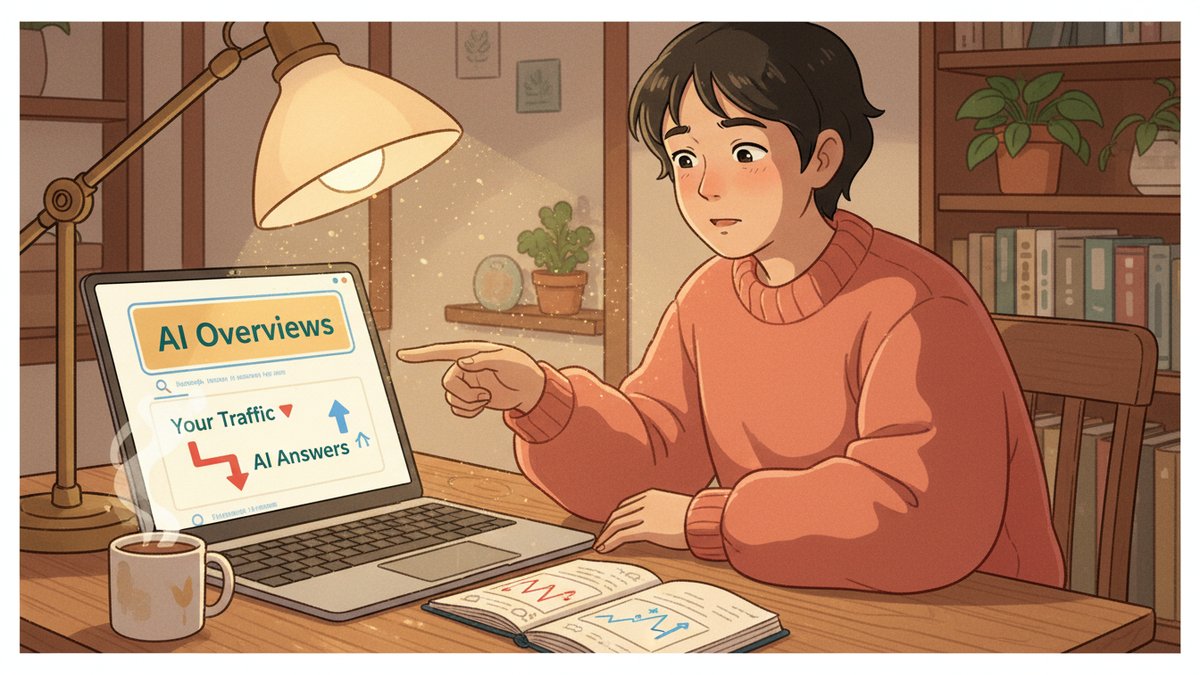
The missing traffic didn't vanish — it went somewhere else. It went to the AI-generated answer sitting at the top of the search results. It went to ChatGPT and Perplexity, where users asked questions and got answers without ever clicking a blue link. It went to Google's own AI Overviews, which answered the query before the user even scrolled down.
This isn't a prediction anymore. The traffic shift from traditional search to AI-powered discovery is happening right now. And most SEOs are still optimizing for a search experience that's disappearing.
The Traffic Shift in Numbers
Let's get concrete.
In 2024, Google rolled out AI Overviews to over 100 countries. By early 2025, research showed AI Overviews appearing in roughly 15% of all Google searches — and that number keeps climbing. When expanded, these AI summaries take up half the screen on both desktop and mobile. The user gets the answer without scrolling, let alone clicking.
Meanwhile, 60% of Google searches now end without a click. Not 60% of AI Overview queries — 60% of all Google searches. The zero-click trend that SEOs have talked about since featured snippets launched in 2014 has finally arrived, and AI Overviews are the accelerant.
Then there are the AI-native search engines. ChatGPT Search launched in late 2024. Perplexity, which handles hundreds of millions of queries monthly, released its own browser in 2025. SearchGPT — OpenAI's prototype — cites sources in 100% of responses, but those citations don't necessarily translate to clicks.
Research from SparkToro shows that even when AI search engines cite a source, the click-through rate is dramatically lower than traditional search — often below 1% for informational queries. Users are getting what they need from the AI-generated summary itself.
The math is straightforward: if 15–20% of Google searches show AI Overviews, and 60% of all searches are zero-click to begin with, then the addressable pool of clickable organic traffic is shrinking fast. Not slowly. Fast.
Three Ways AI Is Rewiring Search Traffic
It helps to think of this as three distinct forces working simultaneously.
1. Google AI Overviews: The Traffic Gatekeeper
AI Overviews don't just answer the question — they preemptively answer related questions the user hasn't even asked yet. It's an information wall that satisfies intent at the top of the SERP.
What this means in practice: for informational queries — the "what is," "how to," "why does" type searches that make up the bulk of most sites' organic traffic — Google is increasingly the destination, not the referral. Users get their answer and leave.
One study by Terakeet found that informational keywords drive roughly 70% of all organic traffic for the average B2B site. Those are exactly the queries AI Overviews are best at handling.
2. AI-Native Search Engines: A Parallel Ecosystem
ChatGPT, Perplexity, Claude, Grok, DeepSeek — these aren't search engines in the traditional sense. They're answer engines. Users type natural-language questions and get synthesized responses with citations.
Here's the thing: these platforms do send traffic. But not nearly at the volume Google does, and not through the same mechanisms. A citation in a ChatGPT response is like getting a Wikipedia reference — valuable for credibility, but not a reliable traffic driver.
The referral pattern is also different. Traditional Google traffic is intent-driven: someone searches "best running shoes," clicks your comparison article, and might buy. AI engine traffic is more scattered — users ask broader, more conversational questions, and the AI pulls from multiple sources to build an answer. Your page might be one of five citations, receiving a fraction of the attention.
3. Content Saturation from AI-Generated Content
This is the layer most people miss. AI doesn't just change how users search — it changes how content is produced. The barrier to creating "good enough" content has collapsed. Every niche is flooding with AI-generated articles, listicles, and guides.
Google's response has been to lean harder into its own AI answers. Why send users to dozens of similar AI-generated pages when it can synthesize the answer itself? The content saturation problem feeds directly into the AI Overview adoption — it gives Google a business reason to keep users on Google.
What Still Works (and What's Dying)
Let me be blunt about what I'm seeing in the data.
Dying:
- Thin informational content targeting head terms. If your article is "What is digital marketing?", AI Overviews will answer that before anyone sees your link.
- The "write 50 blog posts targeting long-tail informational queries" playbook. Volume of content doesn't compensate for collapsing click-through on those query types.
- Ranking #3–#5 for informational queries that trigger AI Overviews. Positions 1–2 still get some clicks. Below that? The AI box gobbles them up.
Still working:
- Transactional and commercial-intent queries. "Buy," "best," "vs," "review," "pricing" — these trigger AI Overviews less frequently, and users still need to visit sites to complete purchases.
- Original research and proprietary data. AI can't synthesize what doesn't exist. If you publish unique data, case studies, or surveys, you're building a moat that AI summaries can't replicate — and that they'll cite when they need authority.
- Branded search. People searching your brand name still click through. Invest in brand-building so more people search for you specifically.
- Deep expertise content. Articles that go beyond "what" and into "how I actually did this, here's what broke, here's what I changed" — AI can summarize facts, but it can't replicate lived experience convincingly.
A Practical Framework: Four Ways to Adapt
Here's what I'm actually doing for my own projects and recommending to clients.
1. Shift Content Strategy Toward Transactional + Commercial Intent
Audit your content inventory. What percentage targets informational vs. commercial vs. transactional intent? If you're like most sites, 70%+ of your content targets informational queries. That's the traffic most at risk.
Rebalance. For every 3 informational articles you planned, write 5 commercial-intent pieces instead. Comparison posts, best-of lists with real testing data, pricing guides, buyer's guides. These are queries where:
- AI Overviews are less aggressive
- Users have genuine intent to visit sites and take action
- The value per visit is higher
This doesn't mean abandon informational content entirely — it means stop treating it as your primary traffic engine.
2. Become a Source Worth Citing
AI engines cite sources. The question is: will they cite you?
I've been experimenting with this for about 8 months, and the pattern is clear: AI models cite content that demonstrates clear authority signals. Think:
- Original data with a named source ("According to a survey of 500 marketers by [Your Brand]...")
- Clear, unambiguous claims backed by specifics
- Structured content with explicit "according to" attribution patterns
- Content referenced by other authoritative sources (AI models weight cross-references)
One practical move: publish an original survey or data study in your niche. Package it with clear methodology notes, named researchers, and publication dates. AI models love citing primary sources — give them one.
3. Optimize for AI Overview Inclusion
This is different from traditional rank optimization. To get cited in AI Overviews specifically:
- Answer the question directly in the first 100 words. AI Overviews extract concise answers. If your article buries the answer in paragraph 5, it won't get pulled in.
- Use the exact question as an H2. "What is the best CRM for small businesses?" — make that an H2, then answer it immediately below.
- Structure content in Q&A format where natural. Not every article needs this, but for informational hubs, a FAQ section with direct answers gives AI scrapers exactly what they're looking for.
- Keep answers authoritative and citation-ready. Include data, name your sources, and make claims specific enough that an AI can confidently attribute them.
4. Diversify Traffic Sources Beyond Google
This is the hardest pill to swallow for SEOs who've spent 15 years optimizing for one search engine. But betting everything on Google organic traffic in 2026 is like betting everything on Facebook organic reach in 2016 — the platform's incentive is to keep users on-platform.
What diversification actually looks like:
- Build direct channels. Email list, community, push notifications. Own the relationship.
- Invest in YouTube and visual search. YouTube is the second-largest search engine, and Google surfaces video results prominently — often above AI Overviews.
- Monitor AI engine referrals. Check your analytics for traffic from
chatgpt.com,perplexity.ai, and other AI platforms. It's small now, but growing. Understanding what content gets referred will tell you what to produce more of. - Build a brand, not just content. Branded search is the last bastion of reliable organic traffic. When people search you, AI can't intercept the click.
One Honest Takeaway
I've been doing SEO for 15 years, and this is the fastest the landscape has shifted. But here's what I actually believe: this isn't the end of SEO. It's the end of lazy SEO.
The playbook of "find low-competition keywords → write decent content → rank → get traffic" is breaking down because the unit economics have changed. When AI can answer the question without sending traffic, the "low-competition keyword" strategy delivers low-value results — even when you rank #1.
What replaces it is harder but more defensible: build real expertise, publish original data, optimize for commercial intent, diversify your channels.
The SEOs who survive this shift aren't the ones fighting to get back into the blue links. They're the ones building brands that AI engines have to cite because nobody else has the information.
Start now. The traffic isn't coming back on its own.