From SEO to GEO: A Practical Guide to Generative Engine Optimization
Contents
A few weeks ago, I watched a friend research a purchase. She didn't open Google. She opened DeepSeek and typed: "I have a 3-meter-wide living room, budget 5000 yuan, which projector should I buy?"
The AI gave her a detailed recommendation with model comparisons, pros and cons, and citations to three review sites. She made a decision in 10 minutes. Never clicked a single blue link.
This is the shift that GEO — Generative Engine Optimization — is built for. And if you've spent years mastering traditional SEO, everything about it will feel a little wrong at first.
But the direction of travel is unmistakable. According to the 2025 Generative Search Adoption Report, brand visibility variance across AI platforms (ChatGPT, Claude, DeepSeek, Gemini) is 3.7 times higher than in traditional search rankings. That means two brands that rank similarly on Google can have wildly different visibility in AI-generated answers. Someone is getting cited. Someone is invisible.
This article explains what GEO and AEO actually are, how AI engines decide what to cite, and what you can do about it — from the perspective of someone who's been doing SEO for 15 years.
First, Let's Get the Terms Straight
The acronym soup around AI search optimization is already getting thick. Here's what each term actually means:
| Term | Full Name | What It Optimizes For |
|---|---|---|
| SEO | Search Engine Optimization | Ranking higher in traditional search engine results pages (SERPs) — Google, Bing |
| GEO | Generative Engine Optimization | Being cited and surfaced in AI-generated answers — ChatGPT, Perplexity, DeepSeek, Google AI Overviews |
| AEO | Answer Engine Optimization | Being the primary source for direct answers from AI assistants and voice search |
GEO and AEO are often used interchangeably, but there's a useful distinction: GEO is about being cited; AEO is about being the answer. GEO says "mention my brand in your response." AEO says "use my content as the definitive source for this answer."
For practical purposes, most marketers should focus on GEO first — getting cited is the prerequisite to becoming the answer.
Why Traditional SEO Logic Breaks Down with AI Engines
If you've done SEO for any length of time, your mental model is built around a specific mechanism: users type keywords → search engine crawls and indexes pages → algorithm ranks pages by relevance and authority → users click results.
AI engines don't work this way. Here's what's different:
There is no "ranking." AI engines don't produce an ordered list of 10 blue links. They synthesize an answer from multiple sources. Your content is either in the synthesis or it isn't — it's binary, not positional. There's no "position 3" in a ChatGPT response.
Keywords matter less; semantic entities matter more. Traditional SEO revolves around matching queries to keywords. AI engines use vector embeddings to match queries to meaning. They don't look for the page with the highest keyword density — they look for the content whose semantic profile best answers the intent.
Authority works differently. In traditional SEO, authority flows through links and domain reputation. In AI engines, authority comes from cross-verification: if multiple independent authoritative sources say the same thing, the AI treats it as established fact. Links help indirectly (they build the underlying authority graph), but the AI's citation decision happens at the semantic level, not the link-graph level.
Citation ≠ click. This is the hardest one for SEOs to accept. Getting cited in a ChatGPT answer is valuable for brand visibility and trust, but it doesn't reliably send traffic. The user may read your brand name in the AI's response without ever visiting your site. GEO success metrics are different from SEO success metrics.
How AI Engines Actually Choose What to Cite
To do GEO effectively, you need to understand — at least at a high level — how these engines work under the hood.
Most AI search engines use a architecture called RAG (Retrieval-Augmented Generation, 检索增强生成). Here's the simplified flow:
- User asks a question → converted into a high-dimensional vector embedding
- Retrieval step → the system searches its knowledge base (web index, curated sources, etc.) for the most semantically similar content
- Scoring and selection → retrieved passages are scored for relevance, authority, and freshness
- Generation step → the LLM synthesizes an answer from the top-scoring passages, with inline citations
The key insight for GEO: your content needs to survive both the retrieval step AND the scoring step. If your content isn't retrieved, it can't be cited. If it's retrieved but scores low on authority signals, it won't make the final cut.
Research from Princeton and Stanford HAI has identified several factors that correlate with higher citation rates in AI-generated answers:
- Evidence density — content with specific data points, logical connectors, and clear conclusions is recalled 72% more often than general descriptive text
- Source diversity — being cited by multiple different types of sources (academic, news, community) increases AI trust
- Structured clarity — content formatted with clear headings, direct answers, and explicit attribution patterns is easier for retrieval systems to parse
- Cross-reference weight — if your claim appears in independent authoritative sources, the AI treats it as "consensus fact"
The SEO → GEO Mindset Shift
Before we get to tactics, let's name the mental shift required, because it's significant:
| Old SEO Thinking | New GEO Thinking |
|---|---|
| "I need to rank #1 for this keyword" | "I need my content to be the source the AI cites for this topic" |
| "More backlinks = higher rankings" | "More authoritative cross-references = higher AI trust" |
| "Optimize the page for crawlers" | "Optimize the content for semantic retrieval" |
| "Measure success by clicks and rankings" | "Measure success by citation rate and brand mentions in AI answers" |
| "Content volume wins" | "Content authority and uniqueness wins" |
This isn't about abandoning SEO. It's about adding a parallel optimization layer for a parallel discovery channel.
Five Practical GEO Strategies
Here are the strategies I'm using and testing, ordered from easiest to most ambitious.
1. Structure Content for AI Extraction
The most immediate thing you can do: make your content easy for AI retrieval systems to parse and extract.
Specific techniques:
- Use the exact question as an H2, then answer it directly in the first paragraph below. AI scrapers love this pattern because it creates a clean Q&A pair for retrieval.
- Write "answer-first" content. Lead with the conclusion, then explain. Traditional SEO often builds up to the answer — GEO needs the answer upfront.
- Add an explicit "Key Takeaways" or "TL;DR" section at the top of important pages. This acts as a ready-made summary for AI extraction.
- Use structured data (Schema.org markup) — especially
FAQ,HowTo,Article, andOrganizationschemas. These give retrieval systems explicit signals about what your content contains. - Keep paragraphs focused. Each paragraph should convey one clear idea. AI retrieval systems chunk content into passages; a focused paragraph survives chunking better than a meandering one.
This isn't fundamentally different from good SEO content practice — but the bar is higher. AI retrieval punishes fluff more aggressively than Google's ranking algorithm does.
2. Build Authority Through Original Data
AI models are trained to prioritize content that contains specific, verifiable, unique information. Generic advice that echoes what everyone else says doesn't get cited.
The most reliable way to become citable: publish original data.
A survey of 500 customers in your industry. A benchmark report with named methodology. A case study with real numbers. A dataset published on GitHub or Kaggle.
Why this works: when an AI model encounters the same statistic cited across multiple sources, it treats that number as "consensus." But when your data is the only source for a specific finding, you become the primary citation — the origin. AI engines preferentially cite primary sources over secondary ones.
One concrete example: a B2B SaaS company I work with published a "State of [Industry] 2025" report with original survey data. Within three months, their data appeared in ChatGPT responses to industry questions — without any direct GEO work beyond publishing the report. The AI found it because it was the only source for that specific data.
3. Optimize Your Entity Footprint
This is where GEO departs most clearly from traditional SEO. Entity optimization is about making your brand recognizable as a distinct, authoritative entity in knowledge graphs and AI training data.
Practical steps:
- Claim and optimize your Wikidata entry. Wikidata is a foundational knowledge graph that many AI systems draw from. A complete, accurate Wikidata entry for your brand (with proper citations) signals entity legitimacy.
- Get listed in authoritative databases. Crunchbase for companies, Google Scholar for academic work, GitHub for open-source projects, industry association directories. Each listing is a corroborating signal.
- Maintain consistent NAP (Name, Address, Phone) across the web, but go further: consistent brand description, consistent founder attribution, consistent product categorization.
- Publish an
llms.txtfile on your domain — a relatively new standard (analogous torobots.txt) that tells AI crawlers which pages to index and how to understand your site's structure. While still emerging, major AI platforms are increasingly respecting this standard.
4. Create Content That Answers Questions AI Users Actually Ask
AI search queries look different from Google queries. Google users type keywords: "best CRM small business." AI users ask questions: "I run a 5-person consulting firm with no dedicated IT. What CRM should I use that won't take more than an afternoon to set up?"
The difference is specificity and context. AI queries are longer, more conversational, and more situation-specific.
How to target these:
- Mine AI platforms directly. Ask ChatGPT, Perplexity, and DeepSeek questions in your niche. See what sources they cite. Note the gap between what's cited and what you could produce that's better.
- Create "scenario-based" content. Instead of "Best CRM 2026," write "Best CRM for a 5-Person Consulting Firm with No IT Support." The more specific the scenario, the better it matches AI query patterns.
- Build content clusters around decision journeys. A user asking an AI for a recommendation is on a decision journey. Create content that covers each stage: problem recognition → option exploration → comparison → decision criteria → implementation.
5. Monitor and Iterate on Your AI Citation Rate
You can't optimize what you don't measure. GEO measurement is still nascent, but there are practical approaches:
- Manual spot-checking. Regularly ask major AI engines questions in your niche and record whether your brand appears. Do this monthly — it's time-consuming but currently the most reliable method.
- GEO monitoring tools. Platforms like Otterly, Profound, and AIclicks are emerging to track brand visibility across AI engines. They're early-stage but improving quickly.
- Referral traffic monitoring. Check your analytics for traffic from
chatgpt.com,perplexity.ai,deepseek.com, and similar domains. Numbers will be small but directional. - Brand mention tracking. Use traditional brand monitoring tools (Mention, Brand24) to catch when AI-generated content on third-party sites references your brand.
The cycle: measure → identify gaps → improve content → re-measure. Same as SEO, different metrics.
GEO and SEO: Complementary, Not Competitive
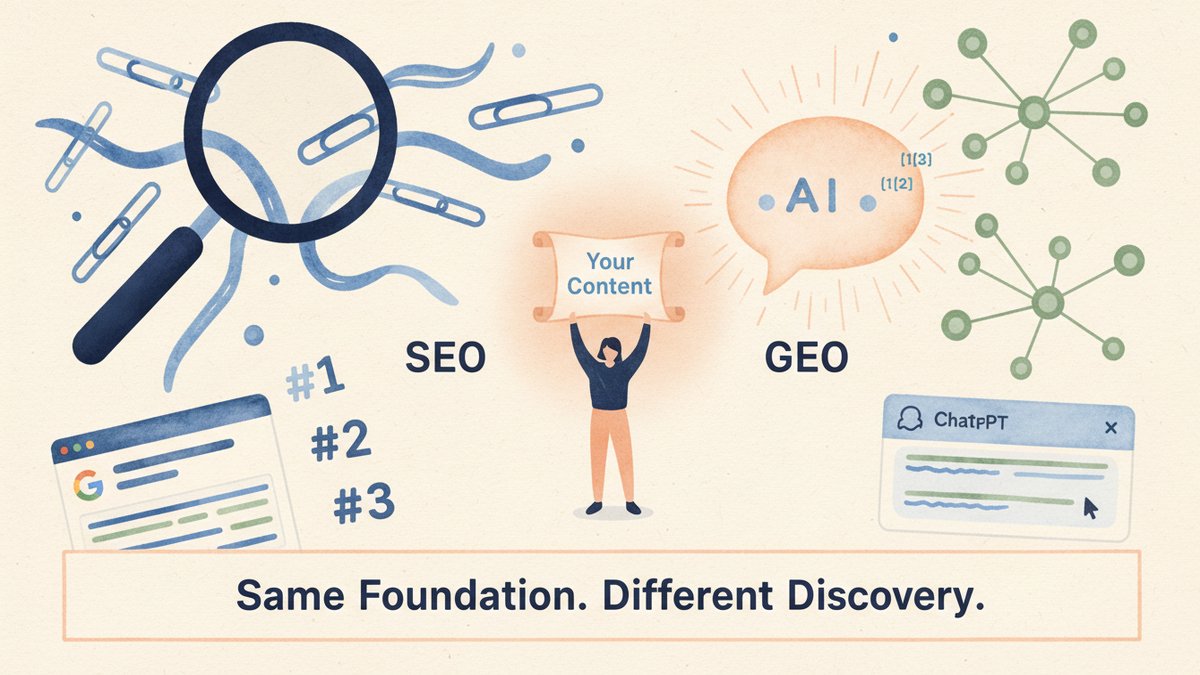
Here's the most important thing I can tell you: GEO doesn't replace SEO. It builds on it.
Everything that makes your site strong for traditional SEO — technical health, quality content, backlinks from reputable sources, clear site architecture — also improves your GEO foundation. AI retrieval systems crawl the same web. The authority signals that Google values also matter to AI engines, just through different mechanisms.
Think of it as two overlapping circles:
- SEO optimizes for search engine ranking algorithms
- GEO optimizes for AI answer generation algorithms
- Both benefit from: original expertise, clear content structure, authoritative backlinks, technical site quality
The practical implication: don't abandon your SEO work. Add GEO on top. When you're writing a new article, ask two questions instead of one: "Will this rank?" AND "Will an AI cite this?"
Where to Start
If you're doing zero GEO today, here's your 30-day starting plan:
Week 1: Audit your top 20 ranking pages. For each, check: does it answer the core question in the first 100 words? Is there original data or unique insight? Would an AI have a reason to cite this over a competitor?
Week 2: Pick 3-5 high-value pages and restructure them: question-based H2s, answer-first format, add specific data points and named sources.
Week 3: Publish one piece of original content — a mini-survey, a data analysis, a detailed case study. Something that doesn't exist anywhere else.
Week 4: Start manual GEO monitoring. Ask 5 AI engines 10 questions each about your niche. Record who gets cited. Set a baseline.
This isn't a massive undertaking. It's a shift in how you think about content. The technical infrastructure is the same; the creative direction is different.
The Bottom Line
I've been in SEO for 15 years. Every few years, someone declares "SEO is dead." It never is. But it does change — sometimes incrementally, sometimes in a lurch.
GEO represents a lurch. Not because Google is going away, but because a parallel discovery ecosystem is forming alongside it, and it operates on fundamentally different rules. The brands that figure out both systems — traditional search AND generative discovery — will capture attention in both places. The ones that optimize for only one will slowly become invisible in the other.
The good news: GEO is still early. Most brands aren't doing anything about it. The playbook isn't settled. There's real advantage to moving first.
Start by making your content citable. The traffic patterns will follow.