How AI Can Help You Do SEO — A Practical Guide from 15 Years of Experience
Contents
I've been doing SEO for 15 years. For the first 12, the fundamental playbook barely changed — keyword research, on-page optimization, backlinks. Then AI happened. The last 3 years have been more transformative than the previous 12 combined.
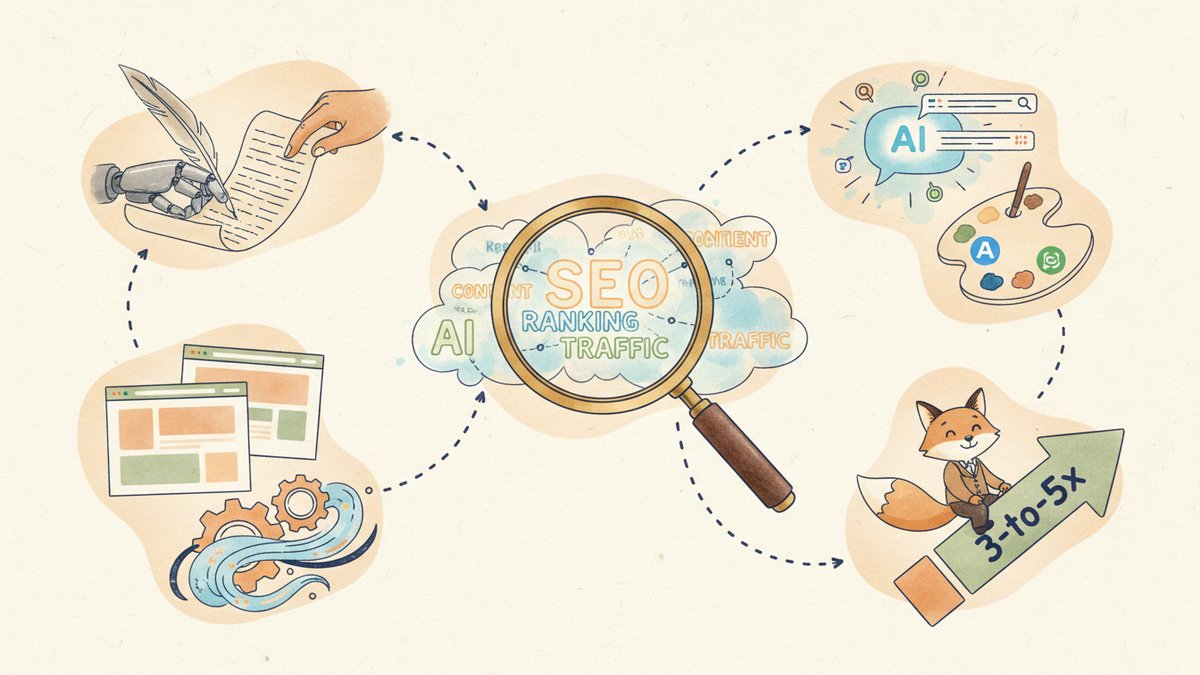
This isn't "AI is killing SEO" fear-mongering. This is about a simple truth: SEO professionals using AI are 3-5x more productive than those who aren't. I've measured this across my own team.
Here are 6 concrete ways AI transforms your SEO workflow. Real tools, real prompts — ready to use.
1. AI-Powered Keyword Research
Traditional keyword research is tedious. Open Ahrefs, manually sift through hundreds of results, rely on gut feeling to decide which keywords to target.
How AI helps:
Generate long-tail variations at scale. Feed ChatGPT a topic, ask for 30-50 long-tail variants categorized by search intent (informational, commercial, transactional). This takes 10 seconds versus 30 minutes of manual work.
Extract real user questions. Use AI to analyze Google's "People Also Ask" boxes and related searches, turning them into content ideas that match actual user queries.
Intent clustering. Dump a keyword list into AI and have it automatically group by search intent — making your content architecture clear in minutes.
Prompt I use:
Act as an SEO expert. For the topic [your topic], generate 20 long-tail keywords grouped by search intent: informational, commercial, transactional. Label each with estimated search volume (High/Medium/Low) and competition level.
Tool stack: ChatGPT/Claude + Ahrefs/SEMrush + Google Search Console. AI handles strategy, traditional tools validate the data.
2. AI-Assisted Content Writing (The Right Way)
Here's what most people get wrong: using AI to auto-generate articles and publish them directly is a penalty waiting to happen. Not because Google hates AI, but because the quality isn't there yet.
The correct approach: AI handles the time-consuming parts of the writing process, while you add the expertise and personality that only a human can provide.
My workflow:
My expertise → AI generates brief → I approve structure → AI writes first draft → I add personal cases, data, and unique insights → AI polishes titles and meta
The human is the decision-maker. AI is the executor. This order matters.
What AI does best in this process:
- Writing structured content briefs (saves 80% of planning time)
- Generating the first draft (that you'll heavily edit)
- Optimizing headlines for CTR based on data-backed reasoning
- Extracting FAQ Schema markup from your content
3. Competitor Analysis in 5 Minutes
Old way: manually find competitors → open each page → manually copy data → create comparison tables. This took 2+ hours per topic.
AI-powered approach:
Instantly analyze competitor content structure. Paste a competitor's article to AI. Get a breakdown: headline strategy, H2/H3 structure, image-to-text ratio, keyword density, internal linking patterns.
Content gap analysis. Ask AI to compare your article with the #1 ranking piece: "What does theirs cover that mine doesn't? What's their structural advantage?"
Keyword overlap analysis. Feed your domain + 3 competitors. AI identifies: keywords you share, keywords they rank for that you don't (your opportunities), keywords only you rank for (your strengths).
4. Technical SEO: Automate the Grunt Work
AI excels at repetitive technical tasks:
Schema generation. Tell AI your page type (article, product, FAQ, breadcrumb). It generates the exact JSON-LD you need.
404 and redirect audits. Export your 404 logs, feed them to AI for pattern analysis. Which URL types fail most? Where should they redirect?
SEO audit interpretation. Run Screaming Frog, dump the summary into AI, get a plain-language explanation: what's critical, what can wait, how to fix each issue.
Warning: Always test AI-generated code in staging before production.
5. The New Frontier: GEO (Generative Engine Optimization)
This might be the most important and most overlooked aspect. AI search traffic — through ChatGPT, Perplexity, Google Gemini — grew 527% in early 2025. This isn't a trend. It's a structural shift in how people discover information.
Core GEO strategies:
- Your content needs to be citable — include clear facts, data points, definitions, and step-by-step instructions
- Structured data is non-negotiable — FAQ, HowTo, and Article Schema help AI understand and reference your content
- Authority signals matter more than ever — author bios, cited sources, and data references
- Answer direct questions clearly — AI search prioritizes content that directly answers user queries
One sentence summary: Optimize for answers, not links.
6. My AI SEO Tool Stack
After 3 years of testing:
| Need | Tool | Why |
|---|---|---|
| Keyword research + rank tracking | Ahrefs | Most comprehensive database |
| Technical audit | Screaming Frog | The gold standard |
| AI writing | ChatGPT (paid) | Most stable for SEO workflows |
| Deep analysis | Claude | Best for long-form content analysis |
| On-page optimization | SurferSEO | High automation, saves time |
| GEO optimization | Keep exploring | This space moves too fast to lock in |
Don't over-buy tools. Start with ChatGPT + Ahrefs + Screaming Frog. Master those three first.
Two Landmines to Avoid
Landmine 1: Mass-publishing AI-generated articles. Quality is the only ranking factor that matters. My rule: at least 30% of every article must be your own experience, data, insights, or perspective. This is your moat.
Landmine 2: Thinking AI makes SEO automatic. The core competitive advantage in SEO was never the tools. It was always your understanding of your industry and your audience. AI amplifies that understanding — it doesn't replace it.
3 Things You Can Do Today
- Re-do your keyword research with AI. Take your current keyword list. Ask AI to find long-tail variants and group by intent. You'll be surprised how many opportunities you've been missing.
- Rewrite titles and meta descriptions for your top 3 articles using AI. Track CTR before and after. Let the data speak.
- Search your core keyword in ChatGPT or Perplexity. Does your brand or content appear? If not, it's time to think about GEO.
SEO isn't dead. It's just different. The gap between those who use AI and those who don't is widening every single day. Which side you're on is a choice.
Questions? Drop a comment.