Grok's Voice Agent Builder for Marketers: What to Delegate to a Talking Bot — and What to Keep Human
Contents
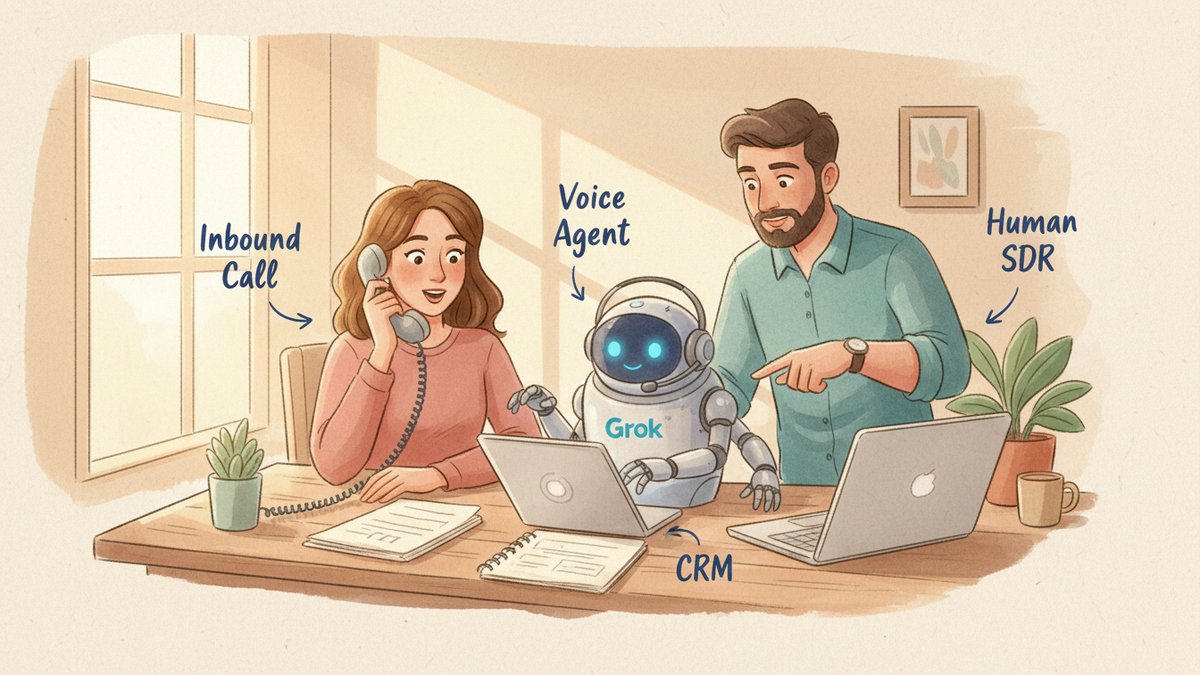
Friday morning, an SDR (Sales Development Representative, 销售开发代表) called in sick. By 10:15, my client's inbox had 47 unworked demo requests, the calendar looked like Swiss cheese, and the only person who could pick up the phone was the head of growth — who should have been closing the deal she was on. So I did the thing I would have called crazy in 2024: I wired a Grok voice agent to the same calendar, the same CRM, and the same "what we sell" page the human SDR used, and let it take inbound calls for four hours. By lunch it had qualified 31 of the 47, booked 22, and only handed back the 8 it could not resolve. The head of growth got to keep closing her deal. Nobody noticed which calls were which.
That gap — between "a chatbot that talks" and "an agent that takes a real action in your stack" — is what xAI's Grok Voice Agent actually changes for a marketing team. It is not a smarter TTS (text-to-speech, 语音合成). It is a WebSocket endpoint (a persistent real-time connection between your code and the model) that listens, talks, and calls your tools in the same session, with 100+ languages, seven built-in voices, and roughly 0.78 seconds before it speaks back. Underneath is a Grok 3 model trained for full-duplex (the model can listen and speak at the same time, just like a human in conversation — no need for separate speech-to-text then text-to-speech round trips). For marketers, that translates to a small set of jobs where it earns its keep this quarter, and a few where it absolutely should not be let near the customer.
What it actually is
The product is the Grok Voice Agent API, exposed at wss://api.x.ai/v1/realtime. It streams audio in both directions, runs server-side voice activity detection with three tunables (threshold, prefix_padding_ms, silence_duration_ms), and ships with web_search, x_search, file_search, and a @function_tool() hook so you can wire it into your own stack. For browser and mobile clients you mint short-lived "client secrets" instead of handing out the API key.
A few specifics that matter for marketing:
- Seven voices, named Eve, Ara, Leo, Sal, Rex, Mika, Valentin. Pick one per agent — don't synthesize a new one with each turn; it's tiring to listen to.
- 100+ languages with automatic mid-call switching. No separate "Spanish agent" to maintain.
- Pricing is transparent enough to budget against:
$0.05/minfor the voice session,$5.00 per 1,000tool calls,$2.50 per 1,000search calls. Add LiveKit (a deployment platform for real-time voice) on top and you land near$0.06/min. The 30-minute per-session cap and 100-concurrent-sessions-per-team ceiling matter for capacity planning. - Compatibility, not sameness. xAI is broadly OpenAI Realtime-compatible — events differ slightly (e.g.
response.text.deltavs OpenAI'sresponse.output_text.delta), so a port is not zero work.
The marketing-friendly version of all that: you build one WebSocket app, point two or three tools at it, and you have an inbound phone agent that does not sleep, does not call in sick, and costs roughly what one phone call costs on a metered long-distance plan.
The 5 jobs I'd hand a Grok voice agent this quarter
1. Inbound demo or lead-qualification calls. This is the obvious one, and the one I tested above. Wire it to the same calendar, CRM, and "what we sell" page the human SDR uses. Its wins are the boring wins: never missing a call, never sounding grumpy on a Friday at 5pm, asking the same qualifying questions in the same order. Hand it back to a human the moment the answer says "we're an enterprise procurement team."
2. Webinar and event re-engagement. Pull the no-show list from your CRM, give the agent a recap and one CTA, and let it call back within an hour of the missed session. The literature says re-contact within the first 60 minutes converts dramatically better than next-day email — humans don't make those calls because the volume is punishing.
3. NPS (Net Promoter Score, 净推荐值) and post-purchase surveys. Five-question surveys that nobody wants to read in an email; many people will talk for two minutes when a bot calls. Ship the transcript to your analytics team the same day.
4. Multilingual first-line support triage. The same deployment that answers English callers answers Mandarin, German, and Vietnamese callers, no queue, no "press 1 for English." It hands off to a human at a clear point.
5. Lifecycle resurrections for dead trials. ElevenLabs-style voice in your re-engagement emails is one part. A voice agent that calls the trial user, walks them back through the activation step, and books a follow-up if they're stuck is a much bigger part. Pair it with the lead-scoring sheet I built earlier and you have a closed loop.
The 3 I'd keep on a short leash
1. Anything that negotiates, discounts, or commits. A voice agent can be coerced. It will quote a discount that is not in the page. A human stays between the agent and any price conversation.
2. Anything dealing with distressed, regulated, or under-18 callers. Health, finance, minors. Don't. This is both an ethics line and a brand-risk line, and the failure mode looks the same in either case.
3. "Polishing" calls — collection, retention, cancel-saves. These need the human voice reading the room. A bot can save you headcount; it cannot save you from being the reason the customer cancels.
The line between give and don't is whether a customer's emotional state matters to the outcome. If it does — and it does in retention, in B2B (business-to-business) negotiation, in anything regulated — keep the human at the other end of the call.
A 90-minute no-code walkthrough
You can have something demoable in 90 minutes if you keep it boring.
- Create an xAI account and copy the API key. ($25 free credit to start.)
- Open LiveKit Cloud's free tier. Run
lk agent create --secrets-filewith a singleXAI_API_KEYline. - In one Python file, define a single
@function_tool()that takes a calendar URL and returns open slots. Connect the agent to your existing booking page URL and to your CRM's webhook (a URL your CRM exposes to receive real-time updates from other apps). - Pick one voice. Pick one script. Test with your own phone — five calls, every time.
- Add a "transfer to a human" branch that dials your cell when the agent encounters any of: pricing talk, refund talk, four consecutive "I don't understand" responses.
That is not production. But it is the part of production that proves whether the use case is real before you spend a quarter building it.
Where I land
The pattern that is genuinely new is "agent in the loop, not chatbot in the loop." The pattern that is genuinely overhyped is "the agent calls every customer you ever had." The right move is the same move I'd prescribe for ChatGPT Work two weeks ago: pick the job, not the tool. The Grok Voice Agent is the right tool for the boring half of your call volume — qualification, re-engagement, survey, multilingual first-line. It is the wrong tool for the half where the human voice is half the product. Just like the broader Grok vs ChatGPT vs Claude vs Gemini split, what wins here is choosing the model for the job — and the job here is "talk to a stranger without burning out my SDR."
The whole "0.78-second time-to-first-audio," 100-language figure, and OpenAI Realtime compatibility story all mean one thing: the bar for "a voice agent that is good enough to put on your website" dropped a lot this year. Marketers who treat that as a reason to fire humans are going to do the same thing every over-eager team has done at every capability jump — confuse "the technology is real" with "the technology is the strategy."