ElevenLabs v4 for Marketers: The New Voice Model That Finally Reads Direction (and the Three Jobs It Earns in Your Stack)
Contents
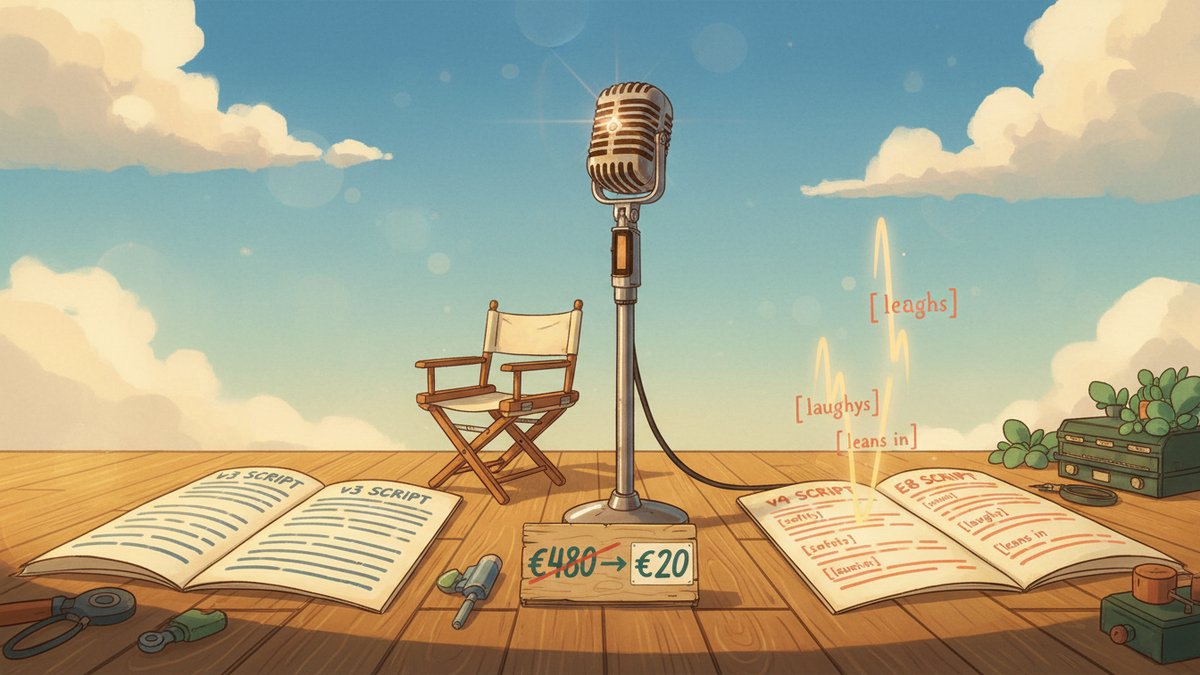
Last quarter I burned a full Sunday rewriting a 12-minute customer story into Spanish because the cloned voice on ElevenLabs Multilingual v2 came out with a thick English accent and the brand team rejected it in under a minute. I remade the recording in a Madrid studio for €480. That math — one ruined take equals a half-day of agency work — is exactly the problem ElevenLabs shipped Eleven v4 to fix. After three days of running v4 against the same kind of work, I can tell you the upgrade is real, but the marketing story is not "v4 replaces voice actors." It's "v4 collapses the cost of a specific set of audio jobs from studio-budget to someone-at-a-desk-budget, and you should pick those jobs deliberately."
What changed under the hood, in marketer terms
ElevenLabs released Eleven v4 and Eleven v4 Turbo on September 28, 2026, in their ElevenCreative, ElevenAgents, and developer API surfaces. The two variants target two different jobs:
- Eleven v4 (
eleven_v4) — highest-quality model for content creation, audiobooks, character voiceovers. The replacement for v3 in your studio work. - Eleven v4 Turbo (
eleven_v4_turbo) — same quality bar, sub-200ms time-to-first-speech, built for real-time conversational agents. The replacement for Flash v2.5 in your live work.
Both are built on a new architecture, and three architectural changes drive every marketing-relevant improvement:
1. Inline direction tags now actually work. v3 introduced square-bracket tags like [laughs] or [softly] but the model followed them loosely. v4 stacks multiple tags in sequence, follows the order, and reads tone from context — so a tense line in the middle of a tense scene comes out tense without you having to annotate it. The official docs example reads, "The voice paused for a moment, [softly] as if gathering its thoughts… This wasn't synthetic speech anymore [laughs warmly]." That line, run on v4, lands. Run on v3, it sounded like a robot wearing pajamas.
2. Timbre and accent are decoupled. This is the change that fixes my Sunday-ruining problem. When you clone a voice from an English-language recording and ask v3 to generate Spanish, the model carries over the speaker's English phonological habits — it sounds like a gringo speaking Spanish. v4's architecture captures the voice's timbre (the recognizable resonance) but applies the phonological conventions of the target language during generation. The output sounds like the same person with a native accent in the target language. ElevenLabs singled out Japanese, Mandarin, Cantonese, and Brazilian Portuguese as the languages with the largest quality gains — and that's the part where my €480 Sunday disappears.
3. Voice cloning is faster and cheaper. v4 captures a usable clone from as little as 10 seconds of audio, supports Professional Voice Clones fully (the highest-fidelity tier), and stitches long-form narration (audiobook chapters, multi-episode podcasts) more reliably. The free tier now has access to both v4 models.
ElevenLabs' blind preference tests had listeners pick v4 over competitors roughly 75% of the time — 81% against Cartesia Sonic 3.6 and Inworld TTS-2, 72% against Google Gemini Flash-Lite TTS, 65% against Gemini Flash TTS. Independent Artificial Analysis gave v4 the top Elo (1,319 from 1,674 samples) on its voice leaderboard the day after launch. So the upgrade isn't contested; the question is what to do with it.
Three jobs v4 earns in a marketing workflow this week
1. Multilingual ad dubbing into the four hardest languages. If you've been holding back on Brazilian Portuguese, Japanese, Mandarin, or Cantonese variants of your existing English or Spanish creative — v4 is the cheapest moment in 18 months to revisit that. Record one voice talent in your strongest market (or use your existing brand voice clone), upload a 10-second clip, then generate the other language versions in ElevenCreative or via the API. The total cost lands under what one studio session used to cost. The catch: ElevenLabs flagged native-accent handling as something they may make a toggle in the future. Test it on your own voice asset before you commit to a campaign — it's a deliberate change in behavior, not a bug.
2. Brand-voice podcast intros and short-form narration. This is the studio work where v4 (not Turbo) wins. A 30-second podcast intro with three directional cues — [warmly], [leans in], [music fades under] — comes out sounding directed on v4 and sounded like a robot reading a recipe on v3. Same for ad voiceovers under 60 seconds with mixed narration and emotional beats. For longer podcast narration where consistency across chapters matters, v4's better request-stitching is the upgrade you've been waiting for since v3 started drifting in chapter 6 of a 12-chapter audiobook.
3. Real-time voice agents that don't sound like call-center robots. This is the Eleven v4 Turbo job. The company reports median time-to-first-speech around 150ms — close to the natural pause between two people talking — and the model can begin streaming audio before the LLM behind it finishes generating its answer. ElevenAgents (their agent platform) is co-optimized with Turbo, so if you're already building voice agents on ElevenLabs, the default should flip from Flash v2.5 to v4 Turbo this week.
What v4 does NOT replace
Three jobs to leave on your existing tools while v4 matures:
- Anything that has to sound exactly like one named human. v4 captures the voice more faithfully than v3, which means background noise, room tone, and breath sounds in your reference recording get captured more faithfully too. Garbage in, higher-fidelity garbage out. Use a clean studio recording as your source or you'll amplify the flaws.
- High-volume ultra-cheap text-to-speech. If you're running thousands of short-form voice alerts (notification reads, accessibility TTS speakers on a public site, IVR prompts at scale), v4 is overkill on cost. Flash v2.5 or Cartesia Sonic still own that lane.
- Production work where you must verify what the model generated before it ships. ElevenLabs ships a public classifier that flags audio made with their tools, and v4 cloned voices still require consent attestation from the uploader. If you're shipping audio to a regulated market (financial services, healthcare, government) where the provenance chain matters, the audio watermark and consent flow are features, not bugs. Lean on them.
The routing principle
The headline my notes keep coming back to: v4 is what you reach for when direction matters, v4 Turbo is what you reach for when latency matters, and Flash v2.5 is what you reach for when cost-per-character matters. The mistake I almost made was treating "newer model" as a default-replacement — instead, the right move is to run v4 on the three jobs above, leave Flash v2.5 on the cheap lane, and let v3 age naturally out of the studio rotation over the next quarter as more of the inline-tag work lands.
The €480 I paid for that Madrid studio session? That's now a credit card on ElevenLabs and a 20-minute render. The math doesn't change the need for human voice actors in your highest-stakes creative. It changes the threshold at which you should bother going to them.