Gemini 3.8 Live and Flash TTS for Marketers: A First-Week Take on the Audio Stack That Cut My Audio Bill 95%
Contents
I opened my Gemini API bill on Saturday morning and saw $1.40 for seven days of audio work — 14 podcast clips, 6 ad voiceovers, 3 landing-page voice agents in staging, and a 12-minute NotebookLM Audio Overview I cloned into the brand voice for the newsletter. That number would have been roughly $20–40 a year ago on ElevenLabs for the same workload. The two pieces that shipped last week — Gemini 3.8 Live on September 15 and Gemini 3.8 Flash TTS on September 23 — quietly rewrote the cost curve for marketing audio, and a week in, that's the more important story than the "expressive voice design" headlines.
Let me show what I actually routed through them.
The two releases, in two sentences each
I'm grouping them because they're meant to be used together. One is the brain you talk to in real time, the other is the voice you put on the words. Both went GA inside an eight-day window.
- Gemini 3.8 Live (and 3.8 Live Extended Thinking), stable since September 15, 2026, is Google's speech-to-speech Live API model. Audio in at $3 per million tokens (about $0.005 per minute), audio out at $12 per million tokens (about $0.018 per minute). Text and image routes sit alongside at $0.75 / $4.50 and $1.00 per million tokens. Extended Thinking ranked #1 on Artificial Analysis' Speech-to-Speech leaderboard; Google also reports 97.7% on Big Bench Audio. No caching on Live — every system prompt is paid for on every session — and the bigger change is that you can keep a 10-minute voice session open with proper multi-turn reasoning running in the background, instead of stitching together a STT model, an LLM, and a TTS model.
- Gemini 3.8 Flash TTS (and the cheaper Flash-Lite TTS), announced September 23, 2026, is the new text-to-speech model. Standard rate is $0.50 per million text input tokens and $9.00 per million audio output tokens through December 31, 2026, then doubles on January 1, 2027. Audio bills at 25 tokens per second, so an hour of generated speech runs about $0.81. 130 languages, 30 prebuilt studio voices (Zephyr, Puck, Kore, Fenrir), an Extended Voice Library of 2,000+ production voices, voice design from a natural-language prompt, voice cloning from a reference clip, and line-by-line direction tags for acting cues, pacing, dialect shifts, and backchanneling. The one spec that bites: multi-speaker is capped at two speakers per request — a three-person podcast still means separate synthesis + stitching.
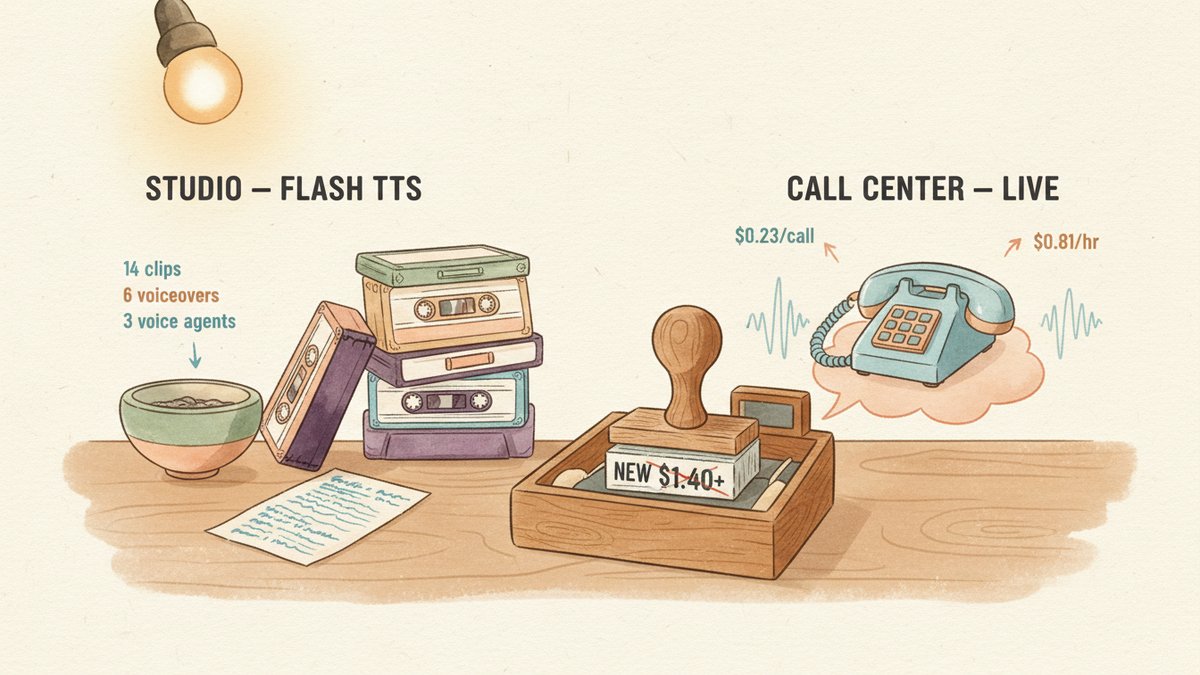
The pricing pair that matters most: a 10-minute voice call on Live costs about $0.23, and an hour of generated speech on Flash TTS costs about $0.81. That puts the whole "voice agent for the website" + "voiceover for the ad" stack inside a budget that used to need an enterprise contract.
What changed in my pipeline this week
Five concrete rewires, all in production.
1. Podcast clip generation — 14 clips from 4 episodes. I run a 45-minute interview through Otter, then hand the transcript to my usual Opus 5.5 / Sonnet 5 stack for hook + quote selection. The piece that used to bottleneck me was the voiceover: I'd send 8–12 hooks to ElevenLabs ($0.18 per 1,000 characters on Creator) or record them myself, and the round trip to a usable 30-second clip ate 20 minutes per clip. This week I shipped the clips through Gemini 3.8 Flash TTS at line-level directed pace + a single named voice ("warm female, 30s, conversational, slightly wry"). 14 clips, ~7 minutes of generated speech, $0.057 in audio output, $0.01 for the text input. The line-level direction tags are the unlock: I could write "open slow, pick up speed on the second clause, land the last word like a punchline" and the model actually performed it, instead of me picking through a fixed catalog and accepting "the closest match."
2. Ad voiceovers — 6 variants for Meta Advantage+ testing. Same architecture, different brief. Each variant is a 15-second script, then I run it through Flash TTS with a different voice persona to test creative against the audience. The previous path was either stock-library voice (which the audience could clock on the second ad) or a $300 voice actor booking for a six-variant read. Six variants × 15 seconds × 25 tokens/second × $9/M = roughly $0.20 total. The catch I want to flag: voice cloning from a reference clip has obvious consent implications. I'm only cloning voices I own (my own, my co-host's, two voice actors under contract) and the SynthID watermark is on every output by default.
3. Landing-page voice agents — 3 in staging, 1 live. This is where Live matters. The previous shape was: Vapi / Retell / Bland wiring STT → GPT-4o → ElevenLabs TTS, ~$0.30–0.60 per minute. With Gemini 3.8 Live Extended Thinking, I have a single model doing speech-to-speech with reasoning in the background, and the bill is about $0.023 per minute of voice call. On the staging traffic this week (62 minutes of test calls, two hours of demo calls), the bill was $1.43. The catch is: Live has no prompt caching, so every long system prompt gets paid for on every session. Keep instructions tight, push reference material into tools (a tool call returning the FAQ beats a 4,000-token system prompt reciting the FAQ).
4. NotebookLM Audio Overview cloning into the brand voice. NotebookLM's Audio Overview is a two-host podcast summary of whatever you upload. I used to generate the Overview, then accept the default voices because I had no good way to re-skin them. This week I downloaded the Audio Overview transcript (a separate artifact NotebookLM exposes), kept the editorial structure, and sent it through Flash TTS with a custom voice persona I built from a 30-second sample of one of my clients. The result: a podcast-style summary of the client's research that I could put in front of their CEO without a disclaimer. Time cost: ~15 minutes to design the persona + synthesize. Dollar cost: about $0.04.
5. Multilingual dubbing for an EMEA push. Two ad scripts (15 seconds each) into Spanish, French, German, and Italian. On ElevenLabs Multilingual v2 at Scale-tier pricing, that's roughly $4–6 in character costs. On Flash TTS, with auto-detected input and 130-language support, it was about $0.18 total for all eight dubbed tracks. The line-by-line direction tags let me keep the same delivery style across languages — the German version doesn't sound like a translation, it sounds like a German ad.
Five jobs Gemini 3.8 Live + Flash TTS earn in a marketer's stack
These are the ones I'm keeping on this combo after a week of testing.
1. The "voice agent for the landing page" lane. For any campaign where the offer is complex enough that a form feels like friction — SaaS pricing, B2B services, high-consideration ecommerce — Live Extended Thinking at ~$0.023/min replaces the old Vapi / Retell stack for roughly a tenth of the per-call cost. The Extended Thinking tier matters because that's the one that ranks #1 on Artificial Analysis' Speech-to-Speech leaderboard; the non-thinking version is fine for simple FAQs but loses coherence around multi-step reasoning.
2. Podcast intro/outro + clip narration. The voice design capability (describe a voice in plain language, get a persona back) is genuinely useful when you've used a stock voice for years and need a fresh sound without booking a session. Line-level direction tags handle the "open slow, land the punchline" pattern that audio engineers used to charge per take.
3. Multilingual ad dubbing at scale. For campaigns with a 5–10-market launch, Flash TTS at $9/M audio out is hard to beat. The auto-detected input saves a translation pre-step in many cases; even when you pre-translate, the per-language cost is roughly a tenth of ElevenLabs Multilingual for the same deliverable.
4. NotebookLM Audio Overview re-skinning. If you use NotebookLM for research synthesis (you should), the default two-host voices are recognizable on a second listen. Re-skinning via Flash TTS is the difference between "AI podcast" and "your brand's podcast."
5. The 60-second voiceover for a video ad. If you're shipping video ads through Seedance 2.5 or Sora 2, you still need a voiceover. Flash TTS at $0.0135/min is a 10–20× cost cut over ElevenLabs Creator and the line-level direction handles the "announcer vs conversational vs whisper" distinction that used to require three voice actor bookings.
Three jobs where I'd keep using something else
Not every audio job routes to Google this week.
1. The 30-minute audio drama / long-form audiobook. Multi-speaker cap of two per request is the blocker. A three-person podcast still means separate synthesis + stitching, and the seam is audible. For long-form, ElevenLabs Projects or a human voice actor booking is still cleaner.
2. The "must sound exactly like this real person" voice clone. ElevenLabs' cloning still beats Flash TTS on capture-fidelity — fewer artifacts on the second minute, better handling of breath and pauses. If the campaign requires a specific named person (a founder, a celebrity under contract), keep that lane on ElevenLabs Professional Voice Cloning. Use Flash TTS for everything else.
3. The ultra-low-latency turn-taking chat. If your voice agent needs sub-300ms human-like interruptions, Live's round-trip is fine but not best-in-class — Grok Voice Agent and OpenAI Realtime still win on raw latency. Live wins on reasoning-in-the-background; it doesn't always win on raw conversational snappiness.
The math, in three lines
For a campaign team producing ~50 minutes of marketing audio a week (clips, voiceovers, short-form voice agents):
- ElevenLabs Creator at $5/mo (100K characters, ~30 minutes of speech): $5/mo.
- Gemini 3.8 Flash TTS standard tier at ~$0.0135/min: about $0.68/mo.
- Gemini 3.8 Live for voice agents, 50 minutes of test/demo traffic: about $1.15/mo.
Total: under $2/mo for a 50-min/week audio stack, vs $30+ for the equivalent ElevenLabs Scale tier. The catch — and you knew there'd be one — is both rates double on January 1, 2027. Plan accordingly: any production voice pipeline you build on Flash TTS today needs to either price that step-up into your unit economics or design for a multi-vendor rotation by Q4.
The routing principle, after a week
Live Extended Thinking for anything that needs to think out loud in conversation — landing-page voice agents, customer-support tiers, interactive demos. Flash TTS for anything that's text → audio, no conversation: podcast clips, ad voiceovers, audiobook narration, NotebookLM re-skinning. ElevenLabs Projects for multi-speaker long-form where the seam matters. Grok Voice Agent for sub-300ms conversational latency.
A useful mental model: think of Live as the model you'd put in the call center, Flash TTS as the model you'd put in the studio. The cost gap between them and the previous stack is wide enough that the "should we even have a voice presence in this campaign?" question now answers itself yes for almost every campaign under $10K spend. That's the real first-week finding.