NotebookLM Audio Overviews: QA Your Drafts By Listening Back
Contents
Last month I caught three bad transitions in a 1,200-word post I'd already proofread twice. The trick? I had two AI hosts read it back to me.
NotebookLM's Audio Overview — the free Google tool that turns documents into a fake podcast between two AI voices — is mostly marketed as a research aid. Drop in 50 PDFs, get a 10-minute summary. Useful. But the use case I keep coming back to is smaller and weirder: I paste my own draft in, generate the audio, and listen to it like a stranger would.
Why listening back works when re-reading doesn't
When you re-read your own writing, your brain auto-fills the gaps. It knows what you meant, so the awkward phrasing at the start of paragraph three looks fine. The claim that doesn't quite land reads as plausible. The transition you never actually wrote still feels present.
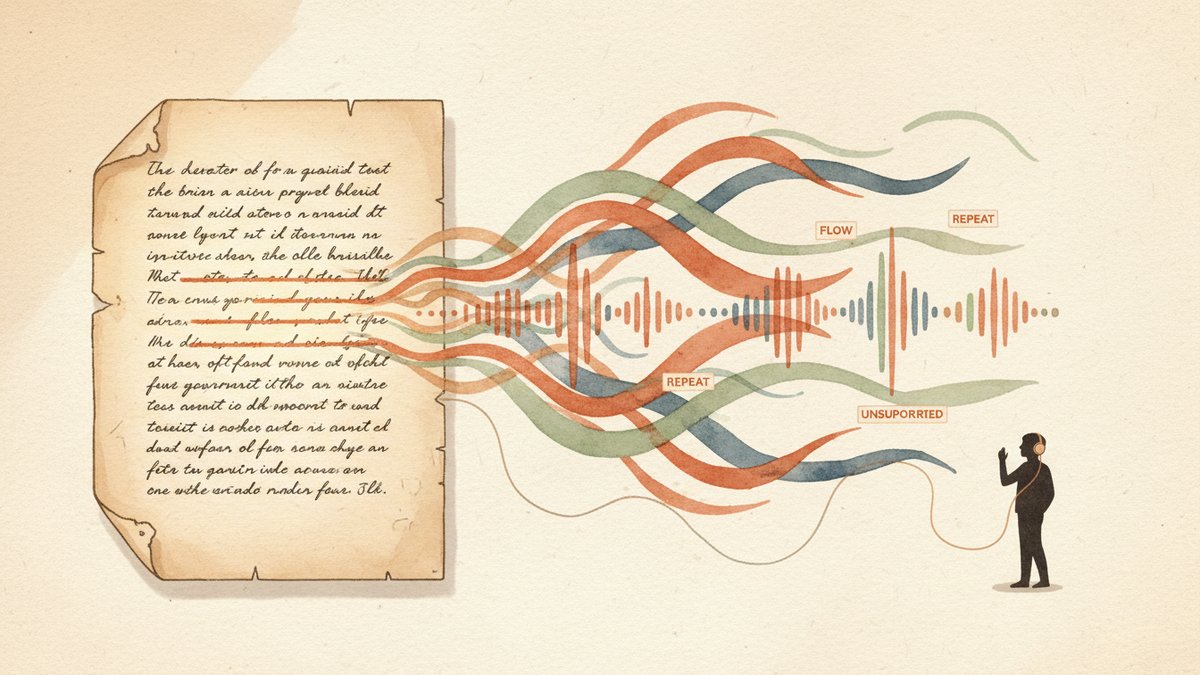
A different voice strips all that out. If the AI hosts hesitate, repeat themselves, or skip past a line without summarizing it, that's a real problem in your draft — not a model quirk. Reading silently is forgiving. Listening is not.
The 4-step loop I run before I hit publish
- Paste the draft in as a single source. Markdown, Google Doc, plain text — it all works. No need to add the supporting research.
- Use the Customize prompt. Before you click Generate, tell the hosts what kind of post this is ("a 1,200-word B2B SEO tutorial") and what to focus on ("explain the methodology, flag any claims you can't back up from the source"). This keeps the audio on topic and turns the hosts into a soft critic.
- Listen once at 1x, once at 1.5x. The first pass, take notes on the moments your attention drifts — that's where the writing is weak. The second pass catches structural problems: sections the hosts skip, claims they don't connect, transitions they stumble over.
- Stop the audio when you wince. Every time I think "ugh, that sounds bad" or "wait, they didn't actually say that," I drop a timestamp in a note. After the listen, I have an edit list of 5–10 specific problems I never would have caught on a re-read.
What to watch out for
- The hosts will sometimes invent context not in your draft. That's useful, not annoying — it usually means the draft left a gap. If they pull in something that isn't there, write the actual sentence.
- The audio lies about length. A 1,500-word post becomes an 8-minute overview. Stuff gets skipped. Don't take the omission as a verdict, but notice what they chose to skip.
- It only works on full drafts. Half-written posts make for incoherent audio and you'll get distracted by the hallucinations.
I used to think editing was mostly about catching typos. It's more about finding the parts where I got lazy — where I assumed the reader already knew what I meant. Listening to my own draft as if someone else wrote it is the fastest way I've found to spot those.
It's free. It takes 6 minutes. You don't even have to ship the audio. The only output that matters is the edit list.