Repurpose One Pillar Post Into 12 LinkedIn/Twitter/IG Posts (Without Sounding Robotic)
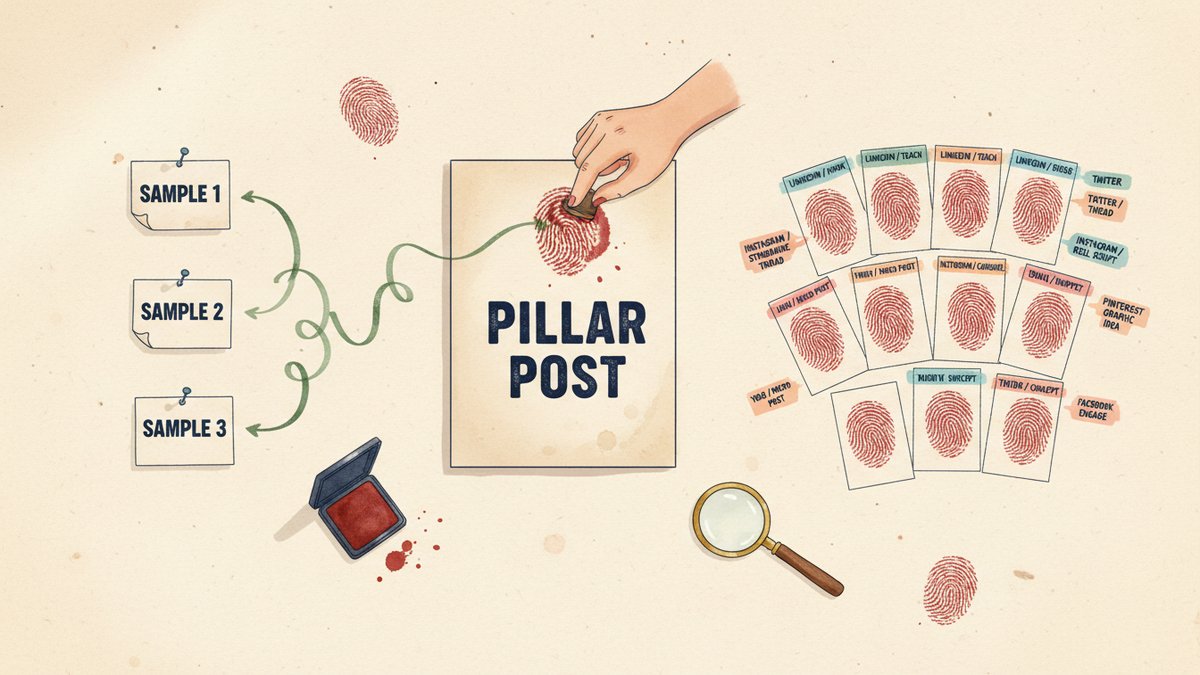
Last Tuesday I turned a 2,400-word piece on AI marketing funnels into 12 platform-native posts in 40 minutes. None of them read like a corporate ghostwriter. The trick wasn't a clever prompt. It was pasting three of my own best posts into Claude before I asked for a single repurposed line.
If you've been generating social posts with AI, you already know the failure mode. The output is technically correct. The hook is reasonable. The structure is fine. And yet the post sounds like a man wearing a rented suit — cuffs too long, shoulders slightly off, no one would mistake it for him. The reason isn't the model. It's that you gave the model a job description and asked it to play you. Models don't know how you write. They only know how the average blog post sounds.
Here's the workflow I've settled on after about 18 months of doing this for B2B SaaS (Software as a Service, 软件即服务) clients and my own brand.
Step 1: Feed the model 3 of your real posts — not a brand voice doc
A "brand voice document" is what committees write. Models learn tone from examples, not adjectives. Open the last 30 days of your content and pick the three posts that got the most reaction (comments, saves, replies). For each, paste the full text, then add a one-line note about why it worked. Example:
POST 1 (LinkedIn, 14 saves, 6 comments):

NOTE: opened with a contrarian claim, ended with a single direct question

POST 2 (Twitter thread, 4K impressions):

NOTE: short sentences, no headers, lots of line breaks
Three is the sweet spot. Two isn't enough signal. Four and the model starts averaging the voices and you lose the edge.
Step 2: The voice-preservation prompt
This is the layer that does the actual work. Paste the three examples, then run this prompt:
You are repurposing my pillar post for social channels. Your job is to extract
the structure, not rewrite the words. The three posts below are my real voice.
Treat them as the source of truth for: sentence length, punctuation habits,
whether I use questions, how I open, how I close, and which words I overuse.

Read them twice. Then for each new output, imitate that voice — do not
"improve" it, do not add corporate hedges, do not explain anything I wouldn't
explain. If the source voice uses sentence fragments, use sentence fragments.
If it avoids hashtags, you avoid hashtags. If it swears once, it swears once.

Here are the three voice samples:
[PASTE HERE]

Here is the pillar post:
[PASTE HERE]

Now generate 12 platform-native posts, 4 per platform
(LinkedIn / Twitter / Instagram), labeled clearly. For each output include:
- PLATFORM: ...
- INTENT: (this post hooks / teaches / collects examples / starts a debate)
- WHY THIS FORMAT FITS: one sentence on why this angle works for this platform
The two specific phrases that do most of the work are "extract the structure, not rewrite the words" and "do not improve it." Without them, the model defaults to smoothing out your rough edges — which is the exact thing that makes output sound like AI.
Step 3: A real before/after
Same pillar paragraph, two outputs.
Source: "Most AI content fails because it tries to be helpful at the wrong scale. A 2,000-word post that gets read in 4 minutes isn't a content problem, it's a packaging problem."
Without voice-preservation (typical AI rewrite): "Many marketers struggle with content engagement. The key is to understand that the issue isn't necessarily the content itself, but rather how it's presented to the audience."
With voice-preservation (my actual output, lightly edited): "The reason your long post isn't working isn't the writing. It's that you're treating a tweet like a memoir. Cut by 80%. Keep the part that made you write it."
The second one reads like a person. The first reads like a brochure. Same idea, two completely different registers.
Step 4: The 12-post map
The prompt asks for 12 because the structure forces variety. My default split is:
- 4 LinkedIn — one contrarian hook, one story-led, one list-format, one question-led
- 4 Twitter/X — one standalone, one short thread (3-5 posts), one quote-tweet style, one reply-bait
- 4 Instagram — one carousel caption, one Reel script (15-30s), one story poll prompt, one "save this" carousel
The intent label matters more than the platform label. "Hook" posts and "teach" posts need completely different openings. Tagging them at generation time means you don't accidentally publish four hooks in a row.
Step 5: The 90-second human review
The model isn't the writer. You are. Before any post goes out, I run this checklist:
- Would I send this in a DM to a peer? If not, rewrite the opening.
- Does the first sentence make me (the author) sound like a person with a specific point of view, or a brand? If brand, rewrite.
- Did I delete at least one sentence? The model over-explains. Always cut.
- Is the "why this format fits" reason actually true, or did the model just make something up? Drop the made-up ones.
That last one is the part most people skip. Models will confidently invent reasons a post should be a thread. Read the reason, not the post.
The honest limit
This works for thought leadership, tactical how-tos, and opinion. It does not work for news cycles, product launches with embargo dates, or anything where speed matters more than voice. If you're breaking news, write the post yourself in 90 seconds — the model is the wrong tool.
And one thing to be careful of: if you paste three of your own posts into a third-party model, you are sending your unreleased voice into someone else's training pipeline. For client work, I run this on Claude with a project-scoped context, never on the public ChatGPT free tier. The prompt is reusable. Your voice is not.