GPT Live Dropped This Week. Here's What the Voice Model Shift Actually Means for Marketers.
Contents
I spent twenty minutes on a walk yesterday talking to the new ChatGPT voice mode. Not testing it systematically — just talking, the way you'd call a colleague. I interrupted it mid-sentence three times. It paused, recalibrated, and continued without missing a beat. At one point I went quiet for maybe forty seconds while crossing a street, and it just… waited. Didn't fill the silence. When I started talking again, it picked up right where we'd left off.
That doesn't sound dramatic. But if you've used the old Advanced Voice Mode — the one that cut you off when you paused to think, jumped in too early, and felt like a walkie-talkie with a PhD — you know why silence that listens is a bigger deal than a faster response time.
On July 8, OpenAI shipped GPT-Live and made it the default voice experience for ChatGPT. There are two models — GPT-Live-1 for paid tiers and GPT-Live-1 mini for free users — plus higher-compute variants (Medium, High) that delegate to the heavier GPT-5.5 Thinking models. The old three-stage pipeline — transcribe speech to text, run the LLM, convert text back to speech — is gone. In its place is a single full-duplex model that makes hundreds of decisions per second: speak now, keep listening, pause, handle an interruption, call a tool.
For marketers, this matters in a specific way. Not because it's "the future of everything." Because voice just crossed a threshold from demo-impressive to channel-viable. And when a channel becomes viable, someone needs to figure out what actually works on it.
What actually changed under the hood
Three things, and they're all connected.
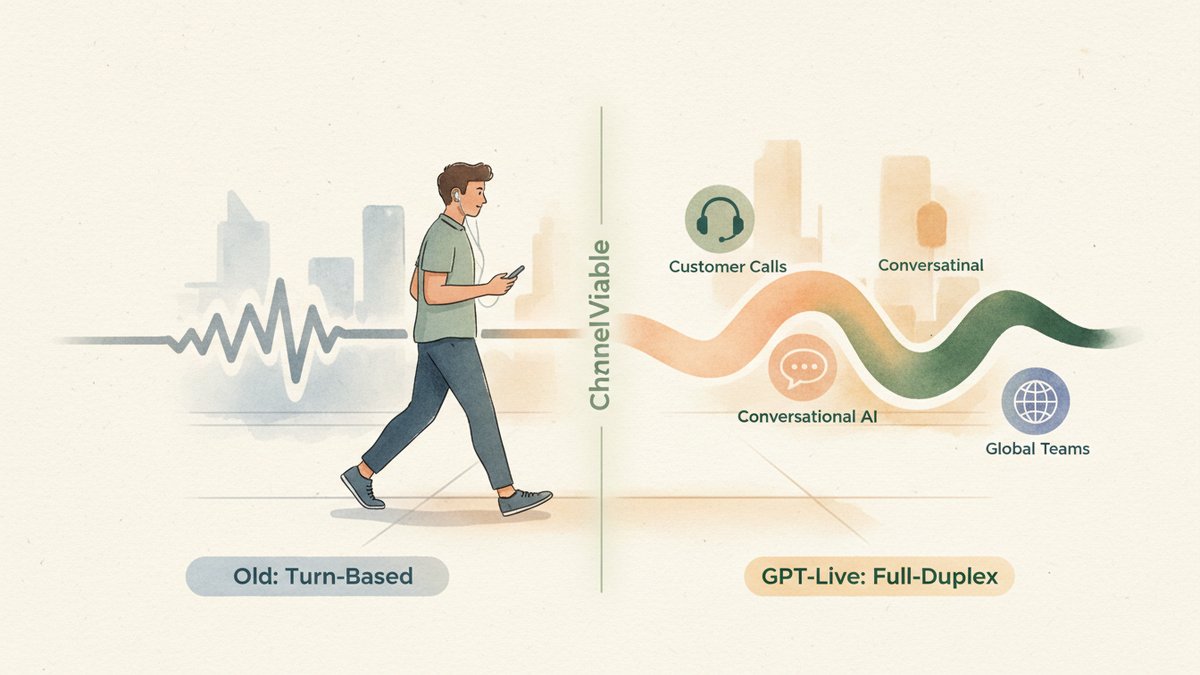
Full-duplex, not turn-based. The old voice mode waited for you to finish a clear turn, then responded. GPT-Live listens and speaks simultaneously — like a human on a phone call. It tracks pauses, interruptions, and pacing changes in real time, and decides on its own whether to jump in or stay quiet. OpenAI's evaluations put it against the previous Advanced Voice Mode in 5–10 minute paired conversations, and GPT-Live won on flow, turn-taking, interruption handling, and overall preference. Not by a little — it was consistently preferred.
Delegation to GPT-5.5 for the hard stuff. The voice model handles conversation flow; when a question needs real reasoning, web search, or agent-like work, it hands off to GPT-5.5 in the background. The pairing looks like this:
| Voice Model | Backend Reasoning |
|---|---|
| GPT-Live-1 / GPT-Live-1 mini | GPT-5.5 Instant |
| GPT-Live-1 Medium | GPT-5.5 Thinking Medium |
| GPT-Live-1 High | GPT-5.5 Thinking High |
This split means the voice model stays light and fast, while complex queries — the kind a customer actually asks when they're stuck — get routed to a model that can handle them. From a product design standpoint, this is the right call. From a marketer's standpoint, it means a voice agent can get smarter mid-conversation without the user noticing a handoff.
150 million people already talk to ChatGPT weekly. That number came out alongside the launch, and it changes the calculus. This isn't a lab toy looking for a use case. It's a platform upgrade landing on an already-massive voice user base. When you push a full-duplex model to 150 million weekly voice users, you learn things about voice behavior that no beta program could surface.
The marketer's framework: three jobs GPT Live is ready for, two it's not
I'm going to skip the "voice will revolutionize everything" take and give you something narrower. Here's what I'd actually use it for — and what I'd keep in text for now.
Ready: high-touch customer conversations that need a human feel
A customer calls about a delayed order. They're frustrated but not furious. The best human agent would listen, acknowledge the emotion, pull up the order, and give a clear next step — all while making the customer feel heard. The old voice bot would have transcribed, waited, generated, and spoken back with a 2-second lag that killed the rhythm.
GPT-Live can do this today: listen continuously, pick up on tone shifts, pull order data via GPT-5.5 delegation, and respond in real time. Not perfectly — but well enough that the interaction doesn't feel broken. For high-consideration purchases (travel bookings, insurance queries, B2B onboarding calls), this crosses a real threshold.
One caveat from the safety report that's worth knowing: GPT-Live-1 showed a slight dip in "emotional reliance" scores compared to the old voice mode (0.88 → 0.82, not statistically significant but directionally interesting). Translation: the model is good enough at sounding human that your guardrails matter. Don't let it run unbranded, unsupervised customer conversations just because the voice sounds warm.
Ready: real-time language assistance for global marketing teams
GPT-Live demoed live Hindi translation. It wasn't perfect — reviewers noted an American accent and overly formal tone — but real-time translation inside a voice conversation is a fundamentally different product from "type text, get translation, read it aloud." Your Mandarin-speaking team member joins a call, asks a question in Chinese, and the model translates and responds without breaking the conversational rhythm.
For distributed marketing teams running campaigns across markets, this is immediately useful. Not as a replacement for native-language copywriting — it's not there yet — but for internal coordination, customer interviews, and quick market checks. Think of it as the voice equivalent of Google Translate graduating from phrasebook-useful to conversation-useful.
Ready: voice-first micro-interactions that replace forms
The low-hanging fruit nobody talks about: short voice interactions that replace a 7-field form. "What's your order number?" → customer says it → system looks it up → "Your package is at the Shenzhen sorting center, estimated delivery Thursday. Want me to text you the tracking link?" That's 15 seconds. The equivalent web form + email response is 3 minutes and a tab you'll forget to check.
These micro-interactions have been technically possible for years. What GPT-Live changes is the naturalness of the turn-taking — the part where the customer hesitates, corrects themselves, or asks a follow-up. The old pipeline models handled structured exchanges fine; they fell apart on the unstructured edges. GPT-Live handles the edges better, and the edges are where real conversations live.
Not ready: replacing your brand's written voice
Voice warmth does not equal brand voice. GPT-Live sounds human, but it sounds like a generic human — polite, helpful, accent-neutral. If your brand voice is sharp, opinionated, or deliberately informal, GPT-Live will sand it down to default-courteous. OpenAI explicitly said this isn't positioned as an "AI companion" product — which means personality and tone customization are not the priority right now. For marketing content that needs your specific voice (ad copy, social, editorial), text models still beat it.
Not ready: complex multi-step transactions with compliance requirements
GPT-Live is constrained by design. It doesn't have independent tool access or code execution — it delegates to GPT-5.5 for that. OpenAI's safety framework explicitly notes this as a deliberate limitation. For a simple order lookup, that's fine. For a mortgage pre-qualification call that needs to pull credit data, verify identity across three systems, and log every step for compliance — the delegation chain introduces too many points of failure. Keep those in text or structured chat, where every exchange leaves an audit trail.
The bigger picture
OpenAI's product lead said the long-term bet is "voice becoming the primary computing interface for complex, long-running agent tasks." That's the vision. Today's reality is narrower but more actionable: voice just got good enough at the basic mechanics of conversation — listening, waiting, not interrupting — that you can build real customer experiences on it without apologizing for the latency.
If you're on the marketing side, the move this week isn't "build a GPT-Live voice agent." It's simpler: use it yourself for a few days. Have real conversations with it while walking, driving, cooking. Notice what flows and what doesn't. The patterns you find in your own usage are the same patterns your customers will experience on your voice channel six months from now.
Voice crossed a threshold this week. The spec sheet hasn't changed — latency numbers, language lists, those will come later. What changed is the experience of talking to the thing and forgetting, for minutes at a stretch, that it isn't a person. That's the bar. It just cleared it.