Google Will Label AI-Made Ads — If You Admit It. Here's the Marketer's Early Read.
Contents
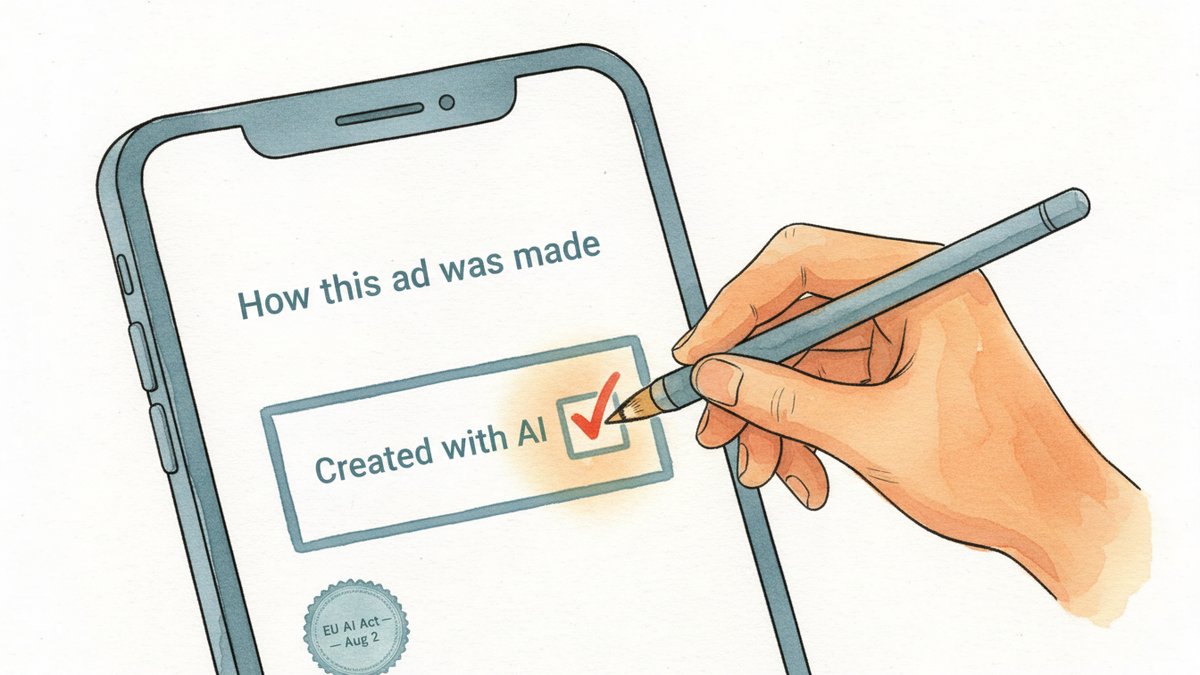
Somewhere in a Google Ads panel that most advertisers haven't opened yet, there's about to be a checkbox that asks, in effect: did you make this ad with AI? Not Google's AI — Google already knows about that one. The other AI. The Midjourney composite, the ChatGPT headline, the voice you cloned in ElevenLabs. That box, and whether you tick it, is the entire substance of the news that Google "will start labeling AI-generated ads."
Let me be upfront about what this is: an early read on Google's July 9 announcement, not a hands-on review. The advertiser-facing control is rolling out, I haven't seen it in a live account yet, and neither has anyone writing confident takes about it this week. But this is one of those announcements you can reason about concretely without touching the toggle — because it isn't a new product, it's a policy-and-UX change to a system we already live in every day. And the honest read is that this changes less than the headline suggests, and more than you'd think.
What Google actually shipped
Here's what's real. Google added a "How this ad was made" section to the My Ad Center panel — the thing users reach by tapping the three-dot menu or info icon on an ad across Search, YouTube, and Discover. If an ad was "created or edited with AI," that section is supposed to say so. My Ad Center is globally accessible, so the plumbing is everywhere at once.
There are two ways an ad earns the label, and the gap between them is the whole ballgame. If you built the creative with Google's own generative ad tools, Google labels it automatically — it knows, because its models tag their outputs with SynthID, the imperceptible watermark Google embeds in its own AI media. If you made the creative anywhere else — any third-party tool — Google does not independently verify anything. It hands you a control and asks you to self-declare. As one outlet put it, more bluntly than Google's blog ever would: Google will label AI-made ads, if advertisers admit it.
(This isn't as out-of-nowhere as it sounds. It generalizes a rule Google set back in 2023, when it began requiring disclosure of synthetic or altered content in election ads. Same idea, now aimed at everyone.)
One correction while we're here, because the coverage is muddying it: Google's own post talks about SynthID, not C2PA / Content Credentials. Meta — which shipped its own comparable ad labels the very same day — is the one leaning on C2PA metadata. If you read "Google uses C2PA for ad labels," that's coverage blurring two companies together. Small thing, but it matters when you're the one being asked to comply.
The honor-system decision, from the advertiser's chair
So put yourself in the seat that matters — yours. You cut a campaign, the hero image is a Midjourney composite, three of the responsive search ad headlines came out of ChatGPT. The panel asks whether you used AI. Do you check the box?
The uncomfortable truth is that, in most of the world today, nothing forces your hand. Google isn't scanning your creative. There's no penalty engine waiting to catch an unticked box. So the near-term, purely tactical answer for a lot of advertisers will be to shrug and skip it — especially since the label lands in a panel roughly nobody opens. Be honest about user behavior: the three-dot "why am I seeing this ad" menu is not where your customers spend their evenings. If your fear is "a visible AI tag will tank my CTR," relax — near-term, in most markets, the performance impact of a buried label is approximately zero. There's no data showing consumers are hunting down and punishing AI ads, and the label is mostly hidden anyway.
That's the "changes less than you think" half. Here's the other half.
Why the box matters anyway: one date
The reason this isn't a nothingburger is a deadline: August 2, 2026. That's when Article 50 of the EU AI Act — its transparency obligations for AI-generated content — takes effect. Google's rollout landing three weeks before that date is not a coincidence, and neither is Meta shipping the same feature on the same day. This is regulation-driven infrastructure, not a spontaneous act of corporate conscience.
In the EU, disclosure of AI-generated ad content stops being a courtesy and becomes an obligation. And Google's post already flags the consequence: in some markets, based on local requirements, the label may appear directly on the ad — not tucked inside a panel, but on the creative face, either automatically or through that same advertiser control.
Read those two facts together and the calculus flips for anyone touching EU audiences. The honor-system box you could ignore in Ohio is a compliance artifact in Ireland. Skipping it there isn't a shrug anymore — it's exposure. Regulatory exposure where the law bites, and brand-trust exposure everywhere else if you're ever caught having quietly hidden it. "We used AI and didn't disclose it" is a bad sentence to have to explain, whether it's a regulator or a journalist doing the asking.
Steelman: is this just transparency theater?
Now the strongest case against caring at all, and it's a real one. You could argue this whole thing is theater: a label almost no one will see, gated behind a checkbox almost no one is forced to tick, verifying almost nothing. Honor-system disclosure sounds flimsy on its face. If Google were serious, wouldn't it scan for third-party AI the way it scans for policy violations?
I don't fully buy the cynicism, and here's why. Honor-system disclosure is how a huge amount of ad policy already works. You self-attest that your claims are substantiated, that you have rights to the footage, that your "clinically proven" is actually proven. Most of it holds — not because a scanner is watching, but because the penalty for lying is what happens when you get caught. SynthID plus automatic labeling of Google-tool ads is not nothing, either; it's real detection infrastructure for the AI Google can see, and its reach will only widen. And starting inside a hidden panel before mandating on-ad labels is arguably the correct order of operations: build the rails, let the norm settle, then turn up the visibility where the law requires it. Seen that way, this is a reasonable, low-friction first step — not a cynical dodge.
Where I land
Somewhere practical. Don't overreact: there's no reason to fear the label as a performance killer, and no reason to treat July 9 as the day AI ads got risky. But don't file it under "someday," either — because the smart-money move is embarrassingly simple, and you can do it this quarter.
Start tracking, inside your own creative workflow, which assets used generative AI and where. A column in the campaign brief. A tag in the asset library. "Hero image: AI. Headlines 4–7: AI-assisted. Voiceover: human." That's the whole thing.
Do that and the August 2 EU deadline becomes a filter you already have the data to satisfy — you tick the box accurately in thirty seconds instead of reconstructing six weeks of production from memory. Skip it and you'll be doing archaeology on your own campaigns the first time a client, a regulator, or Google's own control asks a question you should have logged the answer to.
The label itself is small. The habit it should trigger is not. AI disclosure just moved from "nobody's problem" to "table stakes, phasing in" — and the cheapest time to build the paperwork muscle is now, while the box is still on the honor system and the cost of getting it wrong is still low.