Catch Content Cannibalization with AI Before It Tanks Your Rankings
Contents
A SaaS client pinged me last quarter — organic traffic was down 18% over 90 days, but their dashboard "looked fine." No algorithm update. No big content changes. Backlinks holding steady. They had been publishing a blog post a week for two years and the slow bleed had finally crossed the line into noticeable.
I pulled their Google Search Console export and ran the workflow I'm about to describe. Forty minutes later we had a list of 11 query–page pairs where the same query was being served by two or three of their pages on rotating weeks. Classic cannibalization. We consolidated five, canonicalized three, and rewrote intent on the rest. Six weeks later, traffic was up 22% on the same content set.
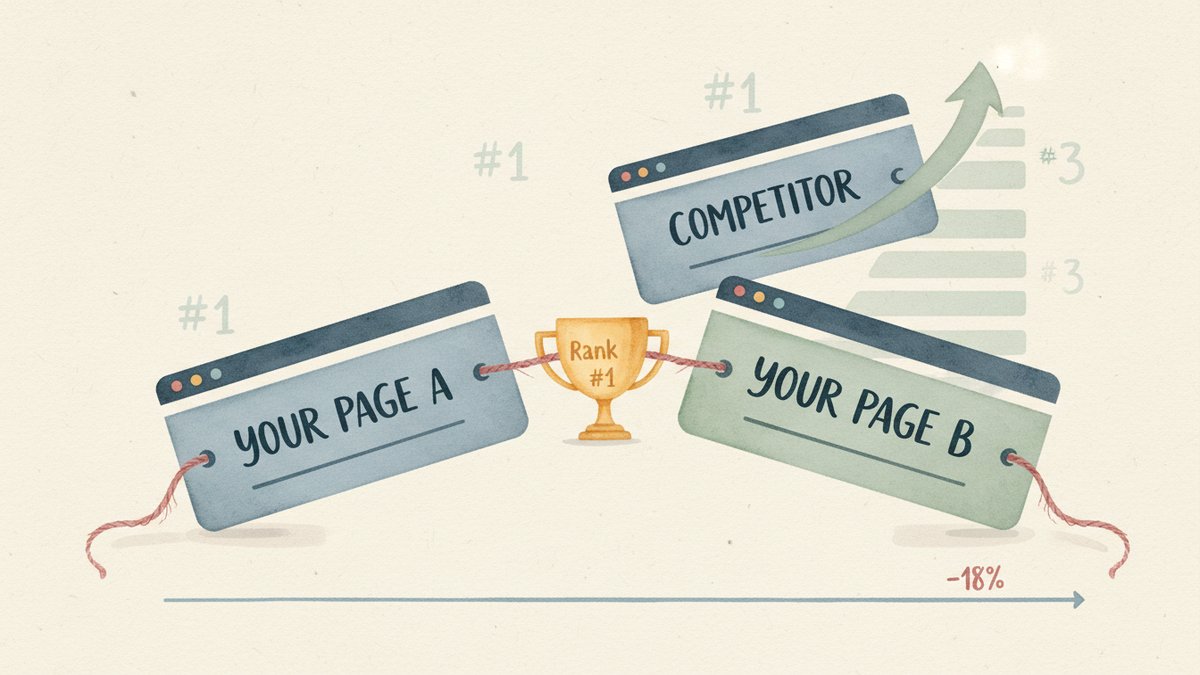
Content cannibalization — when two pages on your own site compete for the same query — is one of the quietest SEO killers I've watched in 15 years. It rarely shows up as a single dramatic drop. It shows up as a slow erosion, and most teams don't catch it until they've lost a quarter of revenue. Here's the AI-assisted workflow I use to catch it early.
The symptom: your pages are taking turns ranking
Before the workflow, you need to recognize the pattern. Cannibalization almost never looks like "this page disappeared." It looks like this:
- Position oscillation. Page A ranks #6 for "best CRM for startups" one week, Page B ranks #8 the next, Page A is back at #11 the week after.
- Two URLs on page 2. You have two pages both sitting around positions 12–18 for a query you should clearly own.
- CTR drop without rank change. Your average position is unchanged, but clicks are sliding — because Google is testing different URLs and none of them are the obvious match for the searcher.
- The wrong URL ranking. A 600-word blog post outranks your detailed pillar page for a high-intent commercial query.
If any of these patterns are in your data, the workflow below will surface the exact pairs.
Step 1 — Pull the right slice of GSC
Open Google Search Console, go to Performance → Search results. Set the date range to the last 90 days (28 days is too noisy; 6 months drowns the signal in old content). Then export with these dimensions:
- Query
- Page
- Filter: Position ≤ 20 (anything ranking below 20 is too volatile to call cannibalization yet)
You'll get a CSV with one row per query–page combination. The shape that matters is: which queries appear with more than one page URL.
If you have GSC API access (or use a tool like Search Analytics for Sheets), pull the raw daily data instead — you'll be able to see the flipping between URLs, which is the strongest cannibalization signal.
Step 2 — Let AI find the duplicate-query pairs
Spreadsheets can do this with a COUNTIF, but ChatGPT does it in one prompt and adds the analysis you'd otherwise do by hand. Paste your CSV (or chunks of it if it's big) into this prompt:
You are an SEO auditor. I will paste a CSV exported from Google Search Console with columns: Query, Page, Clicks, Impressions, CTR, Position.
Find every query where two or more different Page URLs from my site appear. For each, return:
- The query
- All competing URLs, with their clicks, impressions, and average position
- A "cannibalization severity" score from 1–5, where:
- 5 = both URLs in positions 1–20, combined impressions >1000, position difference <5
- 1 = one URL dominant (>10x clicks), other barely showing
- A one-line note: which URL Google seems to prefer (highest clicks) and how close the runner-up is
Sort by severity descending. Output as a markdown table. Don't include queries where only one URL appears.
Two details that matter. First, the severity score saves hours — it tells you which 10 cases to fix this week versus the 50 you can ignore. Second, asking for the "preferred URL" gives you a head start on the consolidation decision in Step 4.
For larger sites (1000+ queries with multi-URL conflicts), run this in chunks of ~300 query–page rows. Quality drops if you paste more.
Step 3 — Confirm intent overlap, not just keyword overlap
Two pages ranking for the same query isn't always a problem. Sometimes a blog post and a product page legitimately serve different intents and Google rotates between them on purpose. The mistake is consolidating those — you'll lose traffic from both intents.
This is where AI earns its keep. For each suspected pair from Step 2, run this:
I will give you two URLs and the query they both rank for. Compare them on three dimensions:
- Search intent match — does each page serve informational, commercial, or transactional intent? Are they the same or different?
- Content overlap — what percentage of the substantive content (headings, key points, examples) is duplicated or near-duplicated?
- Recommended action — pick ONE: consolidate (merge into one), canonicalize (keep both, pick a winner), differentiate (rewrite one to clearly target a different intent), or leave alone (legitimately different intents).
Query: [query] URL A: [paste the relevant content or summary] URL B: [paste the relevant content or summary]
Be ruthless. If the two pages are 60%+ overlapped on substantive content, recommend consolidate.
Don't paste the full HTML — strip it to headings plus the first 200 words of each major section. Claude and ChatGPT both handle this comparison well; I find Claude slightly better at distinguishing intent nuance, ChatGPT slightly better at giving a clean action recommendation. Use whichever you're already paying for.
Step 4 — Decide the fix using a simple decision tree
Once Step 3 has flagged each pair, the fix path is one of four:
| AI recommendation | What it means | What to do |
|---|---|---|
| Consolidate | High overlap, same intent | 301 redirect the losing URL to the winning URL. Merge any unique sections from the loser into the winner. Update internal links. |
| Canonicalize | Some overlap, same intent, both pages have a reason to exist | Add rel="canonical" from the secondary page to the primary. Resubmit to GSC. |
| Differentiate | Same query, but the pages should serve different intents | Rewrite one page to clearly target a sub-intent (e.g., split "best CRM" into "best CRM for startups" vs. "best CRM for enterprises"). Update title tag, H1, and the first 200 words. |
| Leave alone | Different intents legitimately served by both | Do nothing. Set a calendar reminder to check in 90 days. |
The "winning URL" is almost always the one with more backlinks, not the one with more clicks. Clicks are a current symptom; backlinks are the durable asset. When in doubt, run a quick Ahrefs check on both URLs and consolidate toward the one with the stronger link profile.
What to watch out for
- Brand queries don't count. Your homepage and your /about page both ranking for "[brand name] reviews" is fine. Filter brand terms out of Step 1 before you start.
- Featured snippets distort positions. If one URL is the snippet and one is in the blue links, GSC reports them as different positions but it's not a real conflict. Cross-check in the SERP before consolidating.
- Don't fix what's already converting. I've seen teams consolidate two pages that were both ranking page-1 for slight variants and lose more traffic than they "saved." If two URLs are both in top 10 for closely-related queries and combined traffic is growing, leave them alone.
- Run this quarterly, not monthly. Cannibalization needs time to stabilize in the data. Monthly checks generate noise; quarterly checks generate signal. Put it on the calendar.
The honest reason this matters
The reason cannibalization wrecks so many content programs isn't that publishing teams are bad at SEO. It's that no one owns the long tail of past articles. A new post goes up every week, the editorial calendar marches on, and three years later you have 400 posts, 70 of which are quietly competing with each other.
AI doesn't fix that organizational gap — but it makes the audit cheap enough that you can run it without booking a $5,000 agency engagement. Forty minutes a quarter, a free GSC export, and a chat thread. That's the whole cost. The hard part was always the analysis; the analysis is now the easy part.