Optimize for Google's AI Overviews: A 2025 Playbook
Contents
I refreshed Search Console for a B2B client last Tuesday and saw something I had to read twice.
They ranked #1 for their main commercial keyword. Stable for nine months. Featured snippet. People-Also-Ask boxes. The whole package.
And in the 30 days since Google started showing AI Overviews for that query, their clicks dropped 41%. Impressions held steady. Position held steady. Clicks fell off a cliff.
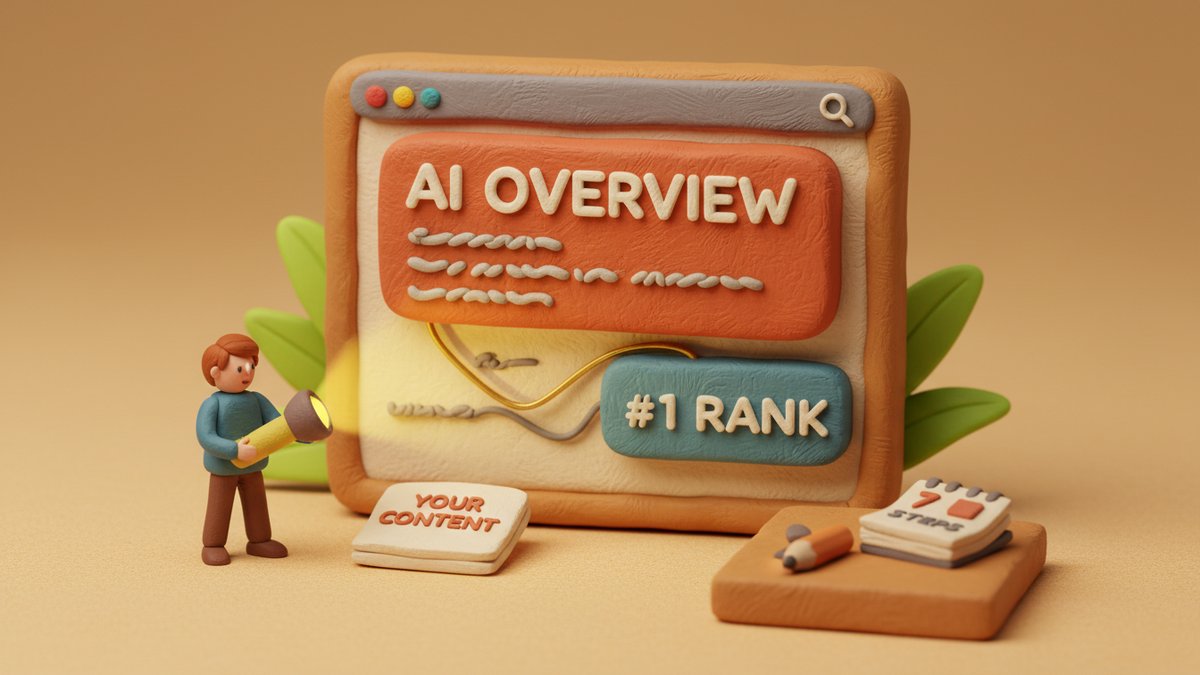
This is the new shape of the SERP: ranking #1 doesn't mean what it used to. Above the #1 organic result, Google now sometimes drops an AI Overview that takes up 1,700 vertical pixels — pushing the blue links down by 140%. The user gets a synthesized answer with a few citation links, often clicks none of them, and leaves.
If you're doing SEO in 2025 and not optimizing for AI Overviews specifically, you're optimizing for a search experience that's quietly being replaced. This post is the playbook I'm using with clients right now — seven steps, in order, that move you from "ranked but invisible" to "cited in the AI box."
What AI Overviews Actually Are (and Aren't) in 2025
Quick alignment before we get tactical, because there's still confusion.
AI Overviews are Google's AI-generated summaries that appear at the top of the SERP for certain queries. They synthesize an answer from multiple web sources, cite the ones they used, and let the user ask follow-up questions. They're powered by Gemini with retrieval-augmented generation — Google retrieves passages from its index, scores them, and has Gemini write a coherent response.
The current state, as of mid-2025:
- Reach: AI Overviews now serve 1.5 billion users monthly and appear in roughly 15% of all Google searches. The trigger rate varies heavily by query type — informational queries are hit hardest, commercial queries less so.
- Pixel footprint: When expanded, an AI Overview pushes organic results down by more than 140% on screen. Users have to actively scroll past it to reach the blue links.
- CTR impact: Ahrefs' study of 300,000 keywords found the average organic click-through rate (CTR) drops 34.5% when an AI Overview appears. For top-ranking pages, the hit is often larger because the AI box sits directly above them.
- Click concentration: The citations inside AI Overviews get the vast majority of clicks. There are typically 3–8 cited sources per overview, and they receive a disproportionate share of the (smaller) click pool. Not getting cited means not being seen.
This isn't a trend. It's the production reality of Google Search in 2025.
How AI Overviews Pick Their Sources
If you want to be cited, you have to understand the selection mechanism. AI Overviews work in three stages, and your content needs to clear all three:
1. Eligibility filter. Google pulls from its main index but applies additional gates — high E-E-A-T (Experience, Expertise, Authoritativeness, Trustworthiness) signals, structured data, topical authority, freshness. Pages that fail this filter don't even get considered for citation.
2. Retrieval. For the qualified candidate set, Google retrieves passages (not whole pages) that semantically match the question. Vector embeddings do the matching, which means your exact keyword phrasing matters less than the semantic completeness of the passage.
3. Citation scoring. The retrieved passages are then scored on authority, factual specificity, attribution clarity, and how well they stand alone as an answer. Only the top-scoring 3–8 passages get cited inline.
The two practical implications:
- You don't need to rank #1 organically to be cited in the AI Overview. Pages that rank on page 2 sometimes get cited because their passage is the best fit for the specific sub-question. Conversely, a #1 ranking doesn't guarantee citation if your passage is generic.
- Being cited ≠ being clicked. Cited pages get the lion's share of remaining clicks, but the overall click pool is much smaller. Optimize for citation first; treat clicks as a downstream bonus.
The 7-Step Playbook
These are ordered. Doing step 6 without step 1 won't move the needle. Skip ahead at your own risk.
Step 1: Lead With the Answer in the First 100 Words
This is the single highest-leverage change. Most articles bury the answer. AI Overviews don't have patience for that.
The pattern that works: open with a 1–3 sentence direct answer to the H2 question, then explain. Don't build up. Don't "contextualize." Just answer.
Example for an article targeting "how to do keyword research with AI":
AI keyword research uses large language models to expand seed keywords into hundreds of semantically related queries, then clusters them by search intent. The fastest way to do it in 2025: feed Claude or ChatGPT a 20-keyword seed list with a clear persona and ask for an intent-grouped expansion, then validate the results against Ahrefs or Semrush data.
That second sentence is your "answer." If an AI Overview scraper reads only that paragraph, it has a citable, specific, named-source answer to pull from.
The biggest mistake I see: articles open with three paragraphs of context before the reader knows what the article actually says. AI retrieval systems rarely read past the first passage. Bury the answer, lose the citation.
Step 2: Use the Question as the H2
For every informational section, the H2 should be the exact question a user (or an AI) would ask. Not a clever reframe. Not a topic label. The question itself.
What works:
- "How do AI Overviews pick which sources to cite?"
- "What is the difference between AI Overviews and featured snippets?"
- "Does structured data help with AI Overview citation?"
What doesn't:
- "The citation mechanism" (too vague)
- "Understanding source selection" (not a question)
- "Why AI Overviews matter for SEO" (answer-asking, not answer-giving)
This isn't just for the AI's benefit. Google's own Quality Rater Guidelines emphasize that high-quality pages should "satisfy the user's query fully" — and the clearest signal of that is mirroring the user's actual question as a heading.
Bonus move: Put a one-line TL;DR or "Key Takeaway" callout directly under each question-H2. AI Overviews love these because they're pre-formatted extractable answers.
Step 3: Write Citable Sentences, Not Vague Claims
Generic statements don't get cited. Specific, attributable statements do. The difference:
Vague (won't get cited):
AI is changing the way people search for information.
Citable (will get cited):
According to a 2025 SparkToro analysis of 1.2 million queries, zero-click searches now account for 60% of all Google searches — up from 50% in 2022.
The citable version has:
- A named source (SparkToro)
- A specific number (60%, 1.2 million queries, 50%)
- A specific timeframe (2025, 2022)
- A verifiable claim
This is the language AI Overviews pull from. The vague version sounds true but is just an opinion; the AI has no reason to cite it because it could write the same sentence itself.
Practical rule of thumb: Every third or fourth sentence in a key section should be a "citable sentence" — a claim with a named source, a number, and a date. Aim for 5–10 of these per long-form article.
Step 4: Build a Topical Authority Cluster Around the Target Query
Single articles rarely earn AI Overview citations in isolation. Google's retrieval system weights topical authority — having multiple interlinked, in-depth articles on a topic cluster.
The structure I use for a target commercial or informational topic:
- 1 pillar page — comprehensive, 3,000+ words, targeting the head term. Acts as the authority anchor.
- 5–8 cluster articles — each targeting a specific long-tail sub-question under the pillar. Each one links back to the pillar and to two or three sibling cluster articles.
- FAQ schema on the pillar — every common sub-question with a 2–4 sentence direct answer.
Why this works for AI Overviews: Google's retrieval system treats clusters as a signal that your site has the depth to be cited. A single article answering "what is X" can be a one-off coincidence. A cluster of 8 articles covering the entire "X" topic is expertise.
Concrete example: a client selling project management software didn't have a cluster around "Agile project management." We built 7 articles covering the sub-questions (methodologies, tools, common mistakes, how to choose, etc.) and linked them to a pillar. Within four months, their pillar article was cited in AI Overviews for 4 different long-tail queries — not just the head term.
Step 5: Add Schema Markup That Maps to AI Retrieval
Structured data (Schema.org markup) doesn't directly cause citation, but it makes your content machine-readable in ways that align with how AI Overviews parse information.
The three schemas that matter most for AI Overview optimization:
- FAQ schema — for Q&A content. AI Overviews frequently use FAQ-structured content because the Q-and-A format is exactly what their retrieval system is looking for.
- HowTo schema — for step-by-step content. Tutorials, processes, and procedures with clear ordered steps.
- Article schema with author markup — ties content to a named author with credentials and sameAs links (LinkedIn, Google Scholar, Twitter). AI Overviews weight authorial authority.
There's also Speakable schema (for voice search / AI assistants reading answers aloud) and Organization schema (for entity legitimacy), but the three above have the highest direct impact on AI Overview citation in 2025.
Implementation note: Use JSON-LD format (Google's preferred), validate with Google's Rich Results Test, and don't spam. Each page should have schema that genuinely describes its content — adding FAQ schema to a non-FAQ page is a quality violation.
Step 6: Earn Brand Mentions and Citations Across the Web
This is the slow, unsexy step that compounds.
AI Overviews trust content that gets mentioned and cited across the broader web — even on sites that don't link to you. The retrieval system has a "consensus" check: if multiple independent sources reference your brand or your data, the AI treats your content as more authoritative.
Practical moves:
- Get your original data cited. When you publish a survey, benchmark, or analysis, pitch it to industry publications and newsletters. The more third-party sites that reference your data, the more likely AI Overviews will cite the original.
- Contribute expert quotes to journalists. Platforms like HARO (Help A Reporter Out), Qwoted, and SourceBottle connect journalists with experts. A single quote in a TechCrunch or NYT article can produce dozens of AI Overview citations over time.
- Get listed in industry roundups. If your brand shows up consistently in "best X tools" lists on authoritative sites, AI Overviews treat that as a corroborating signal.
- Build a Wikipedia presence if you qualify. Wikipedia is heavily weighted in Google's Knowledge Graph. If you have a notable brand or product and meet notability requirements, a Wikipedia page is a long-term investment.
This isn't a one-month project. It's a six-to-twelve-month compounding play. But it's the most defensible moat in AI-era search.
Step 7: Measure Citation Rate, Not Just Rankings
You can't optimize what you don't measure, and traditional rank tracking misses the most important metric: are you being cited in AI Overviews?
The measurement stack I'm using in 2025:
- Google Search Console — AI Overview filter. As of mid-2025, GSC has a dedicated AI Overview performance filter. It shows impressions, clicks, and CTR specifically for queries that triggered an AI Overview. Use it. It's the only first-party data source.
- Manual spot checks. Every two weeks, run your top 20 target queries through a private/incognito Google search. Document which competitors get cited, which sources appear, and which passages are pulled. Spreadsheet this. Patterns emerge within a month.
- Third-party AI visibility tools. Platforms like Profound, Otterly, and Semrush's AI Overview tracker are maturing fast. They're not perfect, but they automate the spot-checking across hundreds of queries.
- Referral monitoring. Check your analytics for referral traffic from
google.comURLs that look like AI Overview citations (long query string, no clear ad parameters). It's directional, not precise, but it tells you whether citation is converting to clicks.
The reporting cadence: track citation rate (cited/total target queries) monthly, not weekly. Citation gains from the playbook above take 4–8 weeks to show in data.
What I'd Do This Week
If you read this far and want to start somewhere concrete, here's the order I'd prioritize for the next 7 days. Not a full implementation — just the highest-ROI first moves.
Day 1–2: Identify your top 10 commercial and informational target queries. Run them through private browsing on Google. Document which queries trigger AI Overviews and who gets cited. That's your baseline.
Day 3–4: Pick the 3 highest-value articles on those topics. Rewrite the first 100 words of each to lead with a direct, specific, source-backed answer. Add a TL;DR callout. That's the fastest visible win.
Day 5–7: Add FAQ schema to those 3 articles. Cover the 5 most common sub-questions in 2–3 sentence answers each. Validate with Google's Rich Results Test. This sets up the structure for AI retrieval to extract cleanly.
After that: the cluster expansion (Step 4) and brand mention building (Step 6) are the longer plays that compound over months.
The Mindset Shift
The hardest part of this playbook isn't technical. It's conceptual.
For 15 years, SEO success meant "rank higher." You optimized for position. You celebrated #1 rankings. You reported organic traffic as the north-star metric.
In 2025, success means "be the source the AI cites." That's a different game with different rules. Position still matters for click-through on the citation links, but the fundamental optimization target is now whether your content passes the retrieval filter and the citation scoring.
The brands that figure this out in 2025 will own the most valuable real estate on the SERP — the AI Overview citation block — for the next several years. The ones that keep optimizing only for blue-link rankings will see traffic slowly drain into Google's answers, with no clear signal of why.
Start with the answer in the first 100 words. The rest of the playbook builds on that foundation.