Re-engagement flow for a dead list: 4 emails over 21 days
Contents
Here's a number that should bother anyone who runs an email list: roughly a quarter of the addresses currently in your ESP (Email Service Provider, 邮件发送平台 — Klaviyo, Mailchimp, HubSpot, etc.) have not opened a single email from you in the last six months. Some of them changed jobs and forgot to update. Some of them set up a "promotions" filter that auto-archives you. A lot of them are simply dormant — the human still has the address, but the relationship is over.
The 25% or so who've unsubscribed are easy. The other 25% — the ones who haven't opened but haven't left — are the part that quietly destroys your sender reputation. They're the reason Gmail starts throttling you, the reason your open rates calcify around 12%, the reason your perfectly fine email lands in spam even when the recipient specifically asked to hear from you.
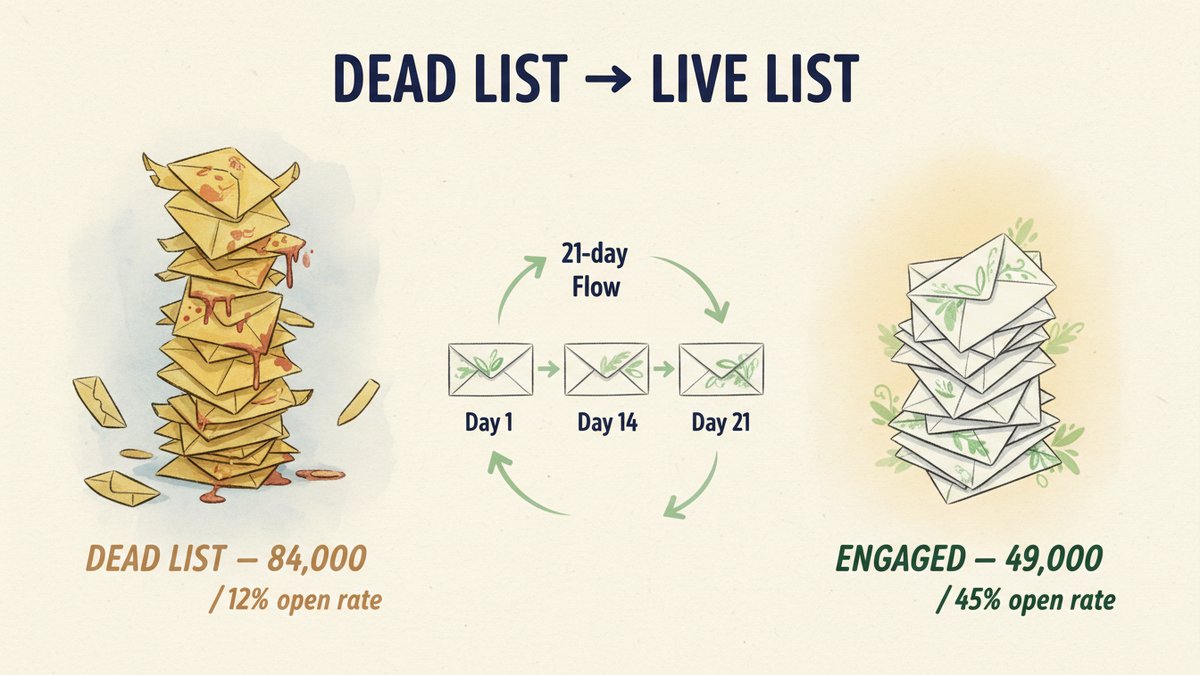
The fix is not a better subject line. It's a 4-email re-engagement flow that runs for 21 days, earns the right to remove dead weight, and segments the survivors into a list you can actually grow. I've run some version of this on roughly twenty client lists over the last six years. The math is always the same: somewhere between 20% and 45% of the "dead" addresses re-engage when you ask, and the remaining 55% to 80% are the addresses you needed to drop a year ago.
What counts as "dead"
Most teams I work with use one of three definitions, and the choice changes the size of the problem:
- 90 days inactive — no opens, no clicks. Aggressive. Treats 6-month-old newsletter subscribers as dead.
- 120 days inactive — the most common definition. The default in most ESPs.
- 180 days inactive — the lenient version. Useful if you have a long purchase cycle (B2B, considered purchases).
The right answer depends on your business. A daily deals site that emails every morning should treat 60 days as dead. A SaaS (Software as a Service, 软件即服务) company that emails weekly can defend 180 days. The point is to pick a number, write it down, and run the flow against that same definition every time. The mistake I see most often is teams running re-engagement only when deliverability is already in the dumpster. By then you've been throttled for weeks. Quarterly is the cadence that actually protects you.
One more thing on the threshold: track clicks, not just opens. Apple Mail Privacy Protection (MPP) has inflated open rates for years by pre-fetching tracking pixels. A 2024 Klaviyo benchmark puts the average open rate in the high 30s partly because of this. If you only use opens to define "dead," you'll mis-segment a chunk of iCloud users. Clicks are the more honest signal.
The flow, email by email
The four emails below are what I send to anyone who crosses the inactivity threshold. Total runtime: 21 days. Total send volume: 4 emails. No more.
Day 1 — the soft check-in
The first email is a low-stakes nudge. You are not asking them to do anything. You are reminding them you exist and giving them a single, frictionless way to confirm they want to keep hearing from you.
Subject line: Still want to hear from us?
Body, in plain text:
Hi {{first_name}},
Quick one. You've been on the {{brand_name}} list for a while, but we haven't seen you open an email in {{X}} months.
No hard feelings either way. If you want to keep getting {{what you actually send — "our weekly product updates" / "campaign tips" / "new music roundups"}}, tap the button below. One click, done.
[ Yes, keep me on the list ]
If you don't tap it, you might hear from us once or twice more over the next few weeks. After that, we'll assume you're done and stop emailing.
— {{brand_name}}
Two things are doing the load here. The "tap the button" mechanic is a one-click list-confirmation — ESPs handle this as a custom event you can branch your flow on. People who tap stay; people who don't get the rest of the sequence. And the line "we'll assume you're done and stop emailing" is not a threat — it is the actual policy, and it earns the rest of the flow's credibility. If the breakup email later is going to feel honest, this first one has to be honest too.
Day 7 — the value reminder
If they didn't click on day 1, they need a reason that isn't "do you want this email?" Six days later, you answer a different question: "Was it actually worth opening?"
Subject line: Three things you missed this month
Body, in plain text:
Hi {{first_name}},
We pulled three pieces from the last 60 days that we thought were the best of what we shipped — in case the timing was off when they came through:
- {{link 1 — your highest-traffic blog post or product update}}
- {{link 2 — your most-clicked newsletter issue}}
- {{link 3 — a customer story, a case study, or a tutorial}}
If any of these are useful, we can keep sending them. If not, you'll get one more email in two weeks, and after that we stop.
— {{brand_name}}
This email works because it pivots from "do you want email" (a question most dormant users find annoying) to "did this email contain things you'd want" (a question with a concrete answer). The three links are doing the actual heavy lifting. Pick the three pieces of content with the highest engagement from the last 60 days, not the three you're proudest of. Engagement is the only metric that matters when you're trying to win someone back.
Day 14 — the incentive, with a hard deadline
Now you can offer something. The 14-day wait has earned it. The incentive works best when it's tied to a deadline measured in hours, not days — and when the deadline is real, not "limited time only" filler.
What the incentive is depends on your business. For ecommerce: 15% off with a 48-hour code. For SaaS: an extended trial, a free month, a 1:1 onboarding call. For media: a paid-tier discount or a members-only piece. The format matters less than the deadline mechanic. A deadline measured in days is invisible; a deadline measured in hours changes behavior.
Subject line: 15% off, only for the next 48 hours
Body, in plain text:
Hi {{first_name}},
One more from us, and a real reason this time.
Use code COMEBACK15 in the next 48 hours for 15% off {{product / order / first paid month}}.
[ Resume checkout ] / [ Start your trial ]
If now isn't the time, that's fine. This is the last promotional email you'll get from us. After that, we'll stop emailing unless you tell us otherwise.
— {{brand_name}}
Two practical notes. First, the code is bolded and repeated — buried codes are a silent killer on this email. Second, the "this is the last promotional email" line is doing the same job as the day-1 line. The breakup has to feel like a continuation of a promise, not a surprise.
Day 21 — the breakup
The last email is short, honest, and has a single job: give the dormant user a graceful exit, and give yourself permission to suppress the address.
Subject line: Should we close your account?
Body, in plain text:
Hi {{first_name}},
Three weeks ago we asked if you still wanted to hear from us. You didn't say yes, so this is the last email.
You don't need to do anything. We'll stop sending, and your data stays where it is — you can come back anytime by signing in.
If you do want to keep getting emails, tap below:
[ Keep me on the list ]
Either way, thanks for being a customer / reader / subscriber.
— {{brand_name}}
The keep-me-on button is optional. Some teams add it; some don't. The case for it is the small cohort (often 2-5%) who ignored the first three emails but would actually come back if given a clean, low-pressure way. The case against it is that the breakup email is more powerful when the choice is binary — you stayed silent, we removed you. Personally, I include the button because the recovery rate on it is real and the unsubscribe rate barely moves.
What to do with the survivors
The 21 days are over. You now have two cohorts: the 20-45% who re-engaged (clicked, opened, replied, used a code, hit the keep-me button), and the 55-80% who didn't. The survivors are the most important list segment you have — they just told you, in their actions, that they want to be there. Move them to a "re-engaged" segment and suppress the rest from your main sends.
The suppression piece is the whole point. ESPs make it trivially easy to mark a profile as unsubscribed without sending a confirmation email — a "suppression list" or "do not mail" tag works. The dormant addresses stop hitting your sender reputation. Your next regular send goes to a smaller, more engaged list. Open rates and click rates climb in a way that compounds for months.
This is the part I have to repeat to clients who are new to it: a smaller list with 45% open rates is worth more than a bigger list with 12% open rates. Email volume does not equal email revenue. The senders who understand this are the ones Gmail and Yahoo keep delivering.
Where AI actually helps in this flow
Three places. First, generating the three "things you missed" links for the day-7 email — ask your model to pull from your CMS (Content Management System, 内容管理系统) or ESP analytics the last 60 days of top-engaged content, then draft the framing. Second, producing subject line variants for AB testing — AI gives you 20 candidates across emotional angles in under a minute, including the off-pattern ones that win. Third, analyzing the post-flow results — feed the model your "who re-engaged" cohort data and ask it to surface patterns (time of day, original signup source, last product purchased) that predict future re-engagement.
The places AI does not help: writing the breakup email (it over-emotes, adds exclamation marks, begs), pricing the incentive (you know your margin better than it does), and making the call about whether to suppress a specific user (the data should drive that, not a model). Treat the breakup email as something you write by hand. The honesty has to be yours.
The actual lesson
Re-engagement is not a campaign. It's a quarterly maintenance habit. The flow above is the part you can copy, but the part that determines whether your email program stays healthy is whether you run it on a schedule. Every quarter. Same definition of "dead." Same four emails. Same suppression at the end.
A dead list is not a sign of a failing business. It is the natural state of any list that has been around for more than six months. The question is whether you let the dead weight drag the live weight down with it, or whether you pay the cleanup cost once a quarter and keep the rest of the program compounding.