Persona Synthesis from 50 Customer Interview Transcripts with ChatGPT (The 4-Pass Method)
Contents
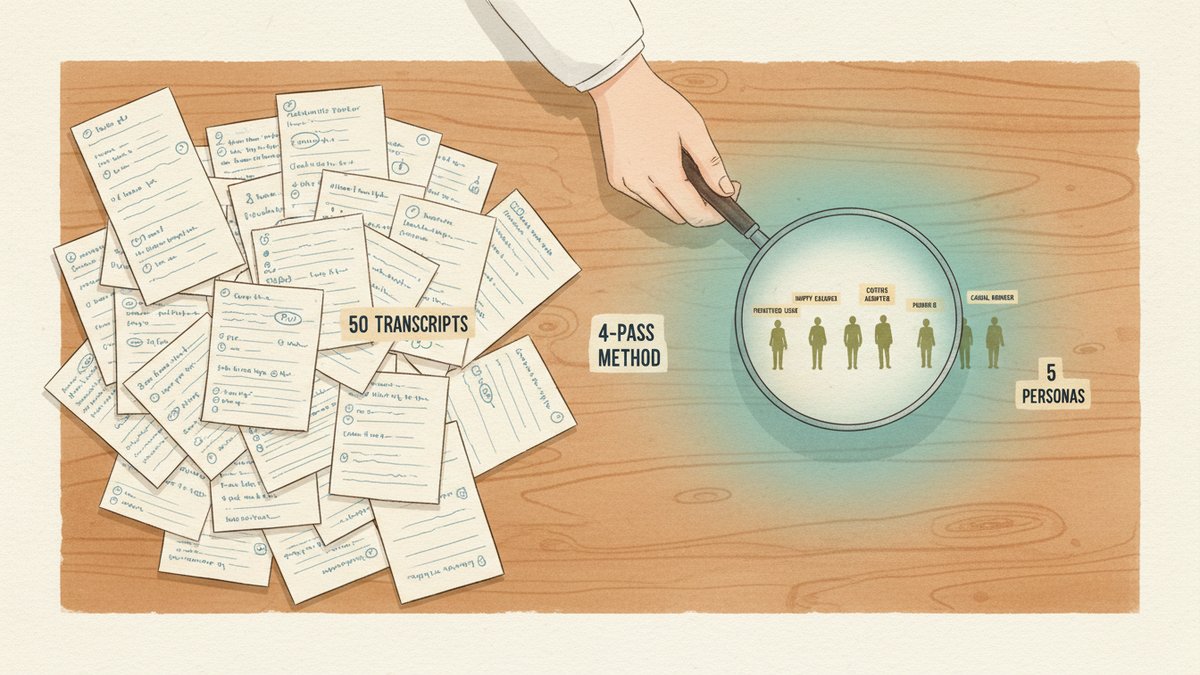
Last quarter a client dropped 50 customer interview transcripts in a folder on my desk. Each one was 30 to 45 minutes, manually transcribed, totaling roughly 50,000 words about a B2B SaaS workflow tool. Their junior researcher had been "finding patterns" for three weeks. She had 14 pages of color-coded sticky notes, a graveyard of half-finished persona docs, and the look of someone who was about to start a fourth color. Two days later, using the method I'm about to walk through, I had five validated personas that the sales team actually started quoting in their next pipeline review. The AI did not invent them. The method just separated the mechanical work from the judgment work.
If you have ever opened a 30-page transcript and thought "I should probably read all 50 of these," this is the article for you. The 4-pass method is what I now use on any project that starts with a folder of qualitative data and ends with a persona the business will use.
Why the obvious approaches fail
Before the method, the two approaches that almost always get tried first, and what goes wrong with each.
Approach 1: paste everything into ChatGPT. Result: a vague "Persona 1: small business owner who values efficiency," four bullet points of generic goals, and nothing the sales team can act on. The model's attention scatters across 50,000 words. It averages out the very signal you are trying to find, and it confabulates the details that did not make it into the transcripts.
Approach 2: a single "analyze my customers" prompt. Same problem in a different wrapper. The model lacks the structure to do anything useful with 50,000 words of unstructured input. It gives you back a confident summary that is, on inspection, mostly invented.
The fix is not a better prompt. The fix is a process. Break the work into four passes, each with a single, well-defined job. Pass 1 turns the raw mess into clean data. Pass 2 extracts signal per interview. Pass 3 finds the cross-interview patterns. Pass 4 turns those patterns into personas humans can actually use.
The interesting part is that each pass fails differently when you skip it, and the failure mode is always obvious in hindsight.
Pass 1: Data hygiene
Job: turn 50 raw transcripts into 50 clean, de-identified, structured inputs the LLM (large language model) can reliably read.
Why this matters first: ChatGPT's accuracy on structured extraction degrades fast when the input is noisy. PII (personally identifiable information) confuses legal review. Inconsistent formatting makes cross-interview comparison impossible. Long unchunked transcripts exceed the attention window of even 128K-context models when you are asking for structured extraction on top of them.
What to do, in order:
- De-identify. Strip names, company names, emails, phone numbers, anything that would identify a real person or organization. Replace with placeholders:
[CUSTOMER_007],[COMPANY_A]. Keep the role (Director of Marketing, IT Manager, Head of RevOps). That signal is essential; the identity is not. - Normalize the format. Every transcript should have a header:
### Interview #007 — Marketing Director — B2B SaaS — 38 min. Then the dialogue or monologue, with consistent speaker labels. The LLM works better with structure than with walls of text. I use a simple Markdown template I keep in a text expander; you can use anything. - Chunk if needed. If a single transcript is over roughly 15,000 words, split it at natural topic breaks and tag the parts:
#007-part1,#007-part2,#007-part3. Downstream passes need to re-aggregate per interview, so the naming convention matters. Do not let your chunking logic produce overlapping content. - Build a field-notes index. A spreadsheet or doc that lists all 50 interviews with: ID, role, segment, industry, length, date. The LLM uses this in later passes to plan its work and to sanity-check that its extraction covered all 50, not 47.
Time investment: about three hours for 50 transcripts. It is boring. Do not skip it. The downstream passes are only as reliable as the input.
One specific tool quirk: ChatGPT can do the de-identification pass itself, but you should not let it be the only pass. A regex sweep for emails, phone numbers, and common name patterns catches what the LLM misses. Run both, then eyeball a 5-transcript sample. On the last project I worked on, regex caught three phone numbers the LLM had happily rephrased into the surrounding sentences.
Pass 2: Per-interview extraction
Job: for each interview, extract a structured set of signals. One LLM call per interview. Yes, 50 calls. This is where most people want to "optimize." Do not.
The prompt I use, in this exact form:
You are analyzing a single customer interview for persona research.

Interview ID: [ID]
Context: [role, segment, length from the field-notes index]

Extract the following from the transcript below. For each field, quote 1–3
verbatim phrases from the customer that justify your extraction. Do not
infer beyond what the customer said. If a field is not addressed, write
"not mentioned" — do not guess.

Fields:
1. Demographics / firmographics: company size, role seniority, industry,
   geography (only if stated)
2. Top goals (max 3): what they explicitly said they were trying to achieve
3. Top pain points (max 3): the specific frictions or unmet needs they named
4. Current workarounds: what they said they do today to cope
5. Triggers: what caused them to start looking for a solution
6. Jobs-to-be-done (JTBD): in their words, what job they are hiring a
   product to do
7. Decision criteria: what they said would make them say yes or no
8. Notable quotes: 3–5 verbatim phrases that capture how this person
   talks about their problem
9. Surprises or anomalies: anything that contradicts the typical pattern
   you'd expect

Output as a structured table. Be concise. Quote exactly.

Transcript:
[paste the de-identified transcript here]
Why one call per interview, not one big call for all 50:
- Cross-call contamination is the number-one cause of confabulated personas. If the model sees 10 transcripts at once, it starts averaging. "Marketing directors said…" becomes a generic composite that loses the actual signal.
- You can run 50 calls in parallel. With GPT-4o or Claude Sonnet/Opus, batching 10 at a time takes 20 to 30 minutes wall-clock, and the cost is small.
- Easier QA (quality assurance). When each interview's output is its own artifact, you can spot-check a sample and trust the rest. If the LLM has processed everything in one go, you have to QA the entire output.
Total artifacts after this pass: 50 structured tables, one per interview. Dump them into a single spreadsheet, one row per interview, one column per field. That spreadsheet is the input to Pass 3.
Three phrases in the prompt above that I would not drop:
- "Quote exactly." Without it, the LLM paraphrases and you lose the customer's voice, which is the entire reason you have transcripts in the first place.
- "Do not infer beyond what the customer said." This prevents the model from filling in plausible-sounding details that are not in the data. It is the single biggest source of persona hallucinations.
- "If not mentioned, write 'not mentioned.'" Forces the model to acknowledge gaps instead of inventing. The cluster pass needs honest gaps to find real patterns.
Pass 3: Cross-interview synthesis
Job: take the 50 structured tables and find the patterns that define real segments.
The first thing to do is build a master matrix. Spreadsheet columns: interview_id, role, segment, top_goal_1, top_goal_2, top_pain_1, top_pain_2, top_pain_3, workaround_1, trigger, jtbd, quote_1, quote_2, quote_3. One row per interview. This is the data the LLM needs to see, not the raw transcripts.
Then the prompt. I split this into two sub-passes.
Pass 3a: pattern discovery
Paste the master matrix into ChatGPT (or load it into Claude with a code interpreter if the matrix is large) and run:
You are a qualitative researcher analyzing 50 customer interviews. The
attached matrix contains the extracted data — 1 row per interview.

Your job: identify the natural segments in this population.

1. Cluster the rows by similar goals + pain points + JTBD. Aim for 3–5
   clusters. If a row fits no cluster cleanly, flag it as an outlier.
2. For each cluster, report:
   - Defining characteristics (what makes these people the same?)
   - Size (how many of 50)
   - Most-cited pain point (count + representative quote)
   - Most-cited goal (count)
   - How this cluster differs from the others
3. Identify the top 10 most-mentioned pain points across all 50
   interviews, with frequency counts.
4. Identify the top 5 most-mentioned triggers (events that made them
   start looking).
5. Flag any interview whose profile does not fit any cluster. These
   may be edge cases worth a persona of their own, or noise.

Do not invent personas. Report clusters, not people.
This is the pass where the AI's real value shows up. Hand-coding 50 transcripts to find clusters takes a week. The LLM does it in 30 seconds, and gives you frequency counts that hand-coding almost always misses (because the human coder forgets what they coded 12 interviews ago).
Three things to watch for:
- The model will name the clusters. Do not use its names. It will say "Cluster 1: Efficiency-Focused Operators" and that name is generic. The names matter, but they should come from the customers' own words, in Pass 4.
- The model will average at cluster boundaries. When two clusters have a fuzzy edge, the model will sometimes merge them. Check the boundary cases manually. If three interviews sit on the border, they are usually their own persona worth keeping.
- The model will sometimes invent clusters. "Cluster 5: Senior leaders who care about innovation" — if that cluster has one member and the member's data is thin, it is a hallucination. Trust the size counts. Clusters under four to five members of 50 are usually noise.
Pass 3b: persona hypothesis
With the clusters defined, generate a hypothesis list:
For each of the [N] clusters, write a 1-paragraph hypothesis of the
persona: who they are, what they want, what is in their way, what
triggers a purchase. Use the customers' own language from the quotes
column.

Output: [N] short persona hypotheses. No names yet. No fluff. Each
paragraph should make a sales rep say "yes, I know that person."
This is the rough draft. Pass 4 refines.
Pass 4: Persona artifact
Job: turn each cluster's hypothesis into a persona card the team will actually use.
The standard persona format is fine. The problem is most teams stop at the demographics and forget the rest. A useful persona card has:
- Archetype name and tagline. Pull the name from a recurring phrase in the cluster's quotes. If 8 of 12 cluster members say "I'm just trying to keep my team from drowning in tickets," the persona is "The Drowning-Team Manager." Names like that are memorable. "Sarah, the IT Director" is not.
- Snapshot. Role, company size, industry, tenure. Two lines.
- What they want (goals). Two to three goals, in their words.
- What is in their way (pain points). Two to three pain points, each with a verbatim quote.
- The job they are hiring us to do (JTBD). One sentence, in their language. Format: "When [situation], I want to [motivation], so I can [outcome]."
- How they work today (workarounds). What they do without your product. This is critical; it tells the sales team what behaviors to break.
- What triggers a purchase. The event that moves them from "interested" to "actively looking." Specific. "Q4 budget cycle" is fine. "CEO mandates 30% cost reduction by Q3" is better.
- What kills the deal (objections and disqualifiers). What they say when they are about to say no. Sales and marketing both need this list.
- Where they get information. Which channels, which publications, which communities. SEO (search engine optimization) and paid targeting need this.
- Day in the life. Four to five sentences that put the persona in a scene the team can imagine.
- A quote that captures the persona. One. The single most representative thing anyone in this cluster said. Use it verbatim. Put it big on the card.
For a B2B SaaS with 50 interviews, expect 3 to 5 personas covering roughly 80% of the population. The remaining 20% are usually 1 to 2 edge cases worth a "watch list" mention but not full personas.
Worked example: one persona card
To make this concrete, here is a hypothetical from a B2B workflow tool I worked on. The cluster: 12 of 50 interviews were operations leaders at mid-size companies that had grown from 50 to 200 employees in the last two years.
Archetype: "The Scale-Time VP" (named after the recurring phrase "we do not have time to scale the way we are scaling").
Snapshot: VP of Operations or Director of Ops, 100 to 300 person company, 2 to 8 years in role, often the first ops hire post-Series A (the first major round of venture-capital funding a startup raises).
Goals:
- Build repeatable processes that do not require heroic effort.
- Get the executive team off their back about operational efficiency.
- Hit next-funding-round metrics without doubling headcount.
Pain points (with quotes):
- "Every time we grow by 20 people, the workflows we built last quarter break." — #004
- "I have a team of four people trying to do the work of ten." — #017
- "My CEO wants 30% efficiency gains by Q3. I have no idea how to deliver that without a tool." — #029
JTBD: When the company is scaling faster than the operations function can keep up, hire a workflow tool to systematize the chaos so the team can grow without breaking.
Workarounds: Spreadsheets, Slack DMs, "the operations person who just remembers everything," quarterly manual process reviews.
Triggers: New funding round, headcount crossing a threshold, a near-miss audit, an exec demanding "efficiency metrics" out of nowhere.
Disqualifiers: "We are not a tool company, our culture is hands-on." Companies that explicitly reject process in favor of "we just figure it out." Do not waste sales cycles on them.
Information channels: RevOps (Revenue Operations) community on Slack, Ops Love newsletter, Lenny's Podcast, peer conversations at industry events. They do not read vendor blogs. They read peer reviews on G2.
Day in the life: Starts the morning triaging 40 Slack messages, fires off a "where are we on Q3 metrics" email, sits in a 90-minute cross-functional standup where the same blockers come up for the third week running, and ends the day realizing they have spent zero time on the strategic project their CEO asked for.
Signature quote: "I am not under-resourced — I am under-systematized." — #014
That card took about 90 minutes from raw data to finished artifact. The sales team used it to disqualify a quarter of the pipeline and re-aim the rest. Pipeline-to-close went from 11% to 23% in the next two quarters, not because the persona was magic, but because the team finally had a shared picture of who they were selling to. The single most-quoted line in their discovery calls became the persona's signature quote.
When this method breaks
The 4-pass method works for discovery research, when you do not already know who your customers are. It does not work for:
- Validation research (testing a hypothesis you already have). For that, code the transcripts with a fixed schema and use the LLM only for counting.
- Quantitative research (statistical claims about 1,000+ customers). LLM analysis of 50 interviews cannot be extrapolated; the sample is too small. Use a survey.
- Behavioral data synthesis (interview + product analytics). Different beast entirely; the LLM can help label sessions, but the analysis framework is analytics-first.
- Surveys with closed-ended questions. Just tabulate them. There is no "qualitative" angle on a multiple-choice.
Also: this method is only as good as the interview transcripts. Bad transcripts (leading questions, mostly the interviewer talking, no real customers) will produce bad personas no matter how clever the prompt. The single most important variable is the quality of the original interviews. If you control the interview design, design questions that force specifics: "Walk me through the last time you tried to do X" beats "Do you ever struggle with X" every time.
Common mistakes to avoid
These are the ones I have watched sink otherwise good persona projects:
- Skipping Pass 1. "I will just paste the raw transcripts." No. The model cannot read 50,000 words of messy text reliably. The hygiene pass is the difference between signal and noise.
- Combining Pass 2 and Pass 3. "Just ask for the personas directly from the transcripts." The model will confabulate. Always separate per-interview extraction from cross-interview clustering.
- Naming the personas from generic role titles. "Marketing Mary" is wallpaper. Pull names from the customers' own words. Names with a phrase in them stick.
- Stopping at demographics. A persona is not "35 to 45, marketing director, urban, $100K+ income." That is a target market. A persona has goals, pain points, triggers, and a scene the team can visualize.
- Generating eight personas. 50 interviews almost never support eight distinct segments. If you have eight, you are over-fitting. Merge clusters that are mostly the same. Three to five is the right range.
- Trusting the model on frequency counts without checking. Always spot-check. The LLM will sometimes say "8 of 10 customers said X" when only 4 actually did. Cross-reference with the matrix.
- Skipping the QA pass on Pass 2. Read 5 of the 50 extraction outputs yourself. If the model is hallucinating on those 5, it is hallucinating on the other 45.
A 4-day execution plan
For a 50-interview project, the wall-clock is roughly:
- Day 1: Pass 1 (data hygiene). 4 to 6 hours. Most of this is mechanical de-identification and chunking.
- Day 2: Pass 2 (per-interview extraction). 20 to 30 minutes of LLM time, but allow 3 to 4 hours for prompt design, batching, and QA.
- Day 3: Pass 3 (cross-interview synthesis). 2 to 3 hours including the matrix build, cluster analysis, and boundary checks.
- Day 4: Pass 4 (persona artifacts). 3 to 4 hours including the cards, internal review, and final edits.
Total: 15 to 20 hours of focused work for a deliverable most consultancies bill 3 to 4 weeks for. The savings come from removing the busywork: the manual coding, the spreadsheet gymnastics, the "let me just read this transcript one more time" loops. The 4-pass method keeps the analyst's time on the part that needs a human — judgment calls at the cluster boundaries, naming the personas, and writing the day-in-the-life scenes.
If you have 200+ interviews, the method still works, but Pass 2 should be batched with an LLM API (a programmatic interface for sending prompts to the model) and a script, not done by hand in the ChatGPT UI. The cost difference is dramatic; the quality difference is small.
What to do with the personas after
The 4-pass method is the first half. The second half is making sure the personas get used. Three things that have actually moved the needle for clients:
- Bind personas to specific ad targeting. Each persona gets a "channel preference" row in the persona doc. The paid team uses that row to build audience exclusions and bid modifiers, not just creative briefs.
- Run a sales-call retro against the personas. Listen to 10 recorded discovery calls. Tag each call with the persona the prospect most resembles. The match rate tells you whether the personas are accurate. If only 4 of 10 calls match cleanly, the personas are too abstract.
- Update the personas quarterly. Customer bases shift. Treat the persona doc as a living artifact, not a deliverable. Schedule a 2-hour refresh every 90 days using the same 4-pass method on the 5 to 10 new interviews from that quarter.
Closing thought
The 4-pass method is not a clever trick. It is the old qualitative analysis workflow — coding, clustering, writing — rebuilt so an LLM handles the mechanical parts and a human handles the judgment parts. When teams skip the structure and try to "just ask ChatGPT," they end up with personas that look like insights but are actually averages. When teams follow the structure, they end up with artifacts the sales team argues about, the marketing team uses for targeting, and the product team references in roadmap discussions.
If you have a stack of transcripts and a deadline, the method works. If you have a stack of transcripts and no deadline, the method still works — you will just spend more time on Pass 3 boundary checks. Either way, do not start with the persona template. Start with the hygiene pass. Everything downstream depends on it.