Palmier Pro: I Let Claude Cut a Video From My Browser. Here's What That Got Right, What It Got Wrong, and What It Means for Marketers
Contents
I let Claude cut a video last week. I did not touch the keyboard once. The result was not shippable — the pacing was off, the B-roll (supplementary cutaway footage layered over the main shot) selection was generic, and the color grading leaned one stop warmer than the brand wants. But the path it took to get there was the most interesting thing I have seen in a video tool in two years, because the path was the product.
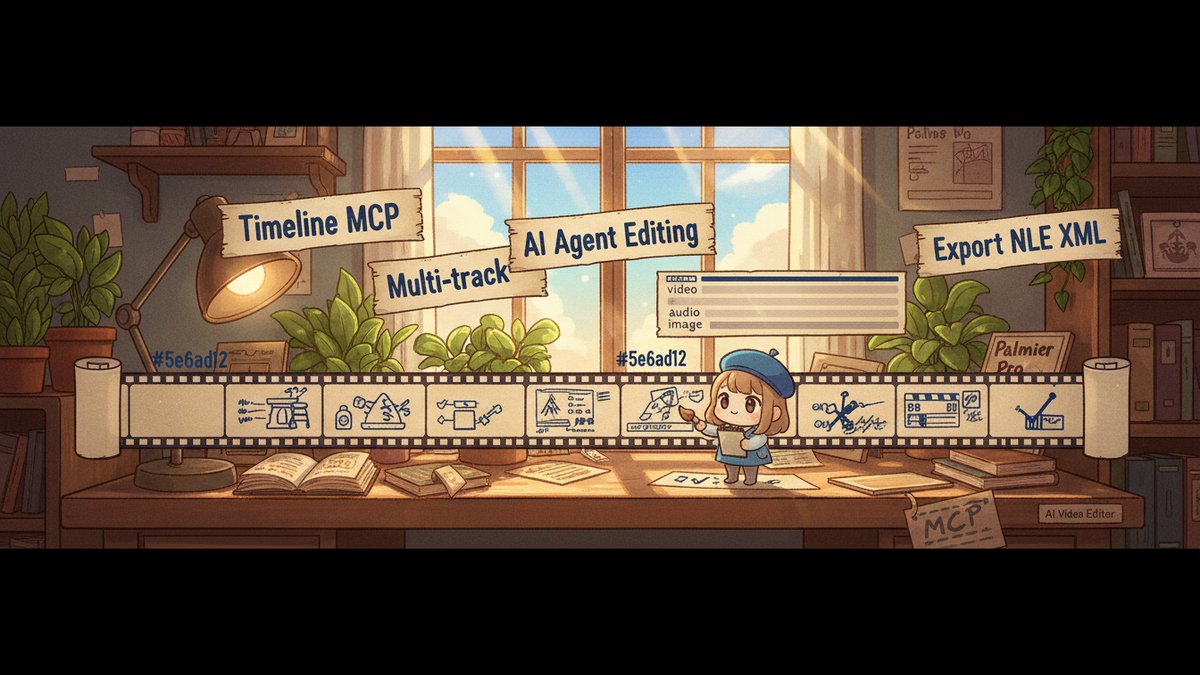
Palmier Pro is a Y Combinator-backed video editor that puts AI agents — specifically Claude, Codex, and Cursor — directly inside your timeline, not behind a chat panel and a copy-paste step. You load footage, mark the rough assembly with voice or text, hand it an MCP server (Model Context Protocol, an open standard that lets AI tools call functions in other apps — think of it as "APIs the AI can actually use"), and the agent reads the timeline, plans a cut, executes trim/split/opacity edits in place, and hands the project back. That last bit — the agent editing timeline state, not generating text that you, the human, then re-execute — is the unlock.
What it actually is
Palmier Pro sits in the gap between three categories that, until recently, did not talk to each other:
- Traditional NLEs (Non-Linear Editing systems) — Premiere Pro, DaVinci Resolve, Final Cut. You trim. The AI is a Smart Cut or a transcription tool bolted on.
- Generation platforms — Runway, Higgsfield, Artlist. You prompt. The output is a clip. You then import that clip into something else for assembly.
- Palmier Pro — a real NLE with multi-track editing (video, audio, image, text), standard controls (trim, split, speed, opacity, transform), and direct integrations with Kling V3, Seedance 2.0, Veo 3.1, and Grok Imagine for inline generation. The AI does not live behind a chat tab. It runs on the same project state, with the same agent framework your dev team probably already uses for code.
Three tiers in pricing shape, as of today:
| Plan | What it does | Launch price | Regular price |
|---|---|---|---|
| Free | Editor + import/export, no AI features | $0 | $0 |
| Pro | AI generation credits included | $29 / month | $49 / month |
| Max | More credits, longer exports, fuller agent access | $69 / month | $99 / month |
The Y Combinator line on privacy is worth quoting plainly: customer content is not used for AI model training. That is the line every video tool of this shape has to draw out loud right now.
Where it fits vs the existing stack
The way I would explain the difference to a marketing team on Monday morning:
| Task | Runway / Higgsfield | Premiere / DaVinci | Palmier Pro |
|---|---|---|---|
| Generate one perfect 6-second clip | Strongest | N/A | Yes (via Kling / Seedance / Veo / Grok) |
| Assemble a 90-second narrative cut | Weak (download-import) | Strong (manual) | Agent-led, with human review |
| Heavy color / VFX (visual effects) work | N/A | Strongest | Basic only (NLE XML export to Premiere/DaVinci) |
| Recurring weekly content with brand consistency | Manual every time | Manual every time | Agent-on-timeline with policy notes |
| 4K raw footage, multicam, color finish | N/A | Strongest | Out of scope; export XML and finish in a real NLE |
The short version: Palmier Pro does not replace a senior video editor on a flagship brand film, and it does not pretend to. It replaces the 80% of marketing video work that is "make another version of the recurring format with this week's talking points," where the value of an AI is not editing skill but production-discipline enforcement — the same cut every week, the same lower-third (branded caption strip overlaid on the bottom of the frame) treatment, the same outro beat.
The 5 jobs I'd hand Palmier Pro today
1. Recurring weekly social formats. Webinar recap, founder POV (point-of-view) posts, customer quote-of-the-week. The cut is repeatable; the content is not. Let the agent take the first pass; you take the final three.
2. Multilingual ad creative adaptations. Take your hero video; the agent pulls new B-roll from Kling, swaps on-screen text via the transcript-to-blog pattern (how I turn YouTube into posts), and ships twelve regional cuts in the time the current pipeline ships one.
3. Product demo v2 — "lead with this feature this week." When the PM says "let's lead with the audit feature this week," the agent pulls the relevant section to the front, regenerates the intro, keeps the outro. Brand consistency stays; feature emphasis moves.
4. Customer quote compilations. Twelve 30-second testimonials from twelve sources. Hand the agent the brief; let it pick the strongest lines, suggest transitions, produce a master cut for human review.
5. Webinars → repurposed short clips. Transcription-aware cut selection for the "I learned something in five minutes" share. The same pattern powers about half of what you would otherwise hand to a junior editor.
The 3 I'd keep on a traditional NLE
1. Anything with serious color work. Color finishing (the final pass where a colorist matches tone shot-to-shot and locks the look) still belongs in DaVinci or Baselight. Palmier does basic grading; the real look is somebody's day job.
2. Multicam narratives, scripted pieces, hero brand films. Six cameras, three angles, every pause scripted. The AI's edits will land flat on a piece where timing IS the writing.
3. Any project where "the AI edited it" is a brand risk. If a customer refuses to believe anything other than a human cut the spot, do not use a product where that claim is even slightly fuzzy. The "no training on your content" line is great; it does not protect you from inference.
The part that is genuinely new for marketing teams
The MCP integration is the under-reported feature. Today, marketing teams routinely hand Claude or Codex a content brief and ask it to draft something the editor has to manually drop into a timeline. With Palmier, the agent does the dropping. That means the same agent that drafted the email subject line can also re-cut the recap video on Slack.
That is a workflow, not a feature. It collapses a step that used to take 20 minutes of human coordination into 2 minutes of an agent call. The implication for any marketing team that already uses AI assistants for content work is direct: stop having the AI write the brief for the video, then handing it to a separate human editor; let one agent see the whole project.
A 30-minute no-prior-history workflow
If you want to test it before believing any of the above, this gets you to "agent suggested a cut" in half an hour:
- Sign up for the Free plan. Import one short (≤60-second) clip and one audio track.
- Drop a short text note under the clip: "open cold with a product shot, B-roll from generated office scenes, close with logo, 30 seconds, no captions."
- Hand the project to Claude via the MCP integration. Watch the agent propose a cut on the timeline itself.
- Reject two of the seven edits, accept three, regen two. Ship to MP4.
- If you already live in Premiere or DaVinci, export the NLE XML (an editable project file both apps understand) instead of MP4 and finish the grade there.
That is not the senior-editor use case. But it is the use case that gets your team to stop reading about "AI in the timeline" and start experiencing it.
Where I land
Palmier Pro is not the video tool that will replace your most expensive editor. It is the one that lets a small marketing team ship the kind of recurring video work that today either gets dropped, gets rushed, or gets bumped to next quarter. That is the same place n8n + ChatGPT pulled content audits out of the backlog, the same place Sora gave a marketer their first demo video ad, the same place HeyGen unlocked for avatar-led video at scale: not replacement of a craftsman, but collapse of a recurring coordination tax.
The model integrations — Kling V3, Seedance 2.0, Veo 3.1, Grok Imagine — cover the "generation in the timeline" part end-to-end without you re-buying subscriptions across four vendors. The MCP integration is the one I will be watching most carefully; if Claude becomes a normal participant on marketing projects the way it is on a codebase, the next twelve months look very different for everyone running video in-house.
For now: pull a recurring video format out of your backlog. Hand it to Palmier. Hand the final pass to whoever was already cutting it. The product is exactly as new as its premise — and the premise is "the agent reads the timeline, not the brief."