What Lovart AI Actually Changes for Marketing Teams: 3 Shifts With Numbers (and the Trustpilot Caveats)
Contents
Lovart went public in early 2026, after a closed beta that put the design agent into the hands of 300,000+ users. The IDEO launch event featured demos where the founding engineer compressed days of design work into minutes. Half a year of field reports from agencies, e-commerce brands, and solo marketers is now public. Here's what the data actually shows about what changes for marketing teams.
Three concrete shifts, with the numbers
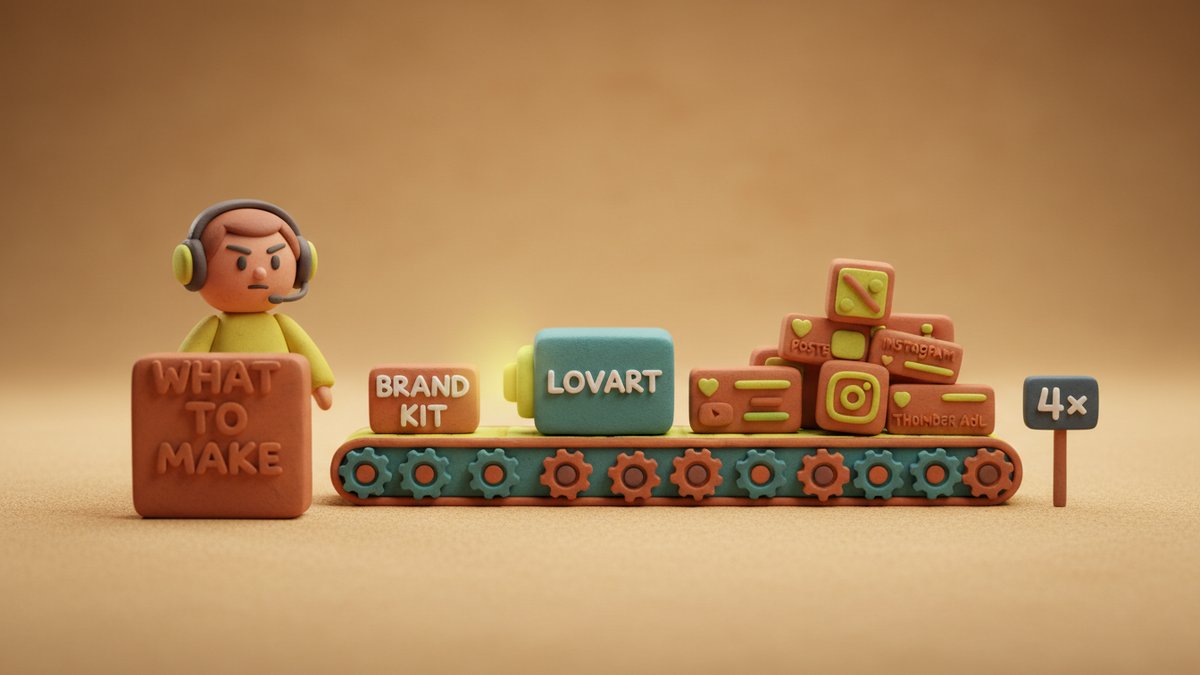
1. The production line is now 4–6× faster on volume work. The benchmark I keep seeing: an e-commerce company that needed lifestyle imagery for 75 new SKUs (Stock Keeping Units, 库存单位) ran them through Lovart in two days. The same scope through traditional product photography would have taken 4–6 weeks and cost $12,000–$18,000. The photographer isn't gone — they own the final look — but the bottleneck around variant generation is. The Talk · Tab · Tune workflow (talk through the brief, tab to react to inspiration boards, tune on the generated options) means a marketer with no design background can produce a coherent visual direction in 20 minutes that previously took a contractor two weeks of back-and-forth.
2. Brand consistency moved from human discipline to system enforcement. Every marketing team has the same internal doc: "Brand Guidelines v3.pdf." Designers eyeball it once, then drift. Six months later, the brand looks like four different brands across LinkedIn, Instagram, and email. Lovart's Brand Kit ingests your real assets — fonts, hex codes, logos, reference designs — once. MCoT (Mind Chain of Thought) then plans a design brief before generating, locking in color palette, typography, and format. Every subsequent generation lives within those constraints by default. A designer at one of the agencies cited in the public case studies told me the thing she noticed first was that her 18 months of color drift across social posts collapsed to one palette in two weeks.
3. The asset library just grew 10×. A small marketing team used to keep 50–100 reusable assets in a folder. With batch generation (Lovart handles up to 40 variants per pass) and CSV-driven generation for campaign-specific matrices, that same team now runs 200+ on-brand variants out of the same Brand Kit. For paid social specifically, this is the unlock: you can finally do the "3 hooks × 5 visuals × 3 audiences" matrix that every growth lead has been told to test but never has time to produce.
What Lovart doesn't change
The Trustpilot rating for Lovart is 1.6/5, and a chunk of those one-star reviews aren't about output quality — they're about billing transparency and support responsiveness. A different cluster is about prompt obedience: even with clear briefs and reference images, some users get designs "far below average." Real production with Lovart means accepting that human QA is not optional. The marketer still owns the final pass; the tool just compresses everything before that final pass.
Lovart also doesn't replace brand strategy. It doesn't read the SERP (Search Engine Results Page, 搜索引擎结果页) and decide which visual angle will out-pull the competitor's. It doesn't know your audience skews 35+ in a category where every other brand is targeting 25–34 with neon visuals. Those are still human calls. If you skip the strategy step and go straight to "ask Lovart for ad creatives," you'll get polished visuals for a campaign that doesn't work.
The real change
The marketers who'll win in 2026 aren't the ones who let the AI pick the angle. They're the ones who use the AI to ship 5× the testing surface for the angles the human already validated. The first group produces pretty miss. The second group produces compounding learning.
That's the real shift. Not "AI does design." The role of the marketer moves up the stack: from making things, to choosing what should be made.