Kimi K3 and the 3-5 Month Gap: Why the Newest Open-Weights Frontier Model Is Disruptive (and What Isn't)
Contents
Two credible people wrote about Kimi K3 the same week. Nathan Lambert titled his essay "Kimi K3: The open-weights escalation" and argued the gap between US and Chinese frontier models just collapsed. Zvi Mowshowitz wrote "Do not get carried away" and put the gap at four to six months. Both are right. That tension — between "the most disruptive release of 2026" and "don't lose your head" — is the whole story, and a marketer trying to figure out what to actually do with Kimi K3 needs both readings.
Kimi K3 shipped on July 16, 2026 from Moonshot AI. The full open weights are scheduled for July 27. Here's what's actually new, what's hype, and what I'd put in my pipeline tomorrow morning.
What's actually new — four things, not one
The "disruptive" talk isn't about a single feature. It's the combination.
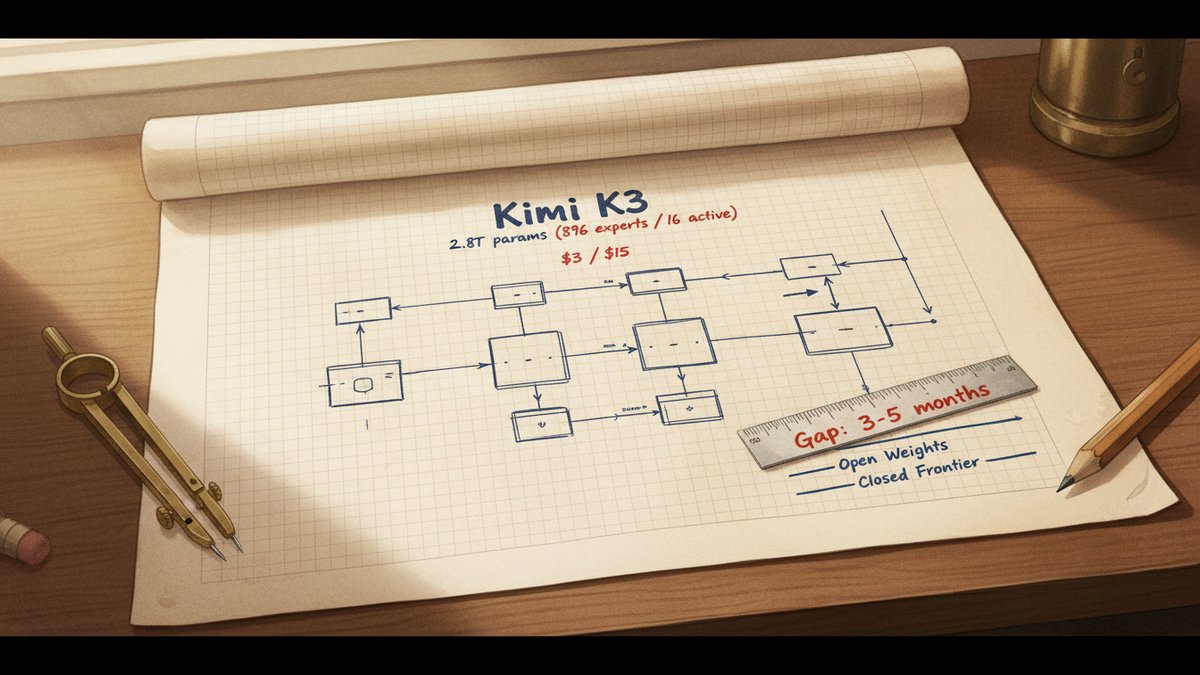
2.8 trillion parameters, open weights. That number isn't special on its own — frontier models have been in the trillion-parameter range for a year. What's new is releasing them open. K3 is the largest open-weight model shipped to date, and the gap between what closed labs can build and what open weights can do just shrank visibly.
896 experts, 16 active per token. The Mixture-of-Experts architecture means only about 1.8% of the parameters fire on any given token. So a 2.8T-parameter model runs at roughly the compute cost of a much smaller dense one. That's why the API can be priced at $3 per million input tokens and $15 per million output tokens — the same tier as Anthropic Sonnet — instead of $30+.
1 million-token context, native multimodal. Long enough to ingest a full site audit, a quarter of competitor scrape, or a year's worth of brand guidelines in one shot. Visual understanding is native, not bolted on.
Always-on "thinking mode." This is the quietly disruptive one. Most reasoning models require a separate variant — you pick "the thinking one" when you need it. K3 reasons by default. The implication: a single API call does what used to require a "should I switch to the reasoning model?" decision every time. For agents running many small steps, that decision cost disappears.
The two architectural innovations that make the economics work
The pricing story only works because Moonshot shipped two genuinely new tricks:
- Kimi Delta Attention — a hybrid linear attention mechanism Moonshot reports runs up to 6.3× faster than standard attention on long-context decoding. Without it, a 1M-context model at this price tier wouldn't be usable at conversational speed.
- Attention Residuals — a replacement for standard residual connections that Moonshot reports delivers about 25% training efficiency gain for under 2% additional compute overhead. This is what made training a 2.8T model economically feasible under China's compute constraints in the first place.
These aren't borrowed ideas. The "Chinese AI = distillation from US labs" narrative — which a lot of US commentators were comfortable with in 2024 and 2025 — has visibly less purchase after this release. Moonshot is solving the same problems OpenAI and Anthropic are solving, in some cases getting there first.
The benchmark reality check
Frontier ranking right now, per independent testing:
- #1 Frontend Code Arena. K3 took the top spot. This is the benchmark the dev community trusts most for shipping production UI.
- DeepSWE 67.5 vs GLM 5.2's 46.2. A 21-point gap on real-world software engineering problems — the largest single-model win of the release.
- Terminal Bench 2.1: 88.3 vs GPT-5.6 Sol's 88.8. Effectively tied for terminal-based dev work.
- Vals AI Index #2. Artificial Analysis Intelligence Index #3. Solidly frontier, but still trailing Claude Fable 5 and GPT-5.6 Sol on aggregate.
The catch — and Zvi's sober reading is right here — is that Moonshot's benchmarks all run at maximum reasoning effort, which burns substantially more tokens than peers use in like-for-like tests. Independent testing put K3's raw accuracy at 46% (up from K2.6's 33%) but the hallucination rate also rose to about 51%. Expect jagged practical performance: K3 will be excellent at some tasks and noticeably weaker at others.
The per-task cost number is the one that should change your routing math. Artificial Analysis measured roughly $0.94 per task for K3 versus $1.04 for GPT-5.6 Sol and $1.80 for Claude Opus 4.8. Same frontier-tier output, lower per-task bill, because K3's answers are more token-efficient.
What I'd actually do tomorrow
Three concrete moves, ordered by how much existing pipeline they touch:
- If you already route through OpenRouter for multi-model runs, add K3 to the rotation. Run the same prompt through K3 alongside Claude Fable 5 and GPT-5.6 Sol for any output where you currently spend human review time — lead copy, executive memos, anything brand-voice-critical. Per-task economics favor K3 on the jobs where its reasoning depth pays off.
- If you have a long-context pipeline — RAG over a content library, a full-site audit, a quarterly competitor dump — K3's 1M context with thinking mode on by default collapses several agent steps into one. Don't rebuild anything yet; just rerun your existing pipeline against K3 and watch the step count.
- Don't switch wholesale. K3 at max effort burns tokens. For high-volume, low-stakes jobs — meta descriptions, alt text, internal link drafts — the smaller cheap models (including K2.6, GLM 5.2, and the existing local-model stack) still win on cost. Treat K3 as a premium-tier option that joins the rotation, not a replacement.
The disruption isn't K3 — it's the speed
The most important number in the launch coverage isn't 2.8T. It's 3-5 months — Nathan Lambert's estimate of the current open-to-closed performance gap, down from the 6-9 months most analysts had been quoting in early 2026. A single release cut the gap in half. Whatever your current model stack is, plan for that gap to keep shrinking on roughly this cadence.
Marketers who treat model choice as a quarterly decision (re-evaluate every 3 months, run new benchmarks, rotate at least one model in the stack) will be in the right place. Marketers who picked an LLM stack in 2025 and haven't looked at it since will be re-platforming in 18 months. That's not a prediction; that's just what the release cadence has been doing for two years now.
Kimi K3 is not the day the frontier moved. It's the day you could see it moving in real time, and the day a Chinese lab visibly joined the architectural conversation rather than just the price conversation. Both of those are durable changes. Neither means you should rewrite your playbook on Monday morning.