Kimi K3.1 Pro for Marketers: Same Model, Better Training — and What Half-Price Frontier Access Changes
Contents
On Terminal-Bench 4.0 — the benchmark where a model opens a terminal, reads the error output, and keeps going until the job is actually finished — Kimi K3.1 Pro scored 67.2%. Claude Opus 5.5 scored 66.4%. Under Moonshot's own harness the two land at 65.7% and 66.4%. Kimi's list price is $2 per million input tokens, $10 per million output. Opus is $4 and $20.
Half the price, a tie with the top of the leaderboard, and it ships with a million tokens of context plus native image and video input.
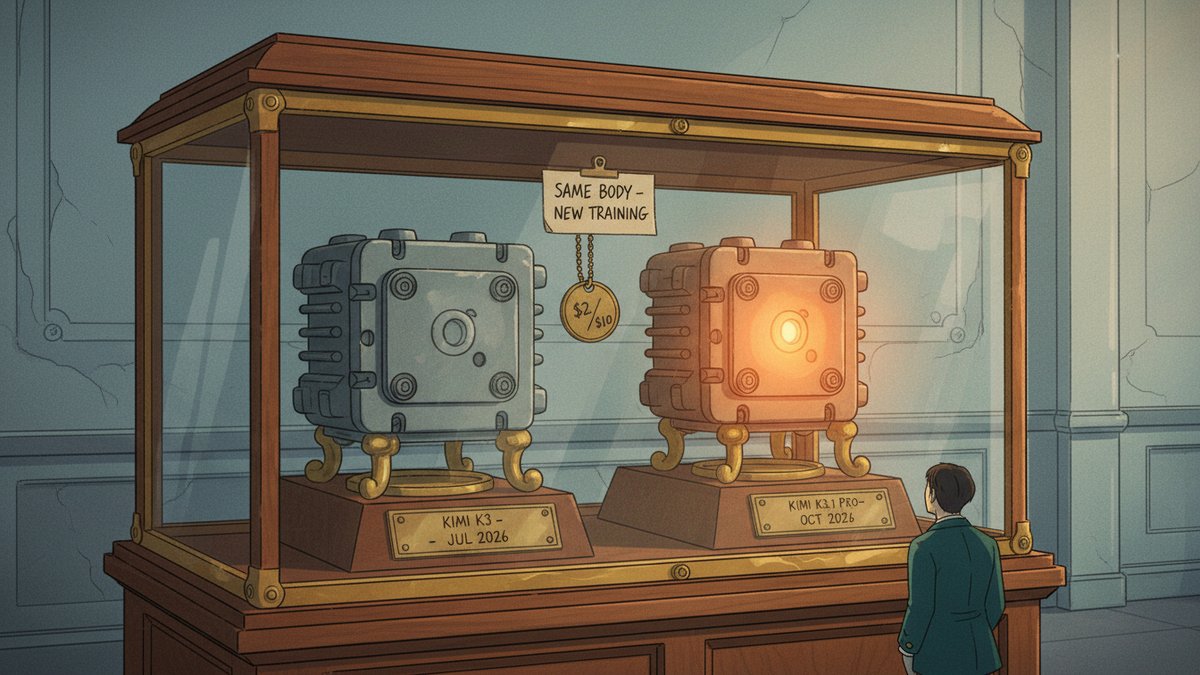
But here's the part I keep coming back to. K3.1 Pro has exactly the same body as Kimi K3. Same 2.8 trillion total parameters, same 104 billion active, same 896-expert mixture-of-experts, same 1M-token window. Moonshot didn't build a bigger model. They post-trained the one they already had, and the Artificial Analysis Intelligence Index moved from 43.6 to 55.1 — fourth in the world, three points behind Claude Opus 5.5.
That's a different story from "China is closing the gap," and it's the part that should change how you think about the model you're already paying for. When I wrote about Kimi K3 in July, the thing I flagged to watch was its hallucination rate. The body of the model is identical. The hallucination number is not.
Everything below is built on published numbers — Moonshot's own harnesses plus Artificial Analysis's independent runs — read one day after launch. I haven't put my own marketing prompts through it yet. Treat the routing as a hypothesis with a price tag attached, and the cost math as exact.
Three numbers worth more than the leaderboard position
One: hallucination, and the second hallucination number that nobody reconciles.
Moonshot's own hard evaluation — the Kimi Hallu Bench Hard — reports claim-level hallucination falling from 23.4% on K3 to 8.3% on K3.1 Pro. On the with-tools variant of that same test, K3.1 Pro at 8.3% beats Opus 5.5 at 15.0%, GLM-5.3 at 22.6%, and Claude Fable 5.1 at 23.3%.
Artificial Analysis's independent run says something much less flattering. On AA-Omniscience, K3.1 Pro has a 56.1% non-hallucination rate — a 44% hallucination rate, down from K3's 53%. So the model is genuinely 9 points better, and the absolute number is still bad enough that I would not let it write a client-facing claim without a human reading it.
Both numbers are true, they measure different things, and the gap between them — 8.3% against 44% — is the actual story. Hallucination rate is not a property of a model. It's a property of the model plus your prompt plus your domain. Which means the only number that has ever mattered to your workflow is the one you measure on your own work. Moonshot's number tells you the vendor's floor rose. Your number is the one that decides whether you can hand the job over.
This is why the release matters more than the index score. Hallucination is the actual gate on delegation. Everyone says they want to give more work to AI; almost nobody can name which work.
Two: the 33% price cut doesn't lower your bill.
Per token, K3.1 Pro is a third cheaper than K3 — $2 and $10 against $3 and $15, cached input $0.20 against $0.30. (In China: ¥13 per million uncached input, ¥1.3 cached, ¥68 output.) Artificial Analysis then measured that K3.1 Pro uses 14% more output tokens per task — 55K against K3's 48K. Cost per Intelligence Index task lands at $1.98 in the launch post and $2.11 on the model page today, against $2.00 for K3.
Flat. The token price fell a third and the bill stayed where it was, because the smarter model spends more tokens thinking.
Where the cut is real: short output. Classifying, tagging, rewriting, pulling one field out of a document, generating subject lines — work where the reasoning trace doesn't blow up the token count. There you genuinely pay a third less. Where it isn't real: anything long-form or multi-step, where the extra thinking tokens eat the whole discount.
So route on accuracy per token, not on the sticker price. "K3.1 Pro is 33% cheaper" is the wrong sentence. "K3.1 Pro is cheaper on jobs where output length is bounded" is the right one.
Three: tools beat the model upgrade.
On BenchCAD — building 3D models from images — K3.1 Pro scores 72.8% working on its own, and 92.7% once you give it tools to run. That's 19.9 points from tool access alone, on the same model, on the same task. Bigger than most model upgrades of the year.
For marketers this is the most actionable thing in the launch, and it isn't even about Kimi. If your agent does everything in one prompt — one long instruction, no tool calls, no retrieval, no browser — then the model upgrade you've been waiting for is worth less than wiring up the tools the model already knows how to use. Check that before you re-platform anything.
Where I'd route it
Five jobs I'd hand K3.1 Pro this month:
Multi-step agent loops that currently stall. Terminal-Bench 4.0 is the clearest number in the release: 13% on K3, 67% on K3.1 Pro. If you run a workflow where the agent gathers, compares, drafts, and files — my daily Reddit monitor is exactly that shape — and it keeps dropping the last step, the model was the bottleneck. One user's side-by-side on a long agentic run is an anecdote, not a benchmark, but it's illustrative: K3.1 Pro at high effort produced 114K output tokens for an API-equivalent $1.57 and finished in 13 minutes of wall clock, against Opus 5.5's 235K output tokens for $5.58 and 29 minutes.
Research briefs where every number has to be traceable. Moonshot's internal financial research evaluation went from 58.8 to 70.4, and internal business operations from 8.9 to 37.0 — roughly four times. Finance-style audited analysis is the closest public analogue to the marketing research you actually want: pull the source, cross-check the numbers across documents, build the model, cite it.
High-volume short output at the new price. Subject-line variants, meta descriptions, alt text, product-tag classification, ad-variant rewrites. Bounded output length is where the 33% cut actually lands.
Everything you parked on frontier pricing. K3.1 Pro ties Opus 5.5 on Terminal-Bench and beats it on SWE Marathon (51.7% against 46.3%) and OfficeQA Pro v2 (64.4 against 62.2). Half the price of the model you were about to switch to for a quality bump you can now skip.
Product and 3D asset work. 3D Make, live on kimi.com and the mobile apps, takes a description, a sketch, or a reference photo and produces an editable 3D model you can preview, adjust, export to video, or hand to a 3D printer. For e-commerce and brand teams, that's a photo-studio-shaped task moving to an API price. The caveat: with tools it scores 92.7% on BenchCAD against Opus 5.5's 96.2%. It's the cheap 3D model, not the best one.
Three I'd keep elsewhere:
- Brand-voice final-pass copy. Nothing in this release measures prose. My rule for brand voice hasn't changed through a year of releases and it isn't changing here: the model that writes the words stays where it is.
- Latency-critical interactive surfaces. Artificial Analysis measured roughly 30 seconds to first answer token for standard K3.1 Pro and 18 seconds for Highspeed, at 73.5 and 129 output tokens per second. Reasoning is mandatory on this model — asking to turn it off returns a 400 error — and it defaults to max. That's fine for a nightly agent and wrong for a chat widget. And Highspeed, at $4 and $20, is exactly Opus pricing, so at that point you should ask whether you need a reasoning model at all.
- Anything where you need the license today. The full weights are promised by November 4 and the license hasn't been published. GLM-5.3's open release arrived under a non-MIT license with an extra condition on hosting businesses above $10B in annual revenue. I don't know what Moonshot will do — but if you're building a self-hosted stack on someone's open weights, wait for the license text, not the weight files. If you're running client work through a hosted API, note that enterprise access to K3.1 Pro is off by default at launch; an admin has to switch it on.
Where a marketer actually meets this
Kimi Code is a terminal coding agent. Not your surface. Kimi Work is — the desktop agent inside Kimi's Windows and Apple-silicon Mac app, and it's where K3.1 Pro lands for people who don't write code.
It reads and writes inside folders you authorize, drives your actual logged-in browser through a Chrome or Edge extension (Moonshot calls it WebBridge), runs scheduled jobs on a real five-field cron engine, and can fan a large job out across up to 300 sub-agents and 4,000+ tool calls. Goal Mode keeps a defined task moving for up to 24 hours.
The marketer-shaped version: a nightly job that opens your logged-in Meta Ads Library tab, pulls your competitors' new creatives, writes the summary into a folder, and asks before it writes anything. That's the Meta Ad Library sweep I already do with a scraper and a cron job — minus the maintenance, running on a laptop that already has your session.
Pricing runs $19 for Plus (25 swarm uses a month, 2 concurrent sub-agents), $39 for Pro (50 uses, 4 concurrent), $99 for Max (120 uses), and $199 for Ultra (240 uses, 8 concurrent). The older account names — Moderato, Allegretto, Allegro, Vivace — sit at the same price points, and Kimi Code's 1M context needs the $39 tier while the 1M-token extra-long chat on the Kimi app itself needs $99 and up. The free plan gives you six agent tasks and two scheduled tasks.
Two things to know before you schedule anything: it runs locally, so if the machine sleeps the trigger doesn't fire and missed runs aren't replayed — turn on Keep Computer Awake. And it's still in beta.
Three things to watch
The weights. Promised by November 4, license unpublished. Watch the license terms, not the file size.
The cyber ablation. Moonshot deliberately removed cyber-related data from mid-training and from its reinforcement learning environments for the open release, then published what that cost them. On their internal xdev-bench-hard, an unfiltered checkpoint solved 90.5% of problems at pass@3; the shipped model solves 81.0%. K3 managed 33.3%. That's the first time a lab has shown its hand on a capability it chose not to ship, and it's a healthier norm than the alternative — but it's also a reminder that an open-weight model's capability profile is a policy decision, not an accident.
The API ergonomics. A mistyped model ID doesn't error out — it silently routes to K2.8 Preview, without thinking. And the docs warn against switching to K3.1 Pro inside an existing K3-series session: unexpected behavior, lower cache hit rates. Start a new session. Test your model IDs. Zero Data Retention is available on the API, which matters if you're moving client data through it.
The number I'd actually keep
The headline is 55.1 — fourth in the world, three points behind the top. The number I'd actually keep is 8.3. A model that invents less than the one above it on the kind of work you do is worth more than a leaderboard position, and this is the first open-weights release at this score where I'd argue that.
The other thing worth sitting with: Moonshot changed nothing about the model and everything about the training. Every lab has that lever, including the two whose APIs you're paying for right now. Which means the model you're calling in 2026 is probably not the model that vendor is shipping in Q4 — it just takes them one release cycle to hand you the difference.
So the question isn't which model won October. It's whether you've read your vendor's changelog since the last release that surprised you.