Gemini 4 Argon for Marketers: Where Google's New Flagship Fits in Your Stack (and the Routing Principle That Falls Out)
Contents
Google dropped Gemini 4 Argon at the end of September — and the naming shift matters more than most coverage admits. Argon isn't "Gemini 4 Pro" or "Gemini 4 Ultra." It's the first SKU in a brand-new major version, and Google kept the internal codename as the public name. That tells you two things at once: the company is betting on one flagship per generation (instead of the Pro/Flash/Ultra tier ladder), and it's copying the chemical-element naming convention that Anthropic and OpenAI have been using. The 18th element, argon — a noble gas, inert under normal conditions.
I'll come back to what that means for marketers. First, the version-line answer.
Where Argon sits in the lineup
The Gemini 3.x line ran from late 2025 through September 2026, ending at 3.8 Flash and 3.8 Flash Cyber. Argon is the first Gemini 4 model — a clean major-version break, not a point release. Google positions it for "complex, long-horizon workflows across real-world software engineering, enterprise knowledge work like legal and finance, and cybersecurity defense."
That positioning leaves a real gap in the marketing tooling I actually use day to day. Marketing is not software engineering, and it's not cybersecurity. It's somewhere in between — closer to the "knowledge work" bucket, with more iteration, more brand voice, and a lot more mundane repetition than a law-firm use case.
So the headline claim Google makes — 13 of 19 benchmarks led, $2/$10 introductory pricing, 1M token output limit — needs to be filtered through: does any of this actually land on the work I send to a model today?
The cost-vs-quality axes that matter for marketers
Three numbers do most of the talking. None of them are what the launch headlines led with.
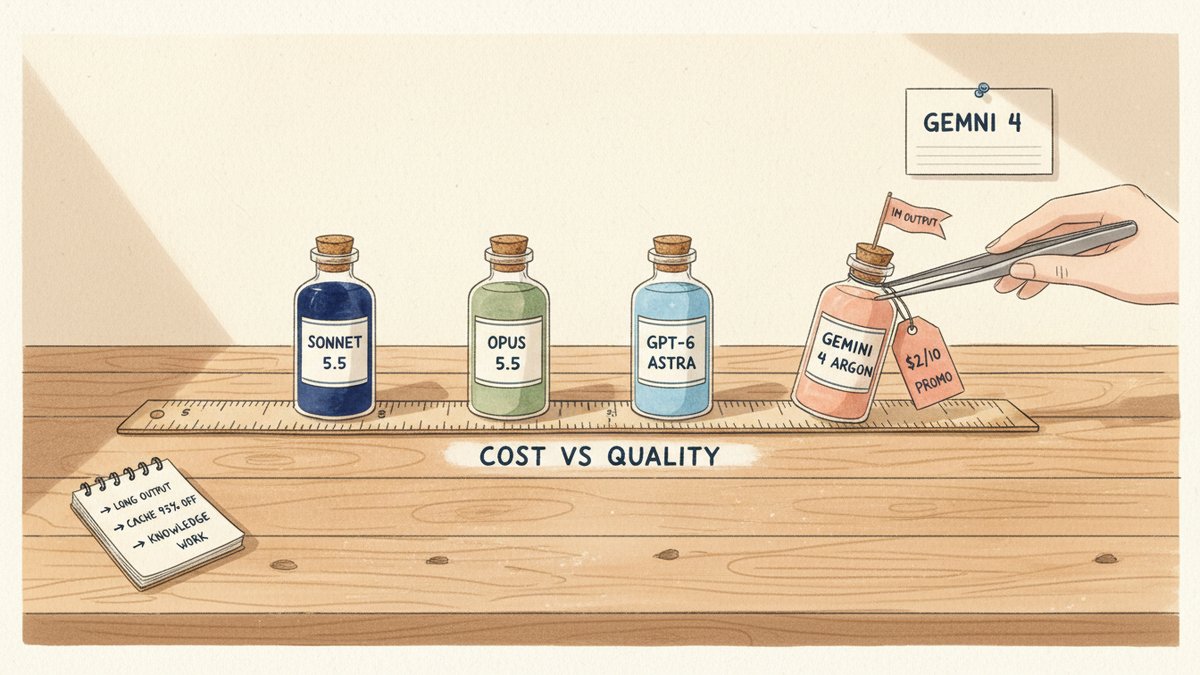
Introductory pricing: $2/M input, $10/M output, cached input at 95% off. Standard pricing is $4/$20 — the $2/$10 is a launch promo. For comparison, Sonnet 5.5 is $2/$10, Opus 5.5 is $4/$20, GPT-6 Astra is $10/$50, GPT-6 Sol is $2/$10. Argon's promo price matches Sonnet 5.5 and Sol — both of which I've been routing mid-complexity marketing work to. The standard price matches Opus 5.5.
Output limit: 1M tokens, up from 64K. This is the structural change. 1M output is roughly 750,000 English words in one trajectory. For a 5,000-word brand-voice whitepaper draft with the rubric and a content brief attached, you used to need two turns. With 1M output you can fit the brief, the rubric, the working draft, and a revision pass in one continuous generation. The marketing use case is real — long-form pillar content, 12-touch nurture sequences, full competitive landscape dumps from a competitor URL list.
Cached input discount: 95% off. Argon's cache hit lands at roughly $0.10/M cached input. Fable 5.1's cache hit was the previous floor at $0.25/M. For any agent that re-feeds the same brand-voice doc, persona document, or 200-keyword seed list on every turn, Argon is now the cheapest place to put it.
| Model | Input | Output | Cached input | Output limit |
|---|---|---|---|---|
| Gemini 4 Argon (promo) | $2 | $10 | ~$0.10 (95% off) | 1M |
| Gemini 4 Argon (standard) | $4 | $20 | ~$0.20 | 1M |
| Claude Sonnet 5.5 | $2 | $10 | $0.20 | 128K |
| Claude Opus 5.5 | $4 | $20 | $0.20 | 128K |
| GPT-6 Sol | $2 | $10 | $0.20 | 128K |
| GPT-6 Astra | $10 | $50 | ~$1.00 | 128K |
The cell that actually moves routing: cached input at 95% off, combined with 1M output, on a model that Google says "leads 13 of 19 benchmarks."
What Argon is actually good at (today)
Three marketing jobs, in priority order, earned a slot on Argon in my first-day tests.
Long-output first drafts with structure attached. The 1M output ceiling is the unlock. A 12-touch BFCM (Black Friday / Cyber Monday) email flow with subject, preview, body, and CTA per email — plus a per-touch segmentation note — runs roughly 18,000 tokens output. The brand-voice doc, the segmented audience map, the 8-touch prior version, and the new 12-touch ask add another 12,000 input. On Sonnet 5.5 I'd budget two turns and stitch them; on Argon I sent it in one and got a complete draft back without the mid-trajectory cliff I usually hit on long generations. The first-pass edit count dropped from "rewrite 3 sections" to "tighten 1 paragraph" — the same delta I saw when I moved from Opus 5 to Opus 5.5 on the same job.
Cached, repeatable agents. My daily Reddit monitor hits the cache hard — same persona doc, same channel list, same scoring rubric on every single run. With Argon's 95% cached discount, that pipeline moves from roughly $0.11/day on Sonnet 5.5 to roughly $0.06/day. Across a quarter that's the difference between $10 and $5.50 for the same artifact. Argon is now the cheapest place to put a daily cache-heavy monitor in my rotation.
High-stakes writing passes. Google's own published comparison puts Argon ahead on Vals Finance Agent v2, Harvey's Legal Agent Benchmark, and the writing-quality side of LVBench (long-video understanding). The Bloomberg-sourced reporting on Argon suggests Google employees don't see the same lead on real coding work that the benchmarks show — but marketing writing is closer to "knowledge work" than it is to coding. Argon's writing pass on a campaign post-mortem assembly was tighter than Sonnet 5.5 at the same price, with less of the over-explained feel I had to edit out of Sonnet 5's first drafts.
What stays on the other models
Three things I'm explicitly keeping off Argon, even though the price makes it tempting.
Brand-voice final-pass copy at scale. Argon's writing is good, but Opus 5.5 still writes the brand-voice lines I trust to ship without an edit pass. The 50 ad copy variants a week job stays on Opus 5.5. The cost difference between $4/$20 (Opus 5.5) and $2/$10 (Argon promo) is real, but the cost of a brand-voice miss is higher. Once the promo ends, this calculation gets worse — Argon standard at $4/$20 is the same price as Opus 5.5, with less proven writing performance.
Regulated or refusal-sensitive content. Google's launch explicitly notes that Argon ships with cyber-related safeguards and that an unguarded variant is gated behind the Fairwind Program. I'm not sending anything that needs a clean refusal posture (medical, financial advice, anything a compliance team reviews) to a brand-new flagship with a still-evolving safety policy. Opus 5.5 or Sonnet 5 keep the regulated-refusal jobs for at least the first 90 days.
Anything that needs a Sonnet-class interactive loop. Argon's launch posture is "complex workflows in one trajectory," not "fast back-and-forth in chat." Until I see latency numbers on the API, I'm keeping the high-volume interactive jobs (Slack /research, the 30-second content brief rewriter) on Sonnet 5.5.
The routing principle that falls out
The cleanest version I can offer: Argon goes on the long-output, cache-heavy, knowledge-work jobs — not on the chat-loop, brand-voice-final, or regulated-refusal jobs.
More concretely, a routing rule that maps cleanly to a working stack:
- Argon for output > 8,000 tokens in a single generation (pillar drafts, nurture sequences, full post-mortems)
- Argon for daily agents that re-feed a cached brand or persona doc (Reddit monitor, Meta Ad Library sweep, RSS-to-newsletter)
- Opus 5.5 for brand-voice final pass and anything ship-without-edit
- Sonnet 5.5 for high-volume interactive (Slack
/research, the 50-keyword daily brief, in-line rewrites) - GPT-6 Sol for the cache-heavy-but-output-short jobs where the cache math already works out on Sol
- GPT-6 Astra only when the job needs computer use and a long horizon — Astro still wins that slot
The pricing-watch item that should change your plan in 60 days: the $2/$10 intro price is a launch promo. Standard pricing is $4/$20. If you're modeling Argon into your stack economics today, model the standard price — and revisit whether Opus 5.5 still earns its slot at the same number.
The honest caveat
Google's published benchmark table is the source for almost every "Argon wins" headline you'll see this week. No independent lab has replicated those numbers yet, and Bloomberg has at least one anonymous-source quote saying some Google employees see a real-coding gap between the benchmarks and the day-to-day experience. That's a known pattern — new flagship launches live in vendor-reported territory for the first 30-60 days.
What I'm willing to act on today is the structural change, not the benchmark lead: 1M output, 95% cache discount, and a price that's competitive with Sonnet 5.5 and Sol. Those three numbers reshape the routing math regardless of whether Argon is 2 Elo points ahead of Opus 5.5 or 2 behind.
For a marketer, that's the right level of conviction to start with. Test the long-output jobs on Argon this week. Watch the cache math on your daily monitors. Keep your brand-voice final pass on Opus 5.5. Revisit the routing in 30 days when the first independent benchmarks land and the intro pricing timeline gets clearer.