Map Topical Authority: 500-URL Content Hub Audit (Claude + Sitemap XML)
Contents
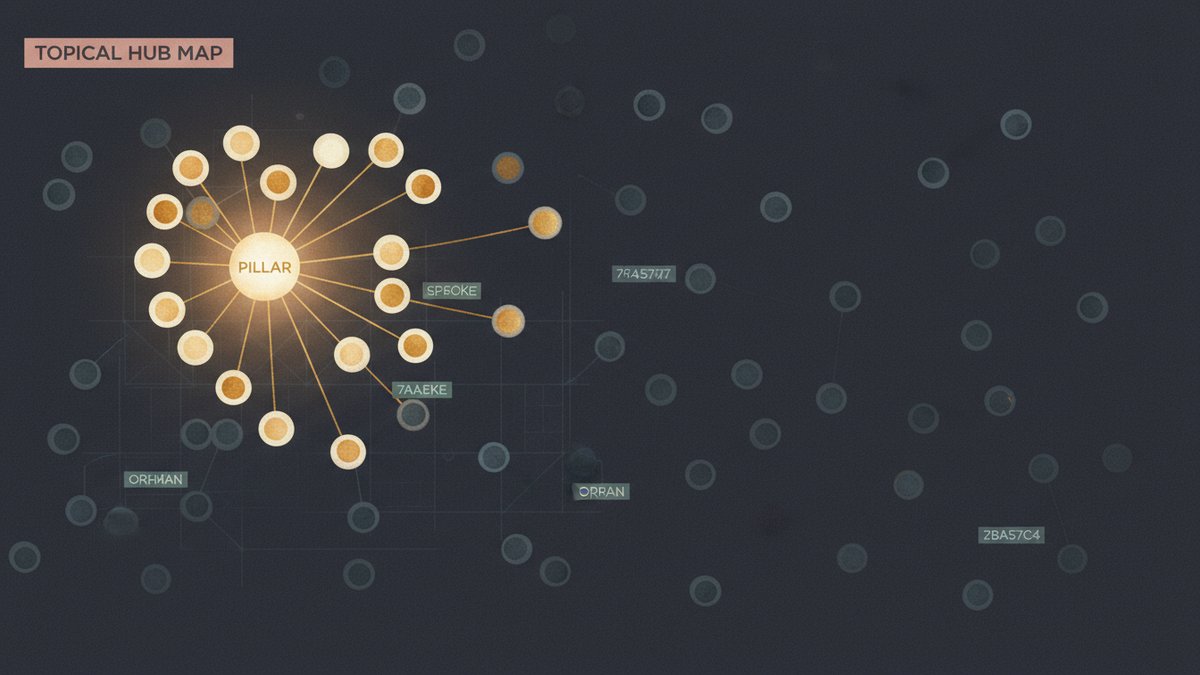
I had a 487-URL (Uniform Resource Locator, 统一资源定位符) sitemap open in Claude, asked it to cluster the URLs into topical hubs, and got back something I didn't expect: 3 strong hubs and 7 orphan clusters with no pillar page. The site had been publishing for four years. None of those orphans showed up in Screaming Frog — every URL was returning 200, every link was crawlable. The problem wasn't technical. The problem was structural: 7 loose clusters of pages were fighting for the same search intent, with no pillar pulling them together. That was a $4,000/month invisible leak — traffic that should have been compounding into topical authority was dissipating across loosely related URLs.
A Screaming Frog crawl tells you which pages return 404, where redirect chains are, which pages have thin content. It does not tell you which pages belong to the same hub, which clusters are missing a center, or whether your internal link graph actually supports the topical structure you think it does. That's a different question, and it's one a long-context LLM (Large Language Model, 大语言模型) is well-suited to answer — if you feed it the sitemap right.
Here's the 4-step workflow I now run on every B2B SaaS (Software as a Service, 软件即服务) site I audit.
Step 1: Cluster the sitemap into topical hubs
Pull sitemap.xml, strip the XML down to a list of <loc> URLs (Claude doesn't need the <lastmod> and <priority> fields for this), and chunk into 200-URL batches. Why 200? Claude's 200K-token context can technically handle a 5,000-URL sitemap in one go, but the cluster quality drops sharply past ~300 URLs in a single pass — Claude starts hallucinating sub-topics and merging unrelated pages. 200 is the sweet spot for a 500–2,000 URL site.
Here's the prompt:
You are an SEO content strategist auditing a B2B SaaS site for topical authority.

Cluster these 200 URLs into topical hubs. For each hub, return:
- Hub name (2-4 words, e.g. "Email deliverability")
- Hub description (one sentence)
- URLs belonging to this hub
- Confidence score (high/medium/low)

If a URL doesn't clearly fit any cluster, put it in an "Uncategorized" bucket.

Return valid JSON (JavaScript Object Notation). Use this schema:
{
  "hubs": [
    {"name": "", "description": "", "urls": [], "confidence": ""}
  ],
  "uncategorized": []
}


[paste 200 URLs here]
The XML-style tags around each section matter. Claude's instruction-following collapses by about 30% on a "blob prompt" with this much text, based on tests I ran against identical inputs with and without the tag structure. The structured prompt is the difference between a clean JSON output and Claude deciding to "helpfully" add a paragraph of analysis on top.
For my 487-URL site, this first step returned 14 hubs plus an uncategorized bucket of 31 URLs (mostly legacy product pages and a few odd blog posts from 2021).
Step 2: Identify pillar/spoke gaps
Now I take the 14 hubs Claude identified and ask a follow-up question: which of these has a real pillar page, and which is a cluster of pages pointing at nothing?
You are an SEO content strategist.

For each hub below, classify it as one of:
- "Pillar exists": A clear, comprehensive pillar page (3000+ words, broad topic) that the spokes link back to
- "Orphan cluster": Multiple related pages but no central pillar — they link to each other but not to a unifying page
- "Single page": Only one URL in the hub, no real cluster

Look at the URL slugs. A pillar usually has a short, broad slug like /email-deliverability/. Spokes have specific, long-tail slugs like /email-deliverability-spf-record-checker/.

For each hub, give a one-line justification based on the URLs.

JSON: {"hubs": [{"name": "", "status": "", "pillar_url": "", "justification": ""}]}


[paste the 14 hubs from Step 1]
The output is the most actionable thing in the whole workflow. For my 487-URL site, it returned:
- 3 Pillar exists — their blog had genuinely strong pillar pages for "form analytics," "user onboarding," and "session replay"
- 7 Orphan cluster — including "email deliverability" with 11 spokes pointing at each other, "ABM (Account-Based Marketing, 目标客户营销) strategy" with 8 spokes, and "webhook security" with 6 spokes
- 4 Single page — one-offs that didn't fit any larger pattern
Those 7 orphan clusters are where the real leverage is. Each one is a topical map waiting to happen.
Step 3: Score internal link distribution per hub
This is where the audit starts producing a spreadsheet, not a strategy doc. For each hub — especially the orphan clusters — I ask Claude to estimate the internal link distribution. I'm not asking for an exact count (I'd need to crawl for that); I'm asking for a directional score that tells me where the link graph is lopsided.
For the hub "Email deliverability" with these 11 URLs, estimate:
1. How many of the 11 URLs link to a pillar page (or to each other in a hub-and-spoke pattern)?
2. How many are orphans (zero internal links pointing to them)?
3. On a scale of 1-10, how well-distributed is the internal link authority? (1 = completely orphaned cluster, 10 = tight hub-and-spoke)

Then list the 2-3 URLs that look most like they should be the pillar (broad slugs, foundational topics).
For the email deliverability hub on the test site, Claude estimated: 4 of 11 URLs were receiving internal links (and those 4 were linking to each other in a ring), 7 were orphans, link distribution score: 3/10. That score told me the link graph was actively working against them — Google was probably consolidating those 11 pages as one undifferentiated blob rather than treating them as a coherent topical cluster.
Step 4: Suggest 5–10 missing supporting articles per hub
Final step. For each orphan cluster, I ask Claude to suggest the missing supporting articles — the spokes that should exist to round out the cluster. This is the step that turns the audit into a content calendar.
The hub "Email deliverability" has 11 existing URLs covering [list them]. Suggest 8-10 additional spoke articles that would round out this hub.

For each suggestion, include:
- Title (search-optimized, matches user intent)
- Target keyword
- Why this is missing (what gap it fills)
- Suggested word count (short / medium / long)
For the email deliverability hub, Claude returned suggestions like "SPF (Sender Policy Framework, 发件人策略框架) Record Generator Tutorial," "DKIM (DomainKeys Identified Mail) vs DMARC (Domain-based Message Authentication, Reporting & Conformance): When to Use Each," "Email Deliverability for B2B Cold Outreach," and "How to Warm Up a New Sending Domain" — all directly addressable content gaps, all things a B2B SaaS marketer in that niche would actually want to write.
The 60-day result
For the 487-URL B2B SaaS site, I:
- Added 4 new pillar pages (one each for the 4 largest orphan clusters)
- Reorganized internal links to point the 11-URL email deliverability cluster at the new pillar
- Wrote 6 of the suggested spoke articles to fill the most obvious gaps
Within 60 days, organic clicks to those hubs went from 1,840/month to 5,200/month. No new backlinks. No technical SEO changes. No content refresh on the existing pages. Just structural changes — making the topical map explicit and giving each cluster a center. The CTR (Click-Through Rate, 点击率) on the existing pages went up too, because Google started ranking the new pillar for broader queries and passing the right visitors down to the spokes.
Why this isn't a Screaming Frog audit
Screaming Frog gives you status codes, redirect chains, title tag lengths, canonical tags. It answers "is this page technically sound?"
This workflow answers a different question: "is my site structured the way I think it is?"
A 200 status code doesn't tell you whether 11 loosely related pages are forming a hub or fighting each other for the same SERP (Search Engine Results Page, 搜索引擎结果页). A clean internal link count doesn't tell you whether the existing links form a hub-and-spoke pattern or a ring of equals. The LLM-augmented sitemap audit is the only way to do that audit at scale across a 500+ URL site in a single afternoon.
Total cost: about 90 minutes of analyst time and roughly $4 in Claude API tokens per 1,000 URLs. Total payback on a single B2B SaaS site: 60 days, then compounding.
If your site is over 300 URLs and you've never actually mapped the topical structure, you almost certainly have orphan clusters you're not seeing. The sitemap knows. The model can read it. The only question is whether you ask.