A Structure for Thought-Leadership Posts That Don't Sound Like LinkedIn Slop
Contents
Last month I was on a flight from Shanghai to Singapore, killing time on LinkedIn. A CMO at a well-known SaaS company (call her V.) had just posted: "The future of B2B marketing isn't about more content. It's about better content. Stop posting. Start leading. 🚀"
It had 4,200 likes, 380 comments, 92 reposts. I read it three times. I closed the app, opened a book, and realized ten minutes later I could not tell you a single concrete thing she had said. The post was a mood. The comments underneath were the same mood at higher volume. Nothing in it would help anyone make a decision on Monday morning.
I went back and screenshotted it. Then I kept scrolling and found a post from a RevOps (Revenue Operations, 营收运营 — the team that owns the funnel metrics and tooling) lead at a Series B (Series B = 第二轮机构融资阶段) startup with 2,400 followers. She wrote about a single client call where a buyer told her, on a recorded Gong (a sales call recording and analytics tool) transcript, that the reason the deal had stalled for 90 days wasn't the price — it was that her champion (内部支持者 — the person inside the buyer company advocating for your product) had been embarrassed in front of his CFO two quarters earlier by a tool the same company had sold him. The post was 600 words. It had one diagram. By the time the plane landed, I had sent it to two clients.
Same platform. Same week. Two posts. One was a foghorn, the other was a piece of evidence. The difference wasn't the writer's experience, or even the writing — both were competent. The difference was the shape. The CMO's post had been built to be liked. The RevOps lead's post had been built to be remembered, and to change what the reader did next.
This is the post I've been trying to write for a year. Here is the structure underneath the second kind.
The mechanism underneath the slop
Most "thought leadership" on LinkedIn is built around a vibe: a confident-sounding claim, a list, a question, an emoji. It optimizes for the first three seconds of the scroll. That is why the engagement numbers are huge and the actual influence is near zero. The post is engineered to register as authoritative before the reader has time to notice it says nothing.
The post that actually moves people forward does something almost opposite. It registers as a specific event in the world — one that the writer happens to have a vantage point on. The reader's first thought isn't "this person is confident" or "I disagree." It's "I haven't seen that." Or: "Wait, is that true?" Both of those reactions buy you another ten seconds. Ten seconds is everything.
The mechanism is a shift in what the post is for. Slop is built to demonstrate authority. Real thought leadership is built to transmit one specific observation the reader couldn't have made on their own. The authority is a side effect of the observation, not the product.
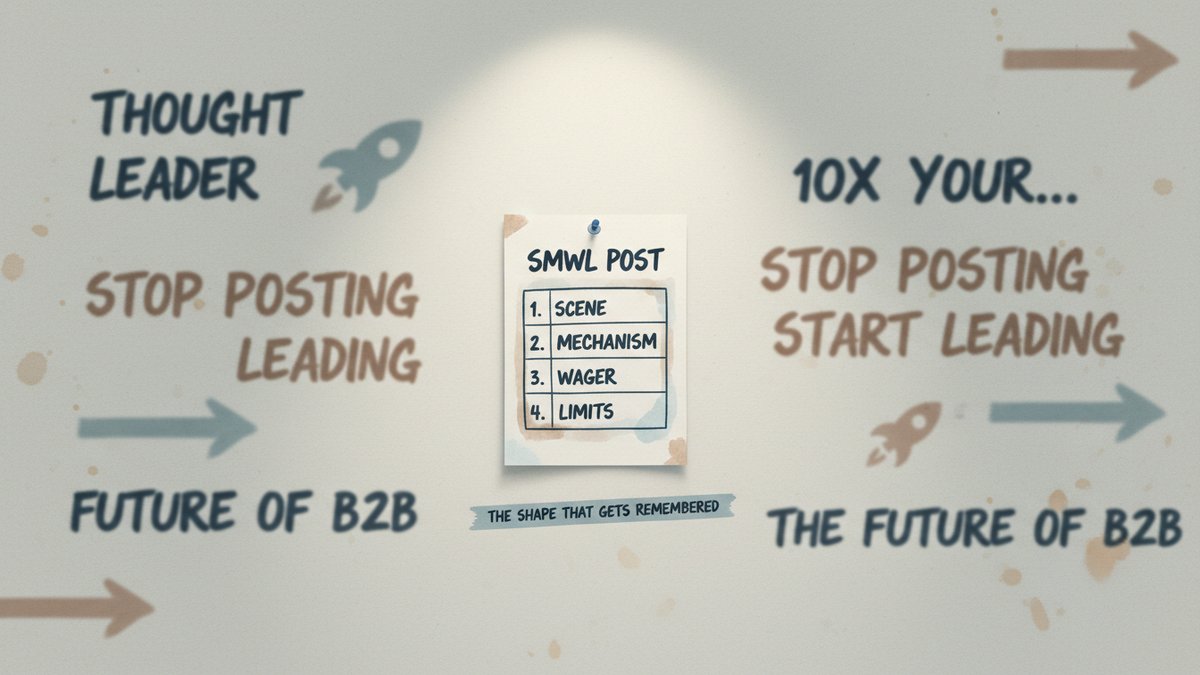
Once you see this, you can build a structure for the second kind. The one I use has four moves. I call it the Scene → Mechanism → Wager → Limits post, or SMWL (Scene, Mechanism, Wager, Limits) for short.
Move 1: The Scene
Open with one specific thing that happened. Not "last year, I learned an important lesson." Not "in my career, I've noticed." A scene has names, places, numbers, dates, transcripts. It sounds like a thing that happened, because it was.
The RevOps lead's opener was a Gong quote. That's almost unfairly good — Gong is a built-in credibility machine, because it makes the scene verifiable in principle. You don't need a transcript; you need the same texture. "On a call in March, the buyer's CFO asked this question. My client didn't have an answer. The deal closed four months later, and the moment the CFO asked the question was the moment it almost died." That's a scene. The reader's brain is in a room with you.
Two rules I run by:
- The scene should embarrass you a little. If the scene makes you look like a genius who saw it coming, the reader knows. The best scenes are ones where you were wrong, slow, or caught off guard — and the insight came from paying attention after the fact.
- The scene must be about a mechanism the reader has access to, not a person they don't. A scene from your private coaching practice won't land because the reader can't see themselves in it. A scene from a generic enterprise SaaS deal lands because the reader has been in a hundred of them.
If you can't open with a real scene, you don't have a thought-leadership post yet. You have a tweet. Save it for a tweet.
Move 2: The Mechanism
The scene is the bait. The mechanism is the post. A mechanism is the underlying pattern that explains the scene — and that the reader will recognize firing in three other places once you name it.
The RevOps lead's mechanism was: deals don't die on price, they die on the buyer's internal social risk — the moment their champion gets embarrassed in front of their boss, the deal is functionally over, no matter what the procurement team does next. That mechanism explains her scene, and it also explains the SaaS CMO's post (which is a CMO trying to manage her own internal social risk in front of a CEO who watches LinkedIn). It explains three other things I won't list here. The reader finishes the post and starts seeing the mechanism everywhere.
A few telltale signs you've written a real mechanism and not a slogan:
- You can state it in one sentence without losing the force of the post. ("Deals die on internal social risk, not price.")
- It has implications that surprise even you, the author. A good mechanism keeps generating predictions after you publish.
- It would still be true if you weren't the one saying it. This is the test most slop fails. A real mechanism doesn't depend on the speaker's résumé.
A bad mechanism is "consistency wins." A good mechanism is "your buyer will never admit their real objection; they'll point to the second-worst reason and let you two spend six weeks solving that instead." Specific, falsifiable, useful.
Move 3: The Wager
Once you have the mechanism, the post needs a wager: a claim about what changes if the reader believes you, or what you predict will happen in the next 6–18 months. This is the part most "thought leaders" skip, because it makes the post falsifiable. Skipping it is exactly why the post is forgettable. A claim that can't be wrong is also a claim that can't be useful.
A good wager is concrete enough to be checked. "B2B marketing in 2026 will be measured by internal buyer confidence, not MQLs (Marketing Qualified Leads, 营销合格线索 — the leads the marketing team hands to sales)." "Within two years, the highest-leverage move in SaaS (Software as a Service, 软件即服务) pricing will be social-risk insurance built into the contract, not discounts." "In the next 18 months, the most-cited thought leadership will be written by people who can attach a real artifact to every claim — a transcript, a screenshot, a financial filing."
If you can't write a wager you're willing to be wrong about, you don't have a thought-leadership post. You have a posture.
This is also the move that gives AI users a free pass. Models are great at the first two moves (scenes synthesized, mechanisms named) and bad at the wager, because the wager requires the author to actually risk something. If your post is fully model-generated, you'll notice there is no wager anywhere in it. Just vibes, just lists, just "what do you think?" at the bottom.
Move 4: The Limits
The fourth move is the one slop posts are constitutionally incapable of making, because the whole point of slop is to be true for everyone at all times. The Limits move says: here is where I'm probably wrong, and here is what would change my mind.
For the RevOps lead: "This probably doesn't apply to deals under $10K ACV (Annual Contract Value, 年度合同价值) where the champion is the buyer. And I might be overweighting my own sample — I see RevOps teams that are unusually good at documenting internal politics, so my view is biased toward companies where the champion is aware of the risk. A clean test would be to look at 30 lost deals and code them for whether the champion had a recent public failure in the account."
The Limits move is also where you earn the right to be loud. A post with a Limits move is read as an argument. A post without one is read as a billboard.
The Limits move is also the only move that AI cannot generate well, and I mean that. The model can write "of course, every framework has limits" but it can't tell you what would actually change your mind about your mechanism. That's the part only the author can write.
A worked example
Let me run one of my own older posts through the structure to show what it looks like in practice. A piece I wrote last year argued that B2B SaaS (Software as a Service, 软件即服务) CMOs should stop optimizing for share of voice (SOV, 在目标客户群中"被看到的声量占比") and start optimizing for share of specific claims.
- Scene: A board prep meeting at a 400-person SaaS company. The CEO asked the CMO to defend the brand-tracking number. She had no idea what specific claims her team had planted in the market over the prior quarter.
- Mechanism: Buyers don't remember brands; they remember one sentence they can repeat. Most "thought leadership" tries to plant ten sentences and gets none of them to survive.
- Wager: Within 24 months, the SaaS brands winning the AI-distributed buying era will be the ones who can answer "what is the one sentence a buyer is repeating on your behalf?" with a transcript-level answer.
- Limits: This probably doesn't apply if you're in a category with fewer than 5 real competitors. And the metric of "the one sentence" is hard to measure without buyer interviews — I don't yet have a clean way to instrument it.
The post is the same length as a typical LinkedIn post. The shape is the difference. Same idea, with this shape, reads as a thesis. Without the shape, it would have read as an opinion.
The anti-slop test
Before I publish anything I think of as thought leadership, I run it through four checks. Any "no" means the post isn't ready.
- Is the first sentence a scene, or is it "I've been thinking about..."? If it's the second, rewrite the opener.
- Can I state the mechanism in one sentence and have it still be true and useful? If not, the post is a vibe, not an argument.
- Is there a specific wager I would defend if someone called it out in the comments? If the post ends with "what do you think?" you have a posture, not a position.
- Did I name one place I might be wrong? If the post is universally true in its own framing, it's slop.
The fastest way to fail test 2 is to write a post that could be the introduction to a longer thing. The mechanism should be a complete thought. "AI is changing marketing" is an introduction. "The buyer's champion is the unit of risk in B2B SaaS deals" is a mechanism.
The quiet reason this works
Here's what I didn't appreciate until I started writing this way for about six months: the structure isn't really a content strategy. It's a selection mechanism. Once you commit to writing Scene → Mechanism → Wager → Limits, you can no longer publish on topics where you have nothing specific to say. The structure filters your own ideas.
This is the part that makes the post rare. Most marketers publish because publishing is the job. SMWL forces you to wait until you have a scene, then a mechanism, then a position. It is, in the worst case, an excuse to publish less. In the best case, it's an excuse to publish things that are still being texted to clients two years later.
If your feed has been full of the first kind of post lately, that's not your audience's fault. The structure is the difference. The CMO with 80K followers could have written the second kind. She just hadn't built the post for it.