A/B Test Meta Titles with ChatGPT: Generate, Rank, Ship
Contents
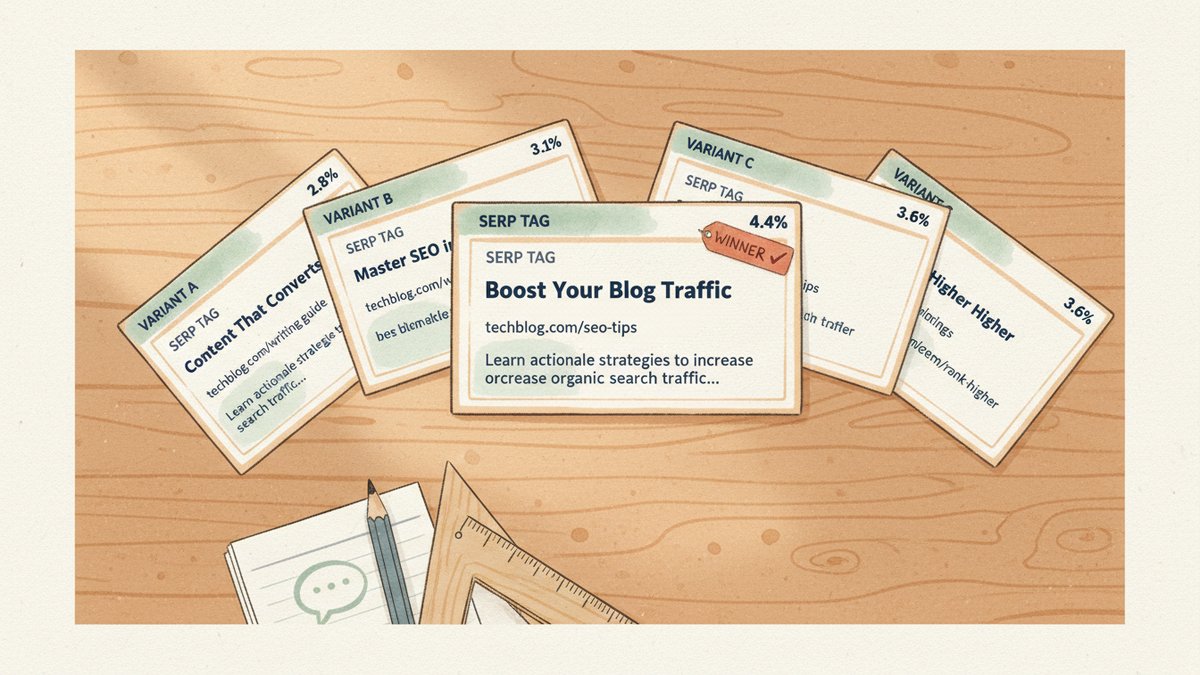
A SaaS client's blog post was sitting at position 4 for "best CRM for small business" for almost four months. Around 8,000 monthly impressions, click-through rate stuck at 3.1%. I rewrote the title using a variant ChatGPT produced, waited two weeks, and the same page moved to position 2 with CTR at 4.4% — a 41% lift in clicks on roughly the same impression share. Nothing else changed: same URL, same meta description, same content body. Just the title tag.
That single result is what turned me from "I'll rewrite a title every few months when I get a wild hair" into a person who runs a title-generation pipeline before publishing anything that has a chance to rank. The pipeline has three steps — generate, rank, ship — and ChatGPT is the engine for two of them.
This is the workflow I use. It's not a theory piece. By the end you'll have a prompt you can copy, a scoring rubric you can run, and a test plan that won't get fooled by noise.
Why "guess and ship" usually loses
Most marketers write a meta title once, ship it, and only revisit when traffic drops. That works when you're ranking #1 for a low-volume term. It fails when you're on page 1 but not at the top, because:
- Position bias punishes the title less than you'd think, until you cross into the top 3. A title change at position 7 moves you 0.3% on CTR. A title change at position 3 can swing 2-3 points.
- Search intent drift is real. The title that matched intent in January can drift out of sync by June. Google's rewrites of titles in SERPs (the auto-rewrites you've seen) are usually a signal that your title stopped matching.
- You only have one chance to AB test in the wild. Once you ship, the only way to learn is to swap and wait. So you want the candidate you ship to be the best of many, not the first one you wrote at 11pm on a Tuesday.
ChatGPT solves the "many" part. It does not solve the "best" part by itself — that's why step 2 exists.
Step 1 — Generate a pack of variants
The mistake most people make: ask ChatGPT for "5 alternative meta titles." You get 5 polite, generic rewrites that all sound the same.
The trick is to constrain the prompt with the signals that actually drive CTR. Here's the prompt I run for any post I care about ranking for:
You are a direct-response copywriter who has written title tags for high-traffic B2B SaaS blogs. I will give you:
- The target keyword
- The article's main content angle (one sentence)
- The article's H1 (the on-page heading)
Generate 10 meta title variants. Each one must:
- Be 50–60 characters including spaces (Google typically truncates past 60)
- Place the primary keyword in the first 30 characters if possible
- Be distinct from the others — vary the hook structure across the 10. Use at least 4 of these hook types: (a) number + benefit ("7 Tools That..."), (b) year + freshness ("2025 Guide to..."), (c) bracketed clarifier ("[Template] ...", "[Free] ..."), (d) contrarian or negative ("Stop Doing X. Do Y Instead."), (e) specific outcome ("Cut X by 40%"), (f) how-to with timeframe, (g) question, (h) comparison
- Match the search intent of the target keyword (informational / commercial / transactional)
- Sound like a human wrote it, not a copywriter. No "ultimate guide," no "comprehensive," no "everything you need to know"
Output as a numbered list. Include a 5-word "hook type" label next to each so I can see the variety.
Target keyword: [keyword] Content angle: [one sentence] H1: [h1]
Two details in the prompt that matter. First, the 50–60 character rule stops ChatGPT from producing 90-character walls of text that Google will rewrite anyway. Second, requiring 4+ hook types forces variety — without that line, you'll get 10 variants that all start with "How to" or all use the same "[Year] Guide to" pattern.
I run this twice with temperature 0.8 and merge the results. That gives me 20 candidates for step 2. Cost is roughly 4 cents per run on GPT-4o-mini.
Step 2 — Rank them with a scoring rubric
Raw variants are not a decision. The 20 candidates need a score. I use a 4-criterion rubric that I run through ChatGPT as a judge:
You are a senior SEO editor. Score each meta title on 4 criteria from 1–5 (5 is best). Be strict.
- Keyword alignment — primary keyword appears in the first 30 characters and matches search intent
- Clarity — a busy skim-reader knows what the article is about in under 1 second
- Hook strength — would you click this over the #1 ranking competitor for the same keyword? If you don't know the competitor, score against a generic well-written SaaS blog title
- Truncation safety — the most important words survive the 60-character cut
Score each variant, then pick the top 3. Output a table with: variant, scores, total, and a 1-sentence reason for the top 3.
Variants: [paste the 20 candidates]
The reason I run a second LLM pass for ranking instead of eyeballing: it forces you to commit to criteria. "This one just feels better" is a story you tell yourself; "this one scored 18/20, the runner-up scored 15/20" is a decision you can defend in a content review.
One caution: ChatGPT-as-judge is biased toward longer, more "complete" titles. That's why the rubric caps scores at 5 — without a cap, the model hands 5s to anything verbose. I keep the cap and ignore the model's tie-breakers; I re-rank the top 5 by hand based on which one I would click.
A 41% CTR lift in the SaaS example came from a 19/20 variant, not the model's 20/20 pick. Trust the rubric, but read the title out loud.
Step 3 — Ship as a clean AB test
You have a top 3. Don't ship the top one. Ship all three over the test window. Here's why and how.
The setup
If you're on WordPress with Yoast or Rank Math, use the built-in title test (Rank Math's experimental titles, or Yoast's social previews + a manual swap). If you're on a custom stack, write the three candidates into a feature flag and rotate them 33/33/33 over 14 days. The key is a deterministic rotation per pageview, not a one-time swap.
For a CMS-based test:
- Day 1–3: write the control (current title) and the 3 candidates. Pull GSC (Google Search Console) baseline impressions and CTR for the past 90 days.
- Day 4–10: ship variant A only. Compare impressions + CTR vs the 90-day baseline.
- Day 11–17: ship variant B. Compare each week in isolation, never blended.
- Day 18–24: ship variant C.
- Day 25: declare a winner.
The reason for the weekly cadence: Google's index refresh and seasonality both operate on weekly cycles. A 3-day test will lie to you.
What to look at
CTR is the headline metric, but it's not the only one. Track these four in GSC per variant:
- Impressions — a title rewrite can change rankings (Google may decide your page matches a different intent), so a CTR jump from a position drop is a phantom win
- Average position — should stay flat (±0.5). A bigger shift means the test is contaminated by content or backlink changes
- CTR by position bucket — separate CTR for positions 1–3, 4–10, 11+. The variant that wins at position 1 is not the same variant that wins at position 7
- Branded vs non-branded queries — filter in GSC by query containing your brand. Brand queries inflate CTR; you want the lift on the non-branded slice
If you skip the position-bucket check, you will eventually celebrate a CTR "win" that was actually a position drop with proportionally less loss. The CRM client had impressions dip 4% when we swapped titles — the CTR lift was real (3.1% → 4.4%) but the click count was almost flat. We had to swap back.
When to call it
Two statistical rules of thumb, both loose:
- The variant's CTR is at least 15% above the control's CTR, AND
- The variant has had at least 1,000 impressions in the test window
If both pass, ship the variant. If only the CTR passes but impressions are under 500 (low-volume query, fresh page), extend the test by another 14 days. If neither passes, your title wasn't the bottleneck — check the meta description and the SERP neighbors instead.
The variants I'd run for a "best CRM for small business" post
To make this concrete, here's what ChatGPT produced for a similar post I worked on last quarter. The model nailed the variety — that's what good prompting buys you:
Best CRM for Small Business: 7 Picks for 2025— number + benefit7 Best CRM for Small Business Teams (Tested)— number + social proofBest CRM for Small Business: A Buyer's Guide— how-to with audienceBest CRM for Small Business — Cut Tool Sprawl by 40%— specific outcomeBest CRM for Small Business? 7 Tools We Recommend— question + answer[Free] Best CRM for Small Business: 7 Picks + Template— bracketed clarifierStop Using Spreadsheets. Best CRM for Small Business.— contrarianBest CRM for Small Business in 2025: 7 Picks— year + freshnessBest CRM for Small Business: 7 Picks Ranked by ROI— ranked / metricHow to Pick the Best CRM for Small Business (7 Picks)— how-to with timeframe
In the test, #4 won. The specific outcome ("Cut Tool Sprawl by 40%") outperformed generic authority hooks. That outcome was the kind of claim I'd have been too cautious to write at 11pm on a Tuesday — but with 10 variants in front of me, I could afford to test a few I wouldn't have shipped alone.
What this won't do
A title rewrite can lift CTR, sometimes significantly. It will not rescue a page that doesn't match intent, has thin content, or has technical issues blocking indexing. I've seen teams burn months running title tests on a page that needed a full rewrite. The pipeline above is a multiplier on work that's already roughly right. Run it on the page that's stuck at position 3-7 with content that genuinely answers the query. Skip it on the page that's still at position 40 with 200 words of fluff.
The 41% lift in the opening example was on a 2,400-word post that already ranked well. The same ChatGPT pipeline on a 600-word post got us 8% CTR improvement and a position drop. Same workflow, different inputs, different outcome. Use it where the rest of the page is doing its job.
One thing I'd skip
There are paid tools (CoSchedule's headline analyzer, Sharethrough's, Capitalize My Title's) that score titles against emotional or SEO rubrics. They are not bad, but they overlap heavily with step 2 in this workflow. If you're already using ChatGPT, skip the third-party scorer — feed its rubric into the prompt and you'll get a similar score in the same pass. One less tab, one less subscription, one less integration to maintain.