GPT Image 2 vs Nano Banana: Which AI Image Tool Should Marketers Actually Use?
Contents
Two weeks ago I sat down to generate a WeChat mini-program banner. Chinese headline, promo badge, product shot, the works. I ran the same prompt through both GPT Image 2 and Nano Banana 2. One gave me a usable banner in one shot. The other gave me a beautiful image with a headline that looked like someone threw alphabet soup at the canvas.
That's the story of these two tools in 2026. Different jobs, different strengths, and no single "best" pick. Here's what I've learned from using both for real marketing work since GPT Image 2 launched in late April.
The Contenders at a Glance
| GPT Image 2 | Nano Banana 2 | |
|---|---|---|
| Maker | OpenAI | |
| Underlying model | GPT-5.4 Image 2 | Gemini 3.1 Flash Image |
| Launched | April 2026 | February 2026 |
| Cheapest per image | ~$0.006 (low quality, 1024×1024) | ~$0.04 (1K) |
| Standard quality cost | ~$0.21 (high quality, 1024×1024) | ~$0.04 (1K) |
| Max resolution | 3840×2160 (4K) | 4K native |
| Text rendering | Near-perfect multilingual | Good, occasional errors |
| Speed | 5-60s (thinking mode) | 2-20s |
| Free tier | 5 images/day (ChatGPT Free) | Yes, watermarked |
| Paid entry | $20/mo (ChatGPT Plus, 120/day) | ~$19/mo (Google AI Pro) |
| API access | Yes (requires org verification) | Yes (Google AI Studio) |
Both are serious tools. Both have API access. Both do 4K. The differences are in what they're good at — which is the whole point of this article.
Round 1: Text Rendering — The Dealbreaker Test
If your marketing image has text on it — a headline, a price, a CTA button, a WeChat mini-program code label — this is the dimension that separates these tools instantly.
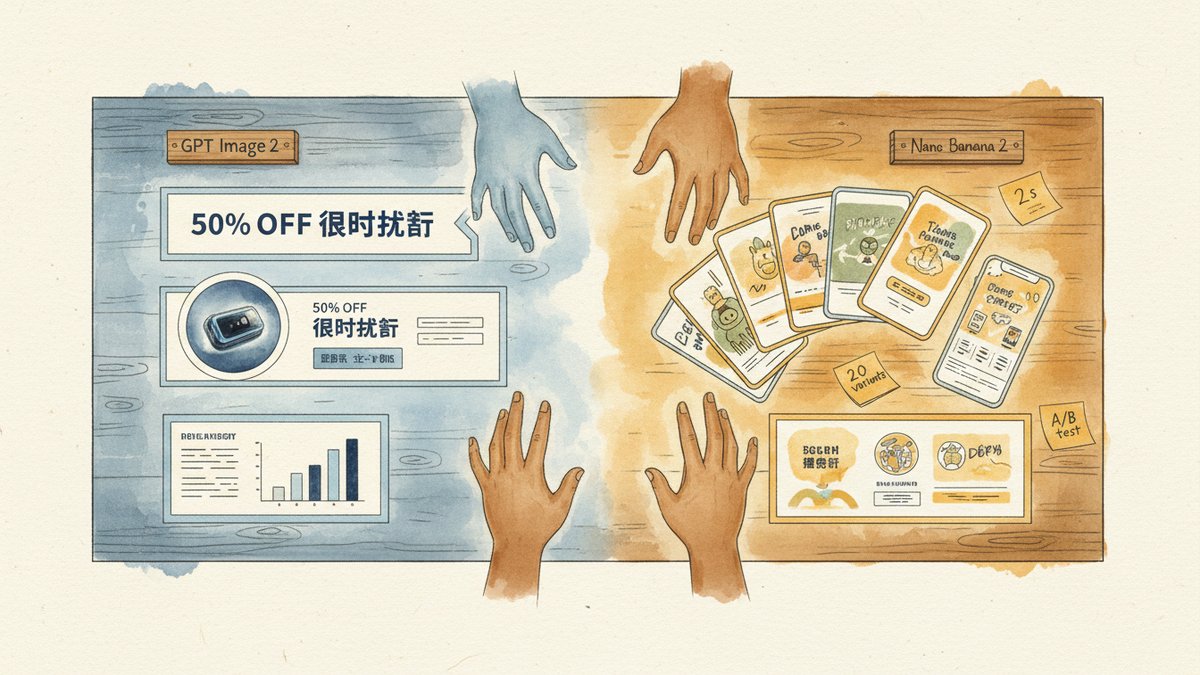
GPT Image 2 wins this decisively. I've generated menus with 20+ dish names, social banners with Chinese/English mixed headlines, and product cards with fine-print disclaimers. The accuracy is near 99% across English, Chinese, Japanese, and Korean. It's the first AI image model where I don't hold my breath waiting for a typo.
Nano Banana 2 is better than it used to be, but not there yet. In my testing, simple English phrases like "Summer Sale" and "50% OFF" render correctly about 80% of the time. Chinese characters fare worse — roughly 60% accuracy on headlines longer than 4 characters. For anything text-critical, you'll be re-generating or fixing in post.
The real-world consequence: If you're a Chinese marketer generating WeChat posts or Xiaohongshu (小红书) images with embedded text, GPT Image 2 saves you an entire post-production step. That alone covers the price difference.
Round 2: Product Photography & E-Commerce
This one surprised me. The common narrative is "GPT Image 2 for realism, Nano Banana 2 for clean studio shots," but it's not that simple.
GPT Image 2 produces more photorealistic contextual imagery. A desk lamp on a nightstand looks like it was photographed in someone's actual bedroom — the lighting has environmental logic, the shadows fall naturally, the materials have subtle wear. For lifestyle marketing and brand storytelling, this is powerful.
Nano Banana 2 is better at clean, isolated product presentation. White-background catalog shots, material detail close-ups, color variant grids — it nails the structured, clinical look that e-commerce platforms demand. Its strength is consistency across bulk generation: 50 product angles with the same lighting, same white balance, same quality bar.
My workflow now: Nano Banana 2 for the catalog spread (50+ SKU images, consistent lighting). GPT Image 2 for the hero banner and the lifestyle context shots that go on the homepage and social ads.
Round 3: Ad Creative at Scale
This is where speed vs. quality becomes a real tradeoff.
Nano Banana 2 generates in 2-20 seconds. For an AB test with 30 ad variants across 5 aspect ratios, that's the difference between a coffee break and a lunch break. The output is polished, "safe," and visually consistent — perfect for programmatic ads where you need volume without surprises.
GPT Image 2 with thinking mode can take 30-60 seconds per image, but the output is more refined. It self-checks text, plans layouts, and the iterative editing is genuinely useful: click to select an element, describe the change, regenerate just that part. For a hero campaign where you'll spend 20 minutes refining one perfect image, this is the better tool.
Speed ≠ better. For a Facebook ad that'll run for 3 days and get scrolled past in 0.5 seconds, Nano Banana 2's speed wins. For a brand campaign billboard or a WeChat article header that represents your brand for months, spend the extra time with GPT Image 2.
Round 4: Iterative Editing — The Underrated Difference
GPT Image 2's conversational editing is a workflow game-changer. You don't need to re-prompt from scratch. You say "make the background darker," "remove that logo from the shirt," "change the model's expression to smile." It remembers your character/product across a long session.
Nano Banana 2 doesn't have this. Each generation is a fresh start. You can use reference images (up to 14), but there's no conversational refinement loop. If something's slightly off, you re-prompt and hope.
For marketing teams where a creative director gives feedback in natural language ("can we try this with a warmer tone?"), GPT Image 2 maps directly to that workflow. Nano Banana 2 requires you to translate that feedback into a new structured prompt each time.
Round 5: Pricing — The Hidden Math
On paper, Nano Banana 2 is cheaper: ~$0.04/image vs. GPT Image 2's ~$0.21/image at comparable quality. Five times cheaper.
But here's the hidden math: re-generation cost. If Nano Banana 2's text error rate means you re-generate 3 times to get one usable image with correct Chinese text, your real cost is $0.12. GPT Image 2 gives you the correct image on the first try at $0.21. The gap narrows.
Also: ChatGPT Plus at $20/month gives you 120 GPT Image 2 generations per day with thinking mode. If you're doing fewer than 100 marketing images daily, the subscription covers you — no API billing needed. Nano Banana 2's value shines at truly high volume (500+ images/day) where the per-image API cost dominates.
The Verdict: Who Should Use What
| If you're... | Use... | Because... |
|---|---|---|
| A social media manager doing 50+ posts/week | Nano Banana 2 | Speed and volume matter more than perfection |
| A brand designer creating campaign hero images | GPT Image 2 | Text accuracy + iterative refinement |
| An e-commerce team with 500+ SKUs | Nano Banana 2 (catalog) + GPT Image 2 (hero) | Each tool's strength |
| A Chinese marketer doing WeChat/小红书 content | GPT Image 2 | Chinese text rendering is the killer feature |
| A solo marketer on a budget | Nano Banana 2 (free tier) or GPT Image 2 (ChatGPT Plus) | Both have affordable entry points |
| An agency producing localized campaigns in 5+ languages | GPT Image 2 | Multilingual text accuracy eliminates post-production |
There isn't one winner. There's the right tool for the job.
The real answer — the one most comparison articles won't give you — is that the marketers getting the best results in 2026 are using both. Nano Banana 2 for volume and speed, GPT Image 2 for precision and polish. Add Midjourney or FLUX if you need premium artistic quality for hero campaigns.
Don't pick a side. Pick both, and know when to reach for which one.