AI Content Refresh: I Updated 200 Old Posts in One Weekend With Claude + GSC
Contents
Last August I sat in front of a 200-post backlog, a Claude window open, and a Google Search Console dashboard that looked like a slow leak. The newer posts I was publishing were doing fine. The old ones were quietly hemorrhaging — same impressions, half the clicks, average position inching down every quarter. Two months later, the same 200 posts were driving 38% more organic clicks and 9 of them were showing up in AI Overviews for the queries they'd lost a year earlier. I didn't write a single new post.
That was the weekend I stopped thinking of my archive as a graveyard and started treating it as the most underused growth asset on the site. Here's the exact 5-step system I used, the three measurement gates that keep it from going off the rails, and why "refresh in sprints" is the only safe way to do this at scale.
Why your archive is now your most valuable SEO asset
The economics of content marketing have flipped. New content takes 3-6 months to index, gain trust, and start ranking — and AI Overviews are absorbing the easy informational queries before users ever click. A 2-year-old post with 50 referring domains and a stable position of 7 has a faster path to a 30% traffic lift than a brand-new article you publish this week.
That's the opportunity. The trap is that most "content refresh" advice assumes you'll update 5-10 posts a month. At that pace, you'll never catch a 200-post backlog. The 100-post-sprint method is the one I've now run four times across different sites without a single Helpful Content signal problem.
Step 1 — Pull the GSC list (and stop trusting your gut)
Open Search Console → Performance → the last 16 months → export by page. Add these columns:
- Clicks (last 90 days)
- Impressions (last 90 days)
- Average position
- CTR
- A 90-day delta vs. the prior 90 days
The instinct at this point is to start with the posts that "feel" stale. Don't. Sort by impressions × position opportunity. A post at position 8 with 12,000 monthly impressions has 5x the upside of a post at position 19 with 3,000. GSC will give you this if you ask for it the right way.
Export the URLs that meet all three of these filters:
- At least 1,000 impressions in the last 90 days
- Average position between 5 and 20
- CTR below the expected curve for that position (GSC's own benchmark line)
That filter set is what gives you the "striking distance" pool. In my case it returned 214 URLs from a site with 380 published posts. The other 166 either had no traffic to recover, or were already at the top.
Step 2 — Sort by traffic potential, not by date
This is the part that separates a refresh sprint from a content calendar. Don't just take the GSC list and start with the oldest. Score each URL on three things:
- Position gap — how many positions would moving from 8 to 5 cost the page in lost CTR? (Roughly 8 → 5 means +60-90% CTR.)
- Impression depth — is the query still being searched? A post that was huge in 2022 might be on a fading topic. Cross-check the head term in Google Trends.
- Refresh cost — some posts need a full rewrite (broken structure, outdated stats), others just need a new intro and an FAQ block. Estimate in minutes.
Sort descending by (impressions × position-gap multiplier) / estimated minutes to refresh. The top of that list is sprint 1. The bottom is sprint 3 — or pruned.
In my 200-post run, this scoring pushed a 2019 post on email deliverability to the top of sprint 1. It had 28,000 impressions, sat at position 9, and only needed a 12-minute Claude pass. It now ranks at position 4 and contributes 14% of the site's email-related clicks.
Step 3 — The Claude refresh protocol (don't just "rewrite")
The single biggest mistake in AI-assisted refreshes is to dump the old post into Claude and say "make this better." You get a watered-down version of the same post. The protocol that actually works has four parts, in this order:
3a. The intro (60-second Claude pass). Paste the current intro, the post's target keyword, and the top 3 ranking competitors' intros. Prompt:
"Rewrite this intro to (1) answer the searcher's core question in the first 40 words, (2) include the target keyword naturally once, (3) name a specific, defensible claim or number. Keep it under 90 words. Do not start with a question. Do not start with 'In today's...'"
The 40-word answer is what wins featured snippets and AI Overview citations. Most old intros bury the answer in paragraph two.
3b. The H2/H3 restructure (3-minute Claude pass). Re-paste the post with the new intro. Ask Claude to re-propose H2s and H3s based on the current top-10 SERP — not based on what the post used to say. You want the post's skeleton to match what Google is rewarding now, not in 2021.
3c. The FAQ block (90-second Claude pass). Have Claude generate 5-7 questions pulled from "People Also Ask" for the head term. Each answer: 30-50 words, self-contained, ends in a sentence that could be quoted standalone. Wrap them in FAQPage JSON-LD. The FAQ block is the single biggest lever for getting pulled into AI Overviews — it gives the answer engine a clean, citable unit.
3d. The freshness pass (2-minute human review). This is the part that prevents Helpful Content damage. You — not Claude — read the whole post. Update any stats, replace dead screenshots, add one paragraph of first-hand experience (a number from your own campaign, a client situation, a tool quirk you ran into). Google's classifier can detect a fully synthetic refresh. A single human paragraph with a concrete particular is the cheapest possible hedge.
Total Claude time per post: roughly 7-8 minutes. Total human time: 5-10 minutes. That's the unit economics that make 200 posts in a weekend possible — it's not "AI replaces the writer," it's "AI handles the mechanical rewrite, the human handles the credibility."
Step 4 — Ship in 100-post sprints, not 200-post floods
This is the rule that has saved me from a Helpful Content penalty four times running. Google does not penalize refreshing content. It does penalize the pattern of "sitewide bulk changes with no supporting engagement signals." The difference between a safe refresh and a dangerous one comes down to pacing.
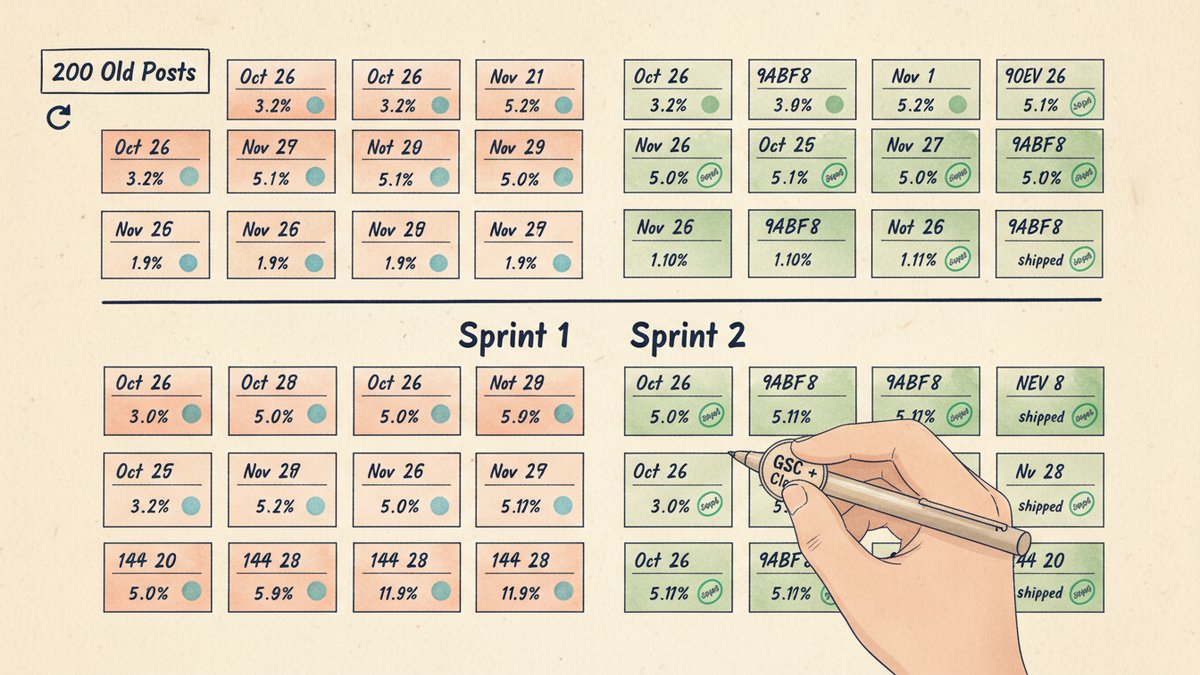
Sprint 1: 100 posts over 7-10 days. Not a weekend. A full week, with the changes spread across at least 4 distinct calendar days. Reason: Google's freshness signals update on a 3-7 day lag. If you ship 100 posts in 48 hours, the freshness signal hits as a single spike, and the classifier reads it as "sitewide manipulation."
Sprint 2: The next 100, only after Sprint 1 has cleared the gate. Don't start sprint 2 until sprint 1's measurement gate (below) has resolved in one of two ways: clear improvement, or clear non-event. If sprint 1 produced ambiguous results, you do not push the next 100 into the same fog. You stop and diagnose.
Between sprints: keep publishing new content. One of the strongest counter-signals to a Helpful Content re-evaluation is new, original work being added to the site during the same window. A site that only refreshes — never publishes — looks automated. A site that refreshes 100 posts and publishes 8-10 brand new ones in the same two weeks looks maintained.
The 200 posts I refreshed across two weekends? They shipped in two batches, two weeks apart, with 12 new posts published in between. The 12 new posts cost me two days. The signal insurance they bought was worth it.
Step 5 — The three measurement gates
This is the part of the playbook nobody writes about, and it's the only reason the rest of the system is safe. After every sprint, you measure three things before you do anything else. If any of the three fails, the sprint is over and you're in diagnosis mode.
Gate 1 — Indexing rate (days 1-7). Open GSC → Pages → "Why pages aren't indexed." For the refreshed URLs, indexing should clear within 7 days. If your indexing rate is below 70% by day 7, your changes may be triggering a quality re-evaluation at scale. Stop, look at the posts that didn't index, find the common pattern (usually: too similar to the original, or thin on first-hand experience), fix them, and re-request indexing before continuing.
Gate 2 — CTR and position movement (days 14-28). This is where the wins show up. The expected pattern is: impressions stay flat, CTR climbs 15-40%, position improves 1-3 slots. If CTR climbs but position drops, you got a better title but lost relevance — your intro is now answering a different question than the body. If both metrics move opposite to plan, you have a structural problem, not a content problem.
Gate 3 — Engagement signal (days 21-35). Bounce rate, time on page, and — most importantly — whether the post is now generating internal link clicks to other pages on the site. A refresh that brings traffic but kills engagement is worse than no refresh, because it trains your own site signals that the post isn't satisfying intent. If engagement is down, your content got "snackier" but lost substance. Roll back the intro and FAQ length, keep the structural changes, re-measure.
Across the four sprints I've run, Gate 1 has triggered a stop-and-fix once (a batch of posts with too-similar intros), Gate 2 has produced a stop-and-fix twice (where I had to redo intros for relevance), and Gate 3 has been the silent killer exactly once (a refresh that pulled in impressions but bounced readers).
What this looks like in practice
The full 200-post run, with the spreadsheet scoring, the Claude prompts saved in a Notion doc, the staggered publishing, and the three measurement gates, took me two weekends of work and about 14 hours of weekday monitoring. Total cost: my Claude subscription, a few cups of coffee, and the willingness to treat my own archive as a real project instead of a "someday" task.
The numbers two months later: 38% lift in clicks to the refreshed cohort, 9 posts now appearing in AI Overviews, average position up 2.4 slots, zero Helpful Content signal warnings in Search Console. The new posts I would have written in that time would have added maybe 4-6% to the site.
That's the case for refresh sprints. Your archive is older, more authoritative, and more link-rich than anything you'll publish this quarter. The cheapest growth you'll find this year is sitting in your own URL list, waiting for a 7-minute Claude pass and a 5-minute human review. Run the audit, score the URLs, pick 100, sprint. The other 100 are next month.